Palo Verde
Palo verde, which translates from Spanish to "green stick," refers to approximately 12 species of trees and shrubs within the pea family (Fabaceae). These…
What are the key characteristics of palo verde plants?
Palo verde, which translates from Spanish to “green stick,” refers to approximately 12 species of trees and shrubs within the pea family (Fabaceae). These plants are native to arid regions across the southwestern United States, Mexico, Central America, and Venezuela.12
Key characteristics include:
- Appearance: They are typically intricately branched with smooth, distinctively green bark and branches.12
- Foliage: The plants feature minute compound leaves that are drought-deciduous, meaning they drop off following the rainy season.1
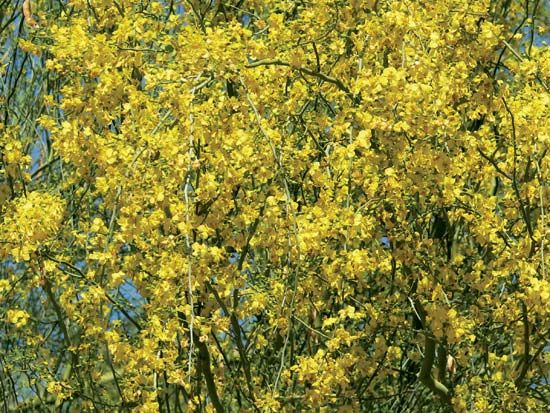
- Reproduction: They produce clusters of bright yellow flowers, which develop into beanlike pods.1
- Habitat: They are well-adapted to dry environments and are frequently utilized in desert landscaping.12
Specific varieties, such as the blue palo verde, are known for their bushy growth and cylindrical legumes, while others are distinguished by flattened fruit pods.1
Where are palo verde trees naturally found, and in what type of environments do they thrive?
Palo verde trees (genus Parkinsonia) are naturally found throughout the arid regions of the southwestern United States, Mexico, Central America, and Venezuela.1
These plants are highly adapted to dry, desert environments. For example, the blue palo verde is a characteristic woody plant that thrives along washes in the Colorado Desert. Their ability to survive in these harsh conditions is supported by their drought-deciduous leaves, which drop off after the rainy season to conserve moisture. Because of their resilience and unique appearance, they are frequently used in desert landscaping.1
How are palo verde trees used by humans, both historically and in modern times?
Palo verde trees have served both practical and aesthetic purposes throughout history and into the modern era.
Historically, several species within the genus Parkinsonia have been valued as important traditional sources of tannin, a chemical compound essential for the process of leatherwork1.
In modern times, these trees are widely recognized for their utility in desert landscaping. Due to their unique appearance—characterized by smooth, green bark and bright yellow flowers—they are popular choices for ornamental planting in arid regions where they can thrive with minimal water. Their resilience and distinct aesthetic make them a staple in xeriscaping and sustainable garden design in the southwestern United States and Mexico.12
What are the different species of palo verde, and how do they differ from each other?
There are approximately 12 species of palo verde (genus Parkinsonia), which are members of the pea family. While they share common characteristics such as smooth green bark, drought-deciduous leaves, and yellow flowers, they can be distinguished by their physical traits and geographic ranges:
- Blue Palo Verde (Parkinsonia florida): A bushy tree reaching up to 9 meters (30 feet) in height. It is native to desert regions of southern California, Arizona, and northwestern Mexico, including the Baja California peninsula. It is notably identified by its cylindrical legumes.1
- Border Palo Verde (P. texana): A tree native to Mexico that extends its range into southeastern Texas. It is easily distinguished from the blue palo verde by its flattened, podlike fruits.1
- Mexican Palo Verde (Parkinsonia aculeata): Also known as the Jerusalem thorn, this species has a wider distribution, occurring in southwestern Arizona and stretching from Texas to Florida.12
Sources
- palo verde — Encyclopædia Britannica
- palo verde — Merriam-Webster
Published on · 2 min read