Panuridae
Panuridae is a family of songbirds within the order Passeriformes that includes approximately 19 species of small, titmouselike birds found in the thickets…
What is Panuridae?
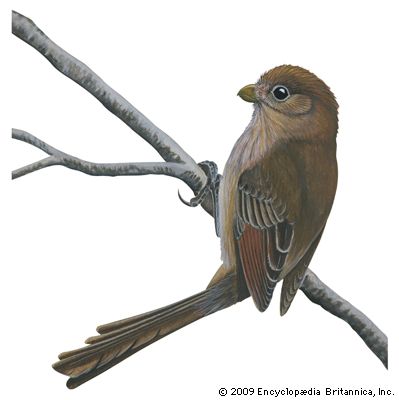
Panuridae is a family of songbirds within the order Passeriformes that includes approximately 19 species of small, titmouselike birds found in the thickets of temperate Eurasia.1
The family is composed of parrotbills and the bearded tit, also known as the reedling (Panurus biarmicus). Most members are characterized by a sideways-flattened bill, which resembles that of a parrot. These birds are typically gregarious, moving in flocks through brush and thickets to forage for seeds, berries, and small insects.21
The taxonomic classification of this group has historically been subject to debate. They have previously been categorized as a subfamily of the babbler family (Timaliidae) or the Old World flycatcher family (Muscicapidae), and they are sometimes classified under the family Paradoxornithidae. Due to these varying interpretations, their precise status remains a subject of ongoing scientific discussion.1
What are the main physical differences between parrotbills and bearded reedlings?
The primary physical distinction between parrotbills and the bearded reedling (also known as the bearded tit) lies in the structure of their bills.
- Parrotbills: These birds are characterized by a distinctive, strongly arched, and sideways-flattened bill that resembles that of a parrot. This unique bill shape is a defining trait for most members of the group.14
- Bearded Reedlings: In contrast, the bearded reedling possesses a small bill that is notably different from the parrotlike bills found in the related parrotbills.5
Beyond the bill, there are also differences in appearance:
- Bearded Reedlings: Males are distinguished by their subtle reddish, yellowish, and gray plumage, complemented by erectile black “moustaches” that give them their name; females are duller and lack these black markings.5
- Parrotbills: These birds are generally described as small to medium, titmouselike birds that are mostly brown and gray with soft, loose plumage.1
Why is the classification of the Panuridae family considered problematic by scientists?
The classification of the Panuridae family is considered problematic by scientists primarily due to the group’s historical instability and the difficulty in determining its precise evolutionary relationships within the order Passeriformes.2
Taxonomists have frequently shifted these birds between different families, leading to conflicting classifications. Historically, they have been categorized as:
- A subfamily (Paradoxornithinae) of the babbler family (Timaliidae).2
- A subfamily (Panurinae) of the Old World flycatcher family (Muscicapidae).2
- Members of the family Sylviidae, which includes warblers and other related groups.4
Currently, many ornithologists prefer to classify these birds under the family Paradoxornithidae. However, because of these varying historical interpretations and the ongoing debate regarding their true phylogenetic status, the classification remains a subject of scientific uncertainty.24
How do birds use their bills to adapt to different environments?
Birds have evolved an extraordinary diversity of bill shapes that function as highly adaptable tools, primarily shaped by selective pressures related to feeding habits rather than just evolutionary lineage. While bill shape can aid in identifying a species, it is best understood as a reflection of how a bird interacts with its environment to secure food.7
Functional Adaptations
Passerine bills are broadly categorized into eight functional types, each suited to specific ecological niches:
- Insectivorous: Ranging from pointed for gleaning to wide-gaped for aerial feeding (e.g., swallows).7
- Conical: Adapted for seed-cracking, with strength varying from small bills for fine seeds to stout, blunt bills for hard objects like cherry pits.7
- Probing: Often long and slender for reaching nectar or insects in flowers, or heavily constructed for extracting prey from wood and bark.78
- Toothed and Tearing: Equipped with hooks or notches to tear apart soft prey or tough plant materials.78
- Frugivorous and Serrated: Specialized for swallowing whole fruits or cutting through buds, shoots, and leaves.7
Specialized Feeding and Environment
Beyond basic morphology, birds utilize unique mechanical adaptations to exploit their environments. For instance, some shorebirds possess bills with mobile tips and tactile sense organs, allowing them to detect and grasp prey underground. Others, like skimmers, have evolved asymmetrical mandibles to feed while flying low over water. Furthermore, many marine birds have developed nasal glands to excrete excess salt, which is then discharged through the nostrils or drips from the tip of the bill, allowing them to thrive in saltwater environments.89
Sources
- Reedling — Encyclopædia Britannica
- Panuridae — Encyclopædia Britannica
- Bird - Behaviour — Encyclopædia Britannica
- Parrotbill — Encyclopædia Britannica
- psittaciform - Bill and skull — Encyclopædia Britannica
- parrotbill — Merriam-Webster
- Passeriform - Bill — Encyclopædia Britannica
- Charadriiform - Adaptations for feeding — Encyclopædia Britannica
- pelecaniform - Physiological adaptations — Encyclopædia Britannica
Published on · 3 min read