Paper Wasp
Paper wasps, belonging to the genus Polistes, are distinguished from other wasp species by several specific physical and behavioral traits.
What are the distinguishing characteristics of paper wasps compared to other wasp species?
Paper wasps, belonging to the genus Polistes, are distinguished from other wasp species by several specific physical and behavioral traits.
Physical Characteristics
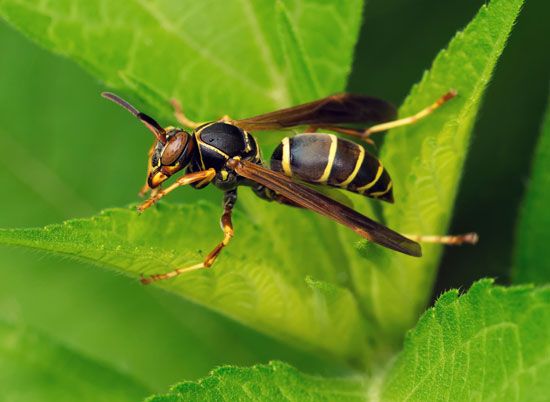
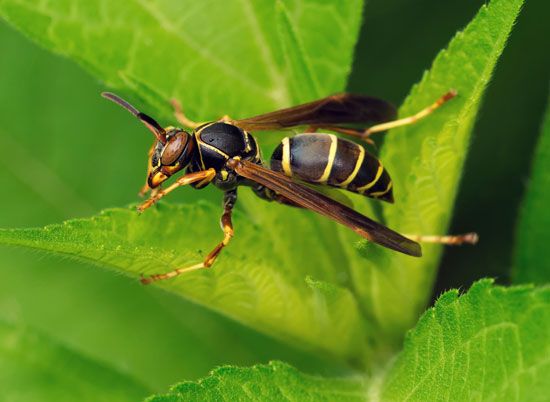
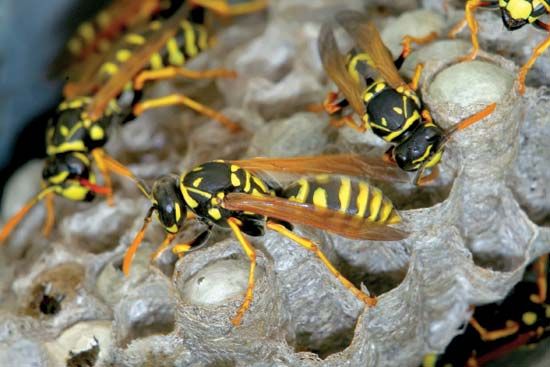
Paper wasps are striking in appearance, typically measuring about 16 mm (0.63 inch) in length. They are characterized by their orange antennae, wings, and tarsi, while their bodies may be jet black or brown with narrow yellow bands and paired segmental spots. Like other wasps, they possess a slender body, a narrow “waist” (petiole) connecting the abdomen to the thorax, and legs with relatively few hairs.12
Behavioral and Nesting Differences
While many wasps are solitary, paper wasps are social insects within the family Vespidae. Their most notable distinction is the construction of their nests:12
- Material: They create a paperlike material by chewing wood from dead trees, fence posts, or lumber and mixing it with saliva to form a paste.12
- Structure: Unlike the enclosed nests of some other Vespidae, a paper wasp nest consists of a single layer of cells arranged vertically with the openings facing downward, attached by a short stalk to a protective overhang.12
- Sting: While they possess a painful sting, it is generally less toxic to humans than the stings of more familiar hornets (Vespa) and yellow jackets (Vespula).1
How do paper wasps construct their nests, and why are they called ‘paper’ wasps?
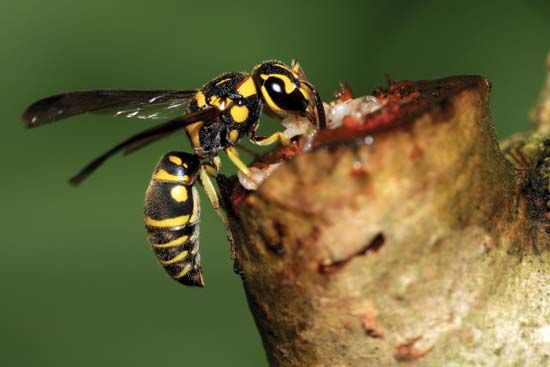
Paper wasps (genus Polistes) are called “paper” wasps because they construct their nests from a paperlike material. This substance is created when female wasps chew dry plant material—typically wood from dead trees, fence posts, or unpainted lumber—and mix it with their saliva to form a paste.12
Once this paste is created, the wasps fashion it into a nest structure. A typical nest consists of approximately 100 cells designed for larvae, arranged in a single layer with the openings facing downward. These nests are attached to a protective overhang by a short stalk. While the queen begins the construction of the nest in the spring, the workers later take over the task of enlarging it.12
What is the life cycle of a paper wasp from egg to adult?
The life cycle of a paper wasp (Polistes) is defined by its social structure, which begins in the spring when a fertilized queen emerges from hibernation to establish a new colony.1
- Egg Laying: The queen initiates the colony by building a small nest and depositing eggs into the individual cells. She is the only member of the colony responsible for egg laying.13
- Larval Stage: Once the eggs hatch, the resulting larvae are completely dependent on the adults for care. In the early stages of the colony, the queen performs all the necessary work, including foraging and feeding the brood.31
- Worker Development: The first eggs to hatch develop into sterile female workers. As these workers mature, they take over the essential tasks of the colony, such as enlarging the paperlike nest, gathering food, and tending to subsequent generations of larvae.13
- Colony Growth: The workers continue to maintain the nest and feed the larvae, allowing the colony to grow throughout the summer. Eventually, the colony produces sexually mature insects that will establish new nests the following spring.31
How do paper wasp nests differ in shape from those of hornets or yellowjackets?
While all three groups—paper wasps, hornets, and yellow jackets—construct nests from a paperlike mixture of wood pulp and saliva, their structural designs differ significantly.142
Nest Structure and Placement
- Paper Wasps: These wasps build relatively small, exposed nests that consist of a single layer of cells arranged with the openings facing downward. These nests are typically attached to a protective overhang, such as the eaves of a building, by a single, short stalk.14
- Hornets and Yellow Jackets: In contrast, these social wasps build more complex, multi-layered nests. While paper wasp nests are always exposed, hornet and yellow jacket nests often feature an outer covering or are built within cavities.452
- Hornets: Generally construct their nests aboveground, often hanging them from trees or building them within the walls or ceilings of structures.26
- Yellow Jackets: Tend to build concealed nests, frequently located underground in soil cavities, though some species may build exposed nests hanging from branches or eaves.4
The size of these colonies also varies; while a paper wasp nest typically contains about 100 cells, hornet and yellow jacket nests can grow much larger, sometimes containing thousands of individuals in warmer climates.14
Sources
- paper wasp — Encyclopædia Britannica
- wasp — Encyclopædia Britannica
- Hymenoptera - Social forms — Encyclopædia Britannica
- yellow jacket — Encyclopædia Britannica
- hornet — Encyclopædia Britannica
- What’s the difference between hornets and wasps? — Encyclopædia Britannica
Published on · 4 min read