Wasp
Wasps are members of the order Hymenoptera and suborder Apocrita. They are primarily distinguished from other insects, including ants and bees, by the…
What are the main characteristics that distinguish wasps from other insects?
Wasps are members of the order Hymenoptera and suborder Apocrita. They are primarily distinguished from other insects, including ants and bees, by the following characteristics:
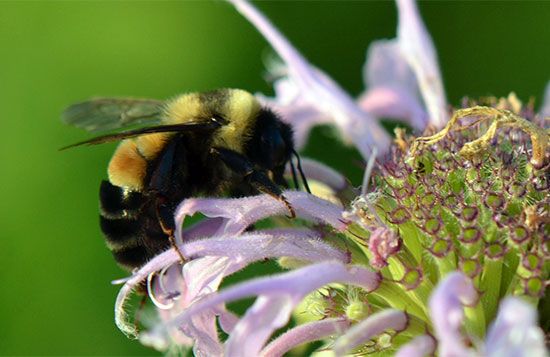
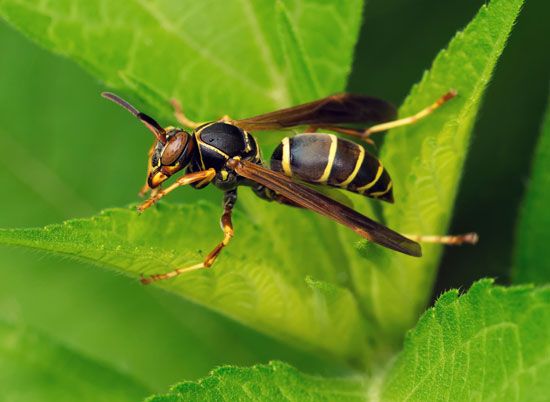
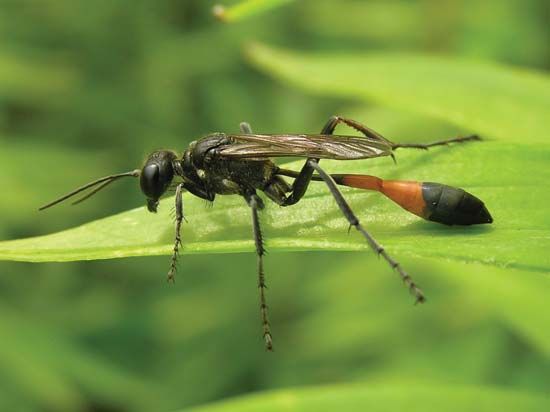
- Physical Appearance: Wasps typically possess a slender, smooth body with legs that have relatively few hairs. Like other members of Apocrita, they feature a narrow petiole, or “waist,” that connects the abdomen to the thorax.
- Stingers: In stinging species, females are equipped with a formidable stinger—a modified ovipositor—that has few barbs, allowing it to be easily removed from victims.
- Diet and Behavior: Most wasps are predatory or parasitic. While adults may feed on nectar, larvae of predatory species typically consume insects, and those of parasitic species feed on their hosts.
- Anatomy: They have biting mouthparts and antennae consisting of 12 or 13 segments.
Wasps are categorized as either solitary or social, with the latter group (family Vespidae) uniquely known for folding their wings longitudinally when at rest.1
What are the different types of wasps, and how do they vary in behavior and appearance?
Wasps are categorized into two primary groups based on their social structure: solitary and social. Their appearance and behavior vary significantly across these groups.1
Social Wasps
Social wasps belong to the family Vespidae and live in colonies with a caste system consisting of queens, drones, and workers. They are known for folding their wings longitudinally when at rest.13
- Yellow Jackets: Often identified by black and yellow abdominal bands, though some species are black and white or red. They build paperlike nests in soil cavities or protected areas.13
- Hornets: Generally larger than yellow jackets, they are mostly black with yellowish markings on the face, thorax, and abdomen. The northern giant hornet is the world’s largest, with queens exceeding 4 cm in length.1
- Paper Wasps: Members of the subfamily Polistinae, they are also common social wasps that construct paper nests.1
Solitary Wasps
The vast majority of wasp species are solitary, meaning they live and nest alone.1
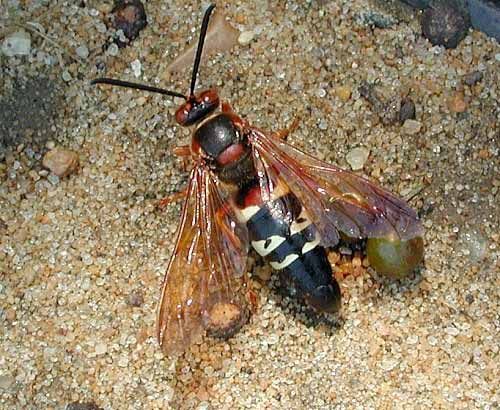
- Thread-waisted Wasps: Named for their stalklike abdominal connection, these wasps often hunt spiders or insects, paralyzing them to provision their nests. Mud daubers are a well-known group that builds mud cells.14
- Parasitic Wasps: These species do not build nests. Cuckoo wasps are often metallic-green or blue and lay eggs in the nests of other insects. Velvet ants are actually wingless, antlike wasps covered in dense, brightly colored hair.1
How do wasps defend themselves and their nests?
Wasps defend themselves and their nests primarily through the use of a formidable sting, which is a specialized defensive mechanism found in females of many species.1
Defensive Mechanisms
- The Sting: In stinging species, the female possesses a modified ovipositor—an organ typically used for egg-laying—that has been adapted into a stinger connected to venom-producing glands. Unlike bees, which often have barbed stingers that can become stuck, many wasps have stingers with few barbs, allowing them to be easily removed from a victim and used repeatedly.1
- Aggressive Behavior: Many social wasps, such as yellow jackets and hornets, are known to be aggressive when they perceive a threat to their colony. If a nest is disturbed—for example, if a yellow jacket nest located in a soil cavity is stepped on—the colony may erupt in a defensive, stinging swarm to protect the site.13
- Venom: The sting delivers venom that can be highly painful to humans and other animals. While the intensity of the pain varies by species, the defensive response is a highly effective deterrent against predators or intruders.135
What is a wasp?
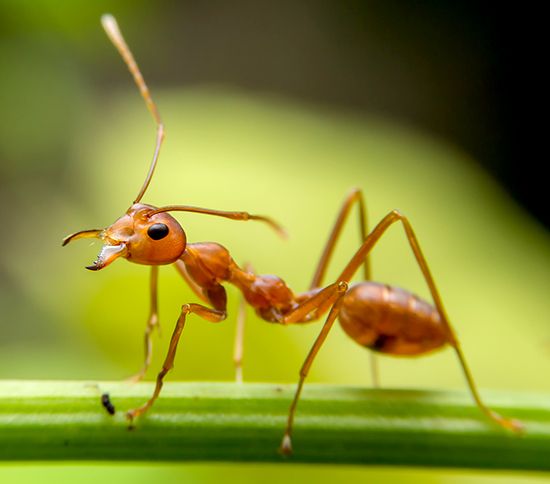
A wasp is any member of a large group of insects within the order Hymenoptera and suborder Apocrita. They are physically distinguished from ants and bees by their slender, smooth bodies, legs with relatively few hairs, and a narrow “waist” (petiole) that connects the abdomen to the thorax.
Wasps are generally predatory or parasitic and possess biting mouthparts and antennae with 12 or 13 segments. In many species, females are equipped with a formidable sting—a modified egg-laying structure (ovipositor) connected to venom glands. Unlike bees, many wasps have stingers with few barbs, allowing them to be removed easily and used repeatedly.
They are categorized into two main groups:
- Social wasps: These live in colonies with a caste system (queens, drones, and workers) and include hornets and yellow jackets.
- Solitary wasps: The vast majority of species, which live and nest alone, often provisioning their nests with paralyzed prey.
Sources
- wasp — Encyclopædia Britannica
- Hymenoptera - Solitary forms — Encyclopædia Britannica
- yellow jacket — Encyclopædia Britannica
- thread-waisted wasp — Encyclopædia Britannica
- paper wasp — Encyclopædia Britannica
Published on · 4 min read