Paris Agreement
The Paris Agreement is an international treaty adopted in December 2015 that aims to mitigate global warming by reducing greenhouse gas emissions. Designed…
What is the Paris Agreement?
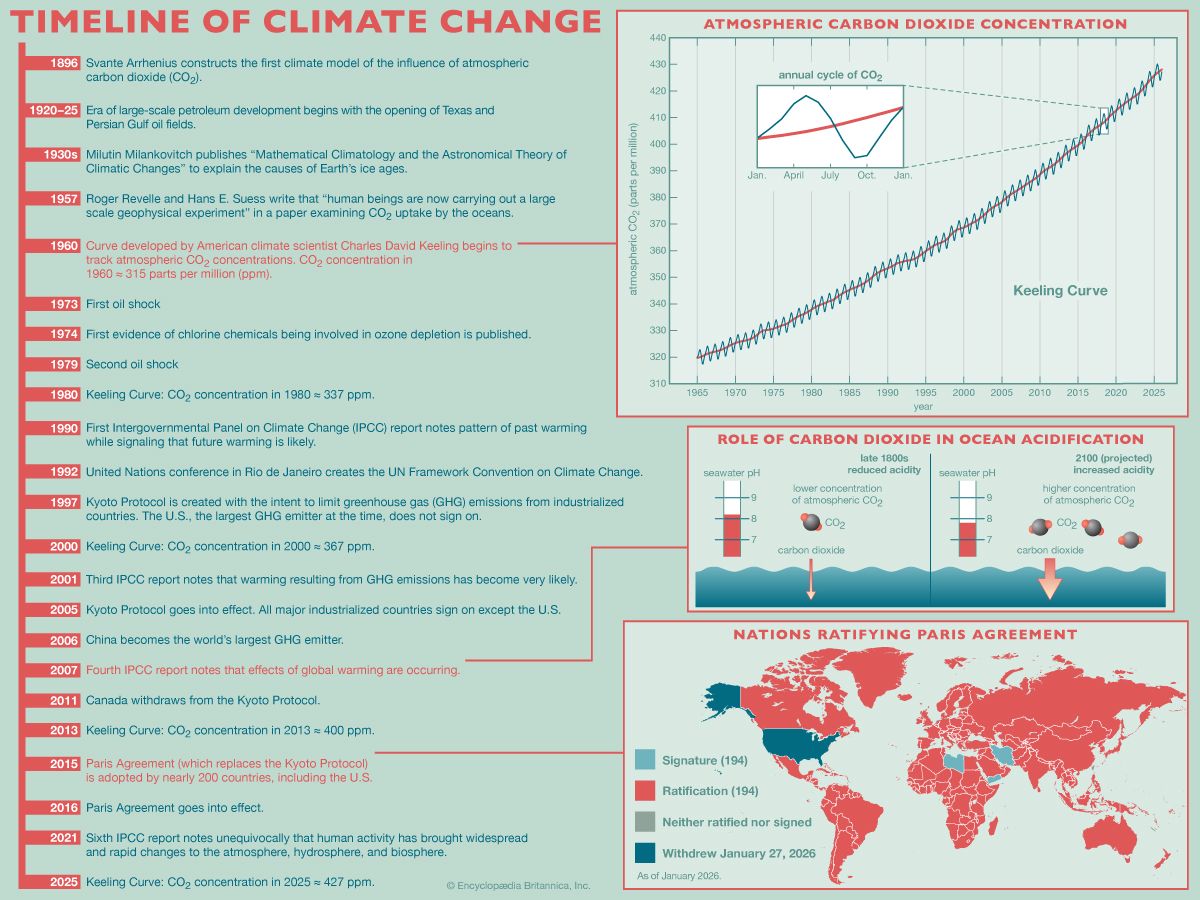
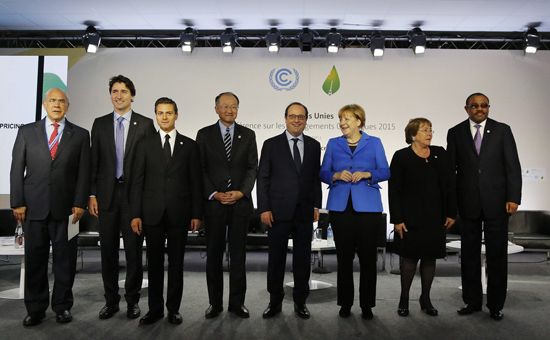
The Paris Agreement is an international treaty adopted in December 2015 that aims to mitigate global warming by reducing greenhouse gas emissions. Designed to improve upon the Kyoto Protocol, the agreement seeks to limit the rise in global temperatures to no more than 2 °C (3.6 °F) above pre-Industrial Revolution levels.1
Unlike its predecessor, the Paris Agreement requires all participating nations—including major emitters like China and the United States—to commit to emission reduction targets. Countries submit these plans as nationally determined contributions, detailing their specific strategies to lower emissions by 2025 or 2030. The treaty also emphasizes international cooperation, including technology transfer and finance to support developing countries in their transition to renewable energy and climate-resilient development.12
Why was the Paris Agreement created?
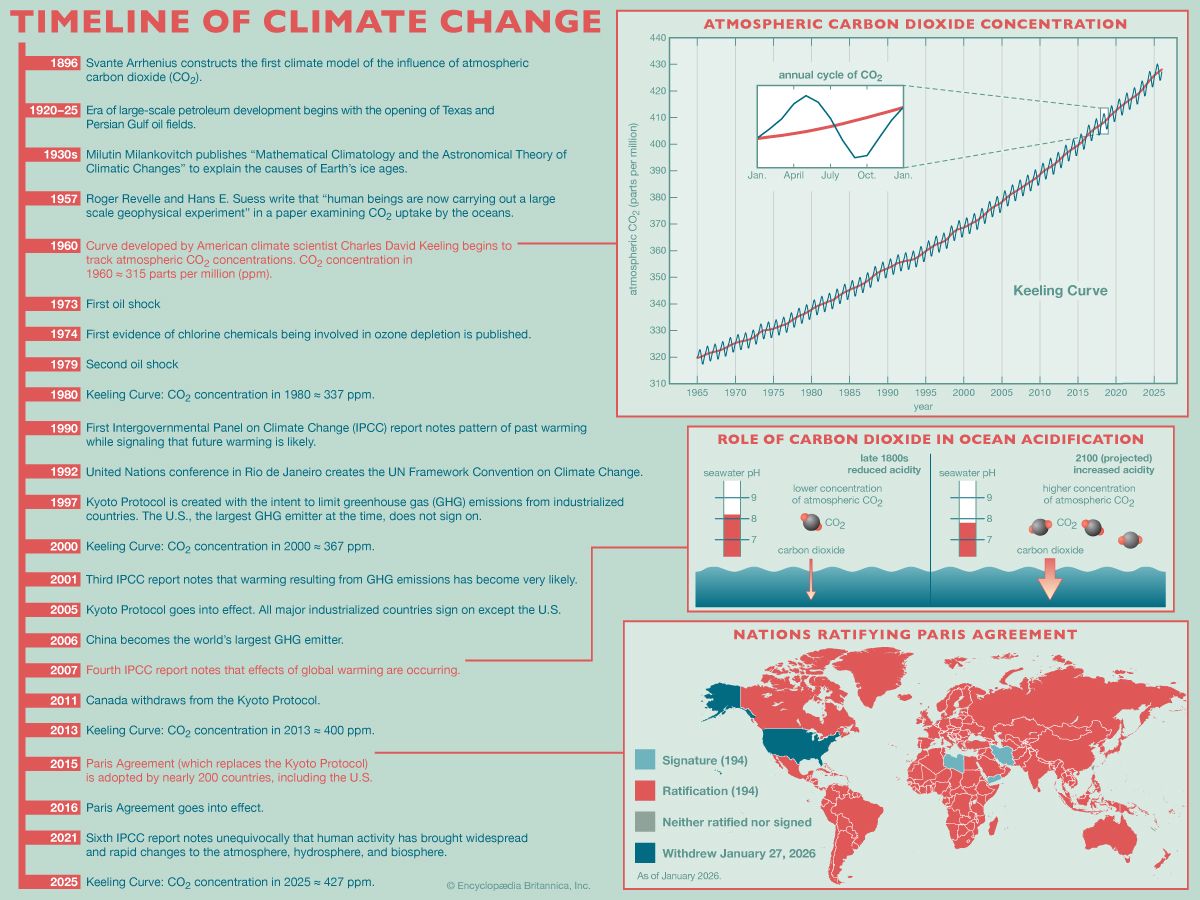
The Paris Agreement was created to establish a comprehensive, universal framework for addressing global warming by reducing the emission of greenhouse gases. Adopted in 2015, it was designed to improve upon and ultimately replace the Kyoto Protocol, which had faced criticism for its limited scope and inability to bind major emitters like the United States and China to mandatory reduction targets.13
The primary objective of the agreement is to prevent global temperatures from rising more than 2 °C (3.6 °F) above pre-Industrial Revolution levels, with an additional effort to limit the increase to 1.5 °C (2.7 °F). By requiring all signatories of the United Nations Framework Convention on Climate Change to participate, the treaty aims to mitigate the long-term environmental risks of climate change, such as rising sea levels, extreme weather events, and the loss of biodiversity.13
What are the main goals of the Paris Agreement?
The Paris Agreement, adopted in 2015, establishes a universal framework to address global warming through several core objectives:
- Temperature Limitation: The primary goal is to hold the increase in global temperatures to well below 2 °C (3.6 °F) above pre-Industrial Revolution levels, while pursuing efforts to limit the increase to 1.5 °C (2.7 °F).41
- Emission Reductions: Parties aim to reach a global peak of greenhouse gas emissions as soon as possible and undertake rapid reductions thereafter to achieve a balance between emissions and removals by sinks (such as forests and oceans) after 2050.4
- Universal Participation: Unlike previous treaties, the agreement requires all nations to submit and update nationally determined contributions (INDCs) every five years to limit or reduce their emissions.42
- Financial and Technical Support: The accord emphasizes the need for developed countries to provide financial resources and technology transfer to assist developing countries in their mitigation and adaptation efforts.42
How do countries work together to achieve these goals?
Countries collaborate to achieve the goals of the Paris Agreement through a framework built on transparency, cooperation, and regular accountability rather than punitive enforcement. The primary mechanism for this cooperation is the submission of Nationally Determined Contributions (INDCs), which each party is required to update every five years to reflect increasingly ambitious climate action.4
To support these efforts, the agreement emphasizes the following collaborative strategies:
- Transparency and Reporting: Parties are committed to regular, transparent reporting on their progress toward meeting their INDCs, ensuring that global efforts remain visible and accountable.4
- Non-Adversarial Compliance: Instead of traditional enforcement, a specialized committee was established to promote compliance in a manner that is transparent, non-adversarial, and non-punitive.4
- Financial and Technical Support: Developed nations are expected to provide financial resources, equipment, and technical expertise to assist developing countries in their mitigation and adaptation efforts, acknowledging that these nations must also balance climate goals with economic growth and poverty reduction.4
Sources
- Paris Agreement — Encyclopædia Britannica
- Paris Agreement - Background — Encyclopædia Britannica
- Kyoto Protocol — Encyclopædia Britannica
- Paris Agreement - Negotiations and agreement — Encyclopædia Britannica
Published on · 3 min read