Timeline of Climate Change
Climate change occurs across vast timescales, ranging from eons to hours. Earth’s history is characterized by alternating "greenhouse" (warm) and "icehouse"…
What is Timeline of Climate Change?
Climate change occurs across vast timescales, ranging from eons to hours. Earth’s history is characterized by alternating “greenhouse” (warm) and “icehouse” (cool) phases, driven by tectonic forces and natural greenhouse gas variations.12
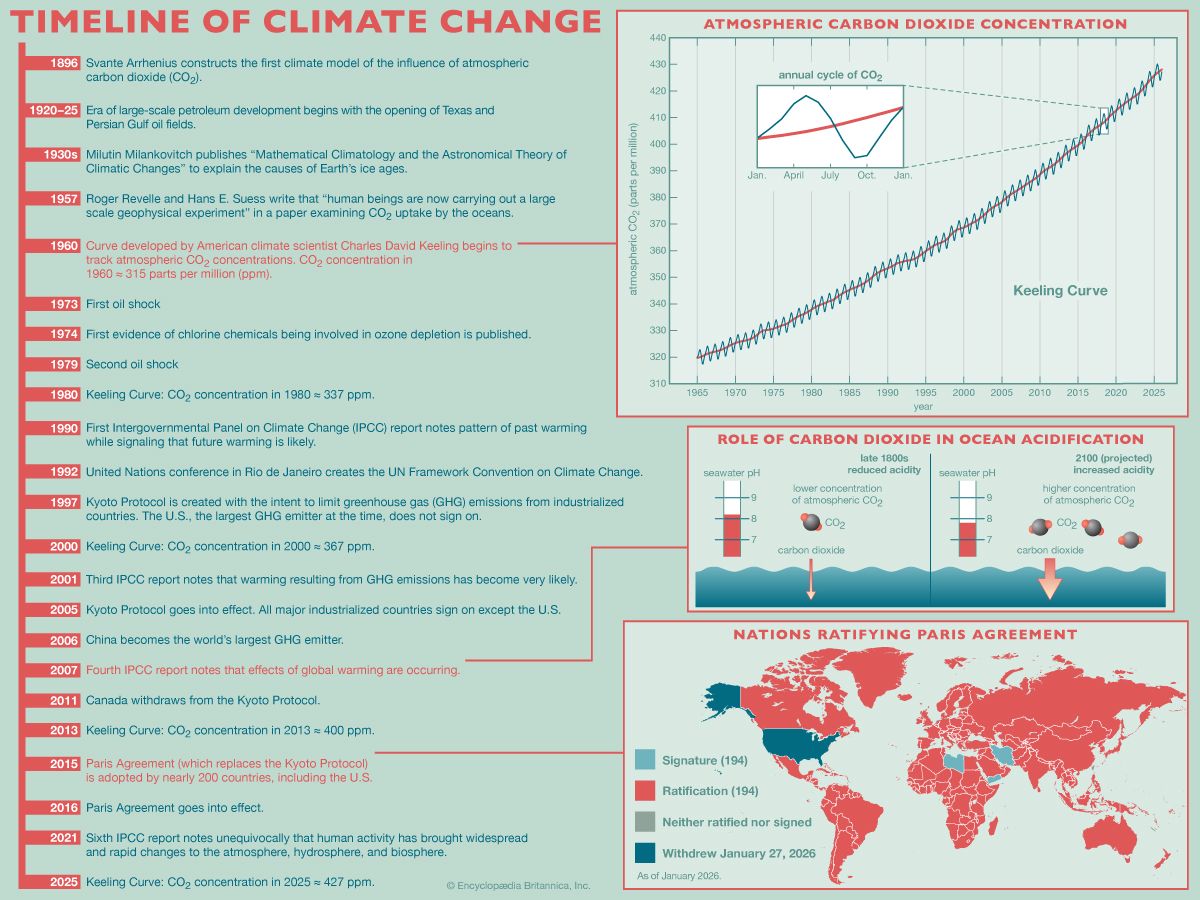
Since the Industrial Revolution, human activity has become a primary driver of modern climate change through the emission of greenhouse gases. Key milestones in our understanding and response include:1
- 1896: Svante Arrhenius constructs the first climate model regarding atmospheric CO₂.1
- 1958: Charles Keeling begins tracking atmospheric CO₂ at Mauna Loa, establishing the Keeling Curve.13
- 1988: The Intergovernmental Panel on Climate Change (IPCC) is established to assess climate data.4
- 1992: The United Nations creates the Framework Convention on Climate Change.1
- 1997/2005: The Kyoto Protocol is created and later enters into force.1
- 2015/2016: The Paris Agreement is adopted and enacted.1
- 2021: The sixth IPCC report confirms that human activity has unequivocally altered the atmosphere, hydrosphere, and biosphere.14
Atmospheric CO₂ concentrations have risen from approximately 315 ppm in 1960 to roughly 427 ppm by 2025.1
What is the difference between global warming and climate change?
While the terms are often used interchangeably, they refer to distinct concepts. Global warming specifically describes the increase in average air temperatures near Earth’s surface over the past one to two centuries. It is a phenomenon primarily driven by human activities, such as the burning of fossil fuels, which releases heat-trapping greenhouse gases into the atmosphere.67
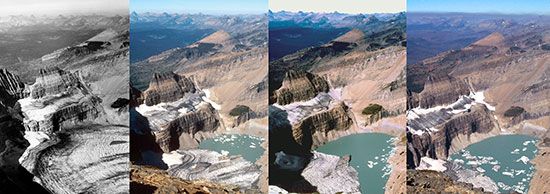
Climate change is a broader term that encompasses global warming but refers to a wider range of long-term shifts in temperatures and weather patterns. These changes include consequences of warming, such as rising sea levels, the shrinking of mountain glaciers, accelerated ice melt in the Arctic, Greenland, and Antarctica, as well as shifts in biological cycles like plant blooming times. In essence, global warming is one specific aspect of the larger, more comprehensive issue of climate change.6
How do scientists use ice cores to study Earth’s ancient climate?
Scientists use ice cores—long cylinders of glacial ice drilled from ice sheets and mountain glaciers—as natural archives to reconstruct Earth’s ancient climate history. By analyzing these cores, researchers can look back over 100,000 years or more to understand past atmospheric conditions.910
Key methods of analysis include:
- Isotopic Composition: Scientists measure the ratios of oxygen and hydrogen isotopes in the ice. Because these ratios are influenced by air temperature and the source of moisture during precipitation, they serve as a direct indicator of past climate variations.119
- Trapped Air Bubbles: As snow compresses into ice, it traps tiny bubbles of ancient air. Analyzing these allows researchers to measure historical concentrations of greenhouse gases like carbon dioxide and methane.119
- Dust and Chemical Analysis: The presence of microparticles (dust) indicates past atmospheric circulation patterns, while sulfate concentrations help identify historical volcanic eruptions that influenced global climate.119
- Layer Counting: In areas with high snowfall, annual layers can be counted to establish an accurate timeline, similar to tree rings.119
What are some of the primary greenhouse gases contributing to climate change?
Several primary greenhouse gases contribute to climate change by absorbing infrared radiation and reradiating it toward Earth’s surface. While these gases occur naturally, human activities have significantly increased their atmospheric concentrations.1213
- Water Vapor: The most potent greenhouse gas, its concentration is primarily determined by air temperature rather than direct human activity. As the surface warms, increased evaporation leads to higher concentrations in the atmosphere.12
- Carbon Dioxide (CO₂): The most prominent greenhouse gas, it is released through natural processes like respiration and volcanic activity, as well as human activities such as fossil-fuel combustion, deforestation, and cement production.1214
- Methane (CH₄): Though present in lower concentrations than CO₂, methane is a highly potent greenhouse gas. Human sources, including livestock farming, rice cultivation, and landfills, account for approximately 70 percent of annual emissions.12
- Surface-level Ozone (O₃): Unlike stratospheric ozone, surface-level ozone is a pollutant resulting from photochemical reactions involving carbon monoxide and other emissions.12
- Nitrous Oxide and Fluorinated Gases: These include nitrous oxide and synthetic compounds like hydrofluorocarbons (HFCs). While HFCs were introduced as alternatives to ozone-depleting chemicals, they are powerful greenhouse gases that are now strictly regulated.1215
Sources
- Timeline of Climate Change — Encyclopædia Britannica
- Climate change - Phanerozoic climates — Encyclopædia Britannica
- Global warming - Modern observations — Encyclopædia Britannica
- Global warming policy - The IPCC and the scientific consensus — Encyclopædia Britannica
- Climate change - The Earth system — Encyclopædia Britannica
- Climate change - What are climate change and global warming? — Encyclopædia Britannica
- climate change — Merriam-Webster
- global warming — Merriam-Webster
- Pleistocene Epoch - Ice-core records — Encyclopædia Britannica
- ice core — Encyclopædia Britannica
- Climate change - Evidence for climate change — Encyclopædia Britannica
- 5 Notorious Greenhouse Gases — Encyclopædia Britannica
- Greenhouse gas — Encyclopædia Britannica
- Climate change - Human activities — Encyclopædia Britannica
- hydrofluorocarbon — Encyclopædia Britannica
Published on · 3 min read