Peach
The peach (Prunus persica) is believed to have originated in China, from where it spread westward through Asia to the Mediterranean and eventually to the…
What are the origins and history of peach cultivation?
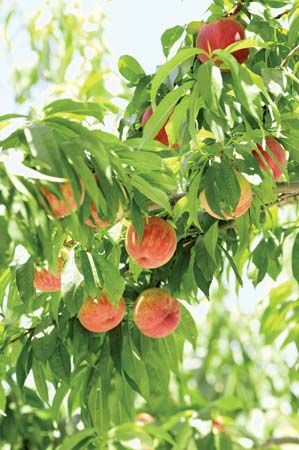
The peach (Prunus persica) is believed to have originated in China, from where it spread westward through Asia to the Mediterranean and eventually to the rest of Europe. Spanish explorers introduced the fruit to the New World, with records of its presence in Mexico by 1600.1
For centuries, peach cultivation was primarily limited to the gardens of the nobility. Large-scale commercial production did not emerge until the 19th century in the United States. Early efforts relied on variable, often low-quality seedling trees; however, the later adoption of grafting superior strains onto hardy rootstocks enabled the development of modern commercial orchards.1
The fruit holds cultural significance as well; in Chinese Daoist mythology, the pantao is known as the peach of immortality, said to grow in the garden of the Queen Mother of the West. Today, the peach is a vital deciduous-tree crop, with major production occurring in China, Italy, Spain, and the United States1.2
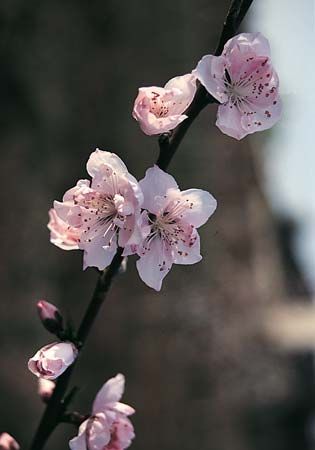
How do peach trees grow, and what are their specific environmental requirements?
Peach trees (Prunus persica) are deciduous trees that thrive in warmer temperate regions. Their growth and productivity are governed by specific environmental and maintenance requirements:
Environmental Requirements
- Temperature: Peach trees are sensitive to extreme cold and cannot survive where temperatures regularly drop to −23 to −26 °C (−10 to −15 °F). Conversely, they require a period of winter chilling to break dormancy and initiate growth; if winters are too mild, the trees will not grow satisfactorily.1
- Soil: While adaptable to various soil types, they perform best in well-drained sandy or gravelly loams.1
- Nutrients: Peach trees generally require nitrogen-rich fertilizers or manures to maintain healthy growth. While phosphorus requirements for woody plants are typically low, peaches have shown favorable responses to phosphorus supplementation.14
Cultivation and Growth
- Pruning: To manage height and ensure sunlight reaches the center of the tree, growers prune them annually, keeping trees between 3 and 4 meters (10 and 13 feet) tall.1
- Propagation: Modern commercial orchards rely on grafting superior fruit-bearing strains onto hardy rootstocks to ensure quality and consistency.1
- Fruit Development: Most varieties produce more fruit than the tree can support. Growers often perform hand thinning to ensure the remaining fruit develops to full size.1
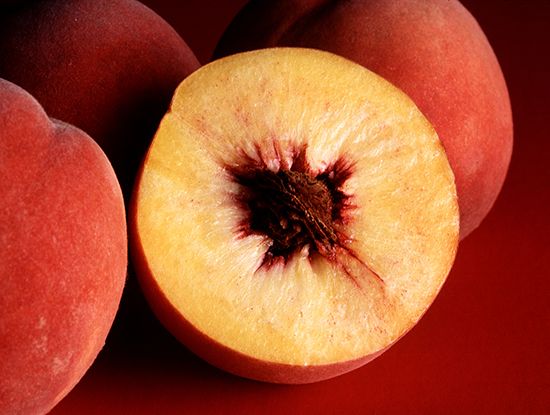
What are the different varieties of peaches, and how do they differ in taste and appearance?
Thousands of varieties of peaches (Prunus persica) have been developed, categorized primarily by their flesh color, stone adherence, and skin texture.
Classification by Flesh and Stone
Peaches are often distinguished by how the fruit interacts with its central pit:
- Freestone: These varieties have stones that separate easily from the ripe flesh, making them convenient for eating fresh or processing.
- Clingstone: In these types, the flesh adheres firmly to the stone.
The flesh itself can be white, yellow, or red. Yellow-fleshed varieties, such as Elberta, Redhaven, and Halford, are particularly popular in North America and are noted for being rich in vitamin A. Both white- and yellow-fleshed types are widely consumed in Europe.
Classification by Skin Texture
- Peaches: Most ripe peaches are characterized by downy, fuzzy skin.
- Nectarines: These are a genetic variant of the common peach that lacks the fuzzy trichomes (plant hairs), resulting in smooth skin. Nectarines are otherwise virtually indistinguishable from peaches in tree growth and fruit structure, and they are also a good source of vitamins A and C.
How does the process of grafting affect peach tree cultivation?
Grafting is a fundamental practice in modern peach tree cultivation, essential for the development of large-scale commercial orchards. By joining a scion—a cutting from a superior fruit-bearing strain—onto a hardy rootstock, growers can ensure the consistency and quality of the fruit produced.78
This process significantly impacts cultivation in several ways:
- Standardization: Early peach cultivation relied on seedlings, which were often variable and of poor quality. Grafting allows growers to propagate specific, high-quality varieties reliably.7
- Environmental Adaptation: The use of specific rootstocks allows peach trees to be better adapted to adverse soil or climatic conditions, improving the tree’s overall hardiness.81
- Performance Control: Rootstocks can influence the performance of the scion, providing opportunities for invigoration or growth control.81
- Efficiency: Grafting and the related technique of budding are highly efficient methods of vegetative propagation; a small amount of scion material can be used to produce hundreds of trees within a single year.81
By utilizing these techniques, growers can maintain the desired varietal characteristics while ensuring the trees are robust enough to thrive in their specific environment.81
Sources
- Peach — Encyclopædia Britannica
- peach — Merriam-Webster
- pantao — Encyclopædia Britannica
- Seed - Afterripening, stratification, and temperature effects — Encyclopædia Britannica
- Fruit farming - Fertilization — Encyclopædia Britannica
- Nectarine — Encyclopædia Britannica
- graft — Encyclopædia Britannica
- horticulture - Grafting — Encyclopædia Britannica
Published on · 4 min read