Percheron
The Percheron is a powerful draft horse breed, but specific data regarding its individual average lifespan is not distinguished from the general life span of…
What is the average lifespan of a Percheron horse, and how does it compare to other horse breeds?
The Percheron is a powerful draft horse breed, but specific data regarding its individual average lifespan is not distinguished from the general life span of horses in the provided records.
Generally, the lifespan of a horse is estimated to be between 20 and 25 years, with a maximum potential of 30 to 35 years. While individual longevity can vary significantly based on care, training, and workload, there is a general trend where smaller equines, such as ponies, tend to live longer than larger breeds. The useful working life of a horse is also highly dependent on how it is managed; for instance, well-maintained riding horses may remain active for over 20 years, whereas racehorses often have much shorter careers.1
What role did Percherons play in agriculture and transportation before the advent of motorized vehicles?
Before the widespread adoption of motorized vehicles, the Percheron played a vital role in both agriculture and transportation. Originally developed in the Perche region of France, these powerful draft horses were specifically bred to handle heavy labor.
Agricultural Impact
In the 19th century, the breed was refined with draft-type blood to create animals capable of intensive farm work. They became the most influential draft breed in United States agriculture, where they were essential for tasks such as pulling plows, threshing grain, and hauling logs in lumbering operations. Their agility and energetic nature, combined with a mild disposition, made them highly effective for these demanding field duties.13
Transportation and Utility
Beyond the farm, Percherons were utilized as draft animals to move heavy loads. Using a rigid, padded collar to transfer their muscle power, they were harnessed to pull various wheeled vehicles, including carts, wagons, and carriages. They were often worked in teams to transport bulk commodities or large machine parts, serving as a primary source of power for logistics before the era of mechanization.3
What are the physical characteristics that define the Percheron horse breed?
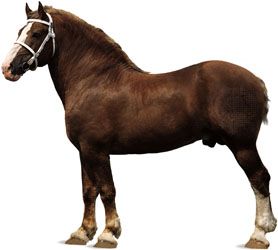
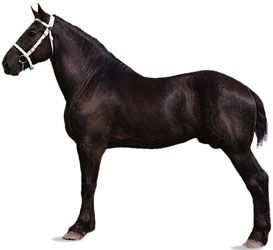
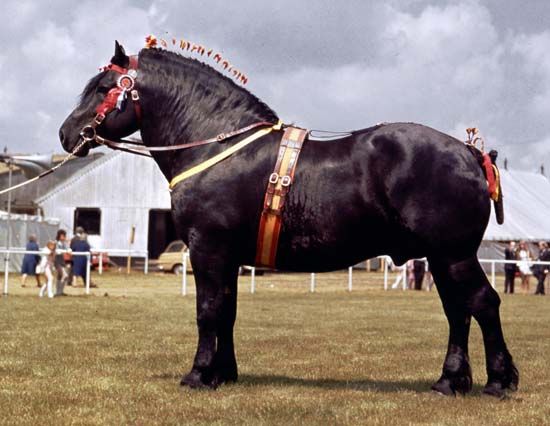
The Percheron is a powerful, heavy draft horse defined by several distinct physical characteristics:
- Size and Build: These horses typically stand between 16 and 17 hands (64 to 68 inches, or 163 to 173 cm) high and weigh between 1,900 and 2,100 pounds (860 to 950 kg). They possess a well-muscled body, a wide chest with a prominent breastbone, and a long, clean-cut neck.15
- Head: The head is described as fine and relatively small, often featuring a broad forehead.15
- Coloration: The most common colors for the breed are black and gray.15
- Legs: Unlike some other heavy draft breeds, Percherons are characterized by having no feathering (long hair) on their legs.5
- Movement: They are noted for being agile and energetic for their size, displaying a distinctive long and low action in their gait.15
Beyond these physical traits, the breed is well-regarded for its mild disposition.1
Where did the Percheron breed originate, and how has it evolved over time?
The Percheron breed originated in the Perche region of France. Its development over time reflects a series of selective breeding phases aimed at adapting the horse to changing societal needs:
- Medieval Origins: The breed is believed to descend from the Flemish “great horse” of the Middle Ages.
- Refinement for Speed: At one point, the breed was modified through the introduction of Arabian blood, which helped develop a lighter, more agile coach-horse type.
- Transition to Heavy Draft: In the 19th century, the breed was further altered by the introduction of draft-type blood. This shift was specifically intended to produce powerful animals capable of performing heavy farm work.
Following these refinements, the Percheron became the most influential draft breed in United States agriculture, particularly after 1851, as it provided the necessary strength for the intensive labor required before the advent of mechanization.14
Sources
- Percheron — Encyclopædia Britannica
- horse - Reproduction and development — Encyclopædia Britannica
- Draft animal — Encyclopædia Britannica
- Percheron — Merriam-Webster
- horse - Heavy breeds — Encyclopædia Britannica
Published on · 3 min read