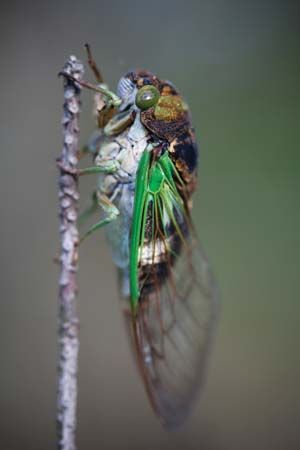
Periodical Cicada
A periodical cicada is any of seven species of insects in the genus Magicicada native to the eastern and midwestern United States. They are widely known for…
What is a periodical cicada?
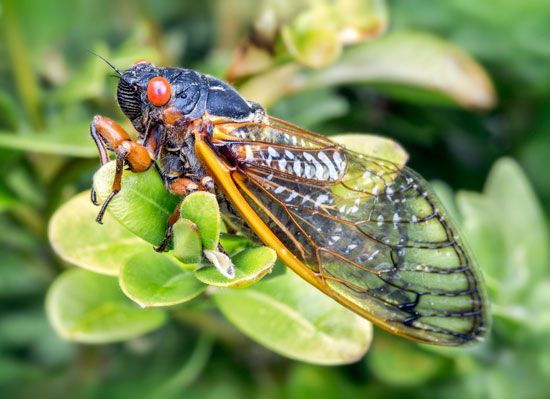
A periodical cicada is any of seven species of insects in the genus Magicicada native to the eastern and midwestern United States1. They are widely known for their highly synchronized life cycles, emerging from the soil in massive numbers only every 13 or 17 years.12
These insects are often erroneously called “17-year locusts,” though they are not related to locusts. Their life cycle is among the longest of any insect. After hatching, nymphs spend nearly their entire lives underground, feeding on the xylem of tree and shrub roots. When they emerge in spring, they undergo their final molt into winged adults, living for only a few weeks to mate and lay eggs.3214
Periodical cicadas are harmless to humans and do not bite or sting. Their emergence in overwhelming numbers is believed to be an evolutionary strategy to satiate predators, ensuring that enough individuals survive to reproduce.12
How do periodical cicadas look different from other insects?
Adult periodical cicadas are large, sturdy insects that can be distinguished from other insects—and specifically from annual cicada species—by several key physical characteristics.5
Physical Appearance
- Distinctive Coloration: Periodical cicadas are easily recognized by their characteristic red eyes and black thorax. In contrast, many annual cicada species are typically green.5
- Size: Adults generally measure between 2.4 and 3.3 cm (0.9 to 1.3 inches) in length, with females being larger than males. They are typically smaller than most annual cicada species.5
- Wings: They possess two pairs of large, translucent wings that extend beyond the length of their bodies. These wings feature distinct orange to gray venation.15
- Abdomen: The underside of the abdomen varies by species, appearing either solid black, solid orange, or striped with those colors.5
General Cicada Features
Like all members of the family Cicadidae, periodical cicadas have a stout body, a wide blunt head, and prominent compound eyes, along with three simple eyes (ocelli) arranged in a triangle between the compound eyes. They are equipped with sap-sucking mouthparts rather than mandibles, meaning they do not bite, and they lack the specialized organs required for stinging.14

Why are they called ‘periodical’ cicadas?
They are called “periodical” cicadas because of their highly synchronized and predictable life cycles, which are among the longest of any insects. Unlike annual cicadas that appear every year, periodical cicadas spend nearly their entire lives as nymphs underground, emerging from the soil in massive numbers only every 13 or 17 years to mate and lay eggs.12
This emergence is organized into groups known as “broods,” which are designated by Roman numerals. Because these broods are geographically distinct and emerge on these specific, long-term schedules, the insects only appear aboveground at these fixed, recurring intervals. This unique evolutionary strategy is believed to help the species satiate predators, ensuring that enough individuals survive to reproduce.1
How long do periodical cicadas live underground before coming out?
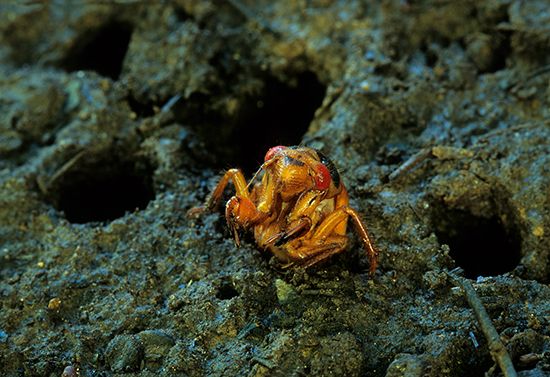
Periodical cicadas spend the vast majority of their lives underground as nymphs, feeding on the xylem of tree and shrub roots for either 13 or 17 years before emerging as adults.21
During this subterranean period, they live at depths ranging from 5 to 61 cm (2 to 24 inches), depending on soil conditions. While they are nearly full-grown after eight years, they continue to feed and develop underground until the final year of their cycle. As they age, the nymphs typically move deeper into the soil to access larger roots, eventually digging closer to the surface as their scheduled emergence approaches.21
Sources
- periodical cicada — Encyclopædia Britannica
- homopteran - Periodical cicada — Encyclopædia Britannica
- periodical cicada — Merriam-Webster
- cicada — Encyclopædia Britannica
- Did you know? — Merriam-Webster
Published on · 3 min read