Homopteran
Homopterans typically undergo incomplete metamorphosis, also referred to as simple or gradual metamorphosis. Their life cycle consists of three primary…
What are the life cycle stages of a typical homopteran insect?
Homopterans typically undergo incomplete metamorphosis, also referred to as simple or gradual metamorphosis. Their life cycle consists of three primary stages:123
- Egg: The cycle begins when eggs are laid, often on the stems or sheaths of host plants. The embryo develops within a protective shell that provides necessary nutrients.14
- Nymph: Upon hatching, the immature insect—known as a nymph—resembles the adult in form and eating habits. Nymphs differ from adults primarily in size, body proportions, and color patterns. During this stage, they undergo a series of molts, shedding their outer skeleton to accommodate growth4. Rudimentary wings develop externally throughout these molts.5
- Adult: The adult emerges from the final molt. This stage is characterized by fully developed genitalia and wings, with the primary focus on mating and reproduction.354
While this is the typical pattern, it is important to note that some homopterans, such as scale insects and whiteflies, exhibit developmental stages that resemble complete metamorphosis.2
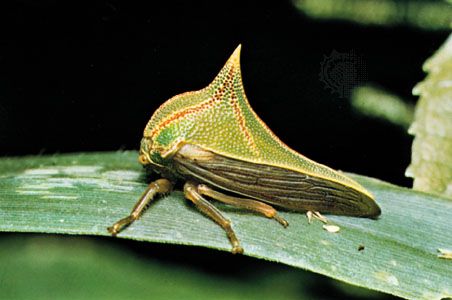
What are some common examples of homopteran insects?
Homopterans are a diverse group of over 32,000 species of sucking insects, all of which are plant feeders that utilize specialized mouthparts to extract sap. They are generally categorized into two large groups: the Auchenorrhyncha and the Sternorrhyncha.67
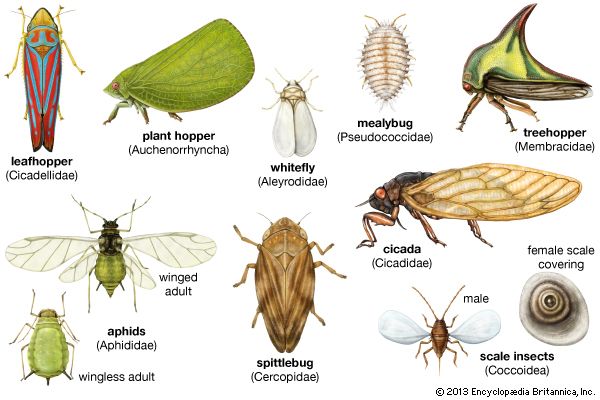
Common examples of homopteran insects include:
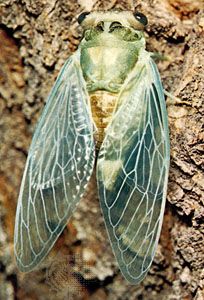
- Cicadas: Known for their stout bodies and the loud, rhythmic sounds produced by males.68
- Aphids: Small, soft-bodied insects often referred to as plant lice.67
- Leafhoppers: Members of the family Cicadellidae that are common in many environments.7
- Treehoppers: Insects often recognized by their unique, enlarged pronotums.7
- Froghoppers (Spittlebugs): Named for the frothy, spittle-like substance their nymphs produce.67
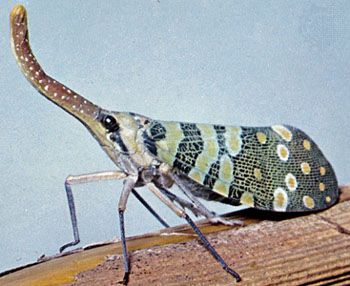
- Planthoppers: A diverse group that includes the lanternfly and the spotted lanternfly.7
- Scale insects: A varied group that includes the cottony-cushion scale and oystershell scale.7
- Whiteflies: Small insects that can be significant pests in agricultural settings.67
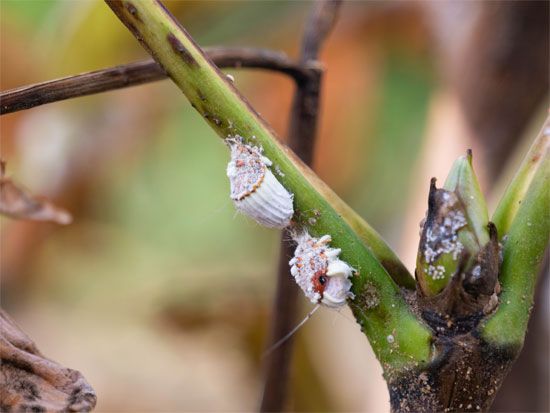
- Mealybugs: Soft-bodied insects often covered in a waxy, white secretion.67
- Jumping plant lice: Members of the family Psyllidae.7
What are the main characteristics that define the homopteran insect order?
Homopteran insects are defined by several distinct morphological and biological characteristics that distinguish them within the insect world. While some entomologists classify them as a suborder of Hemiptera, others argue for their status as a separate order due to these unique traits:6211
Key Characteristics
- Piercing-Sucking Mouthparts: All homopterans are plant feeders that use a specialized beak (proboscis) to extract sap. Unlike heteropterans, the homopteran beak is fastened rigidly to the head and appears to arise from the underside of the head or between the front legs.121311
- Wing Structure: The forewings of homopterans are generally of uniform texture throughout their length, appearing either membranous or leathery. When at rest, these wings are held at a rooflike angle over the abdomen, overlapping only slightly.611
- Absence of Scent Glands: A primary anatomical difference between homopterans and heteropterans is that homopterans lack scent glands entirely.11
- Head Anatomy: The gula—a structure separating the mouthparts from the prothorax—is either small, membranous, or absent in homopterans, which allows the base of the mouthparts to fuse or abut directly to the prothorax.11
- Metamorphosis: Most homopterans undergo gradual (incomplete) metamorphosis, though some groups, such as whiteflies and scale insects, exhibit developmental stages that resemble complete metamorphosis.611
What role do homopterans play in pollination, if any?
Based on the provided information, homopterans do not play a significant role in pollination.
The members of the order Homoptera are exclusively plant feeders that possess specialized mouthparts adapted for sucking sap from various trees and plants. Because their primary interaction with plants involves extracting fluids—often causing injury, stunting growth, or transmitting plant diseases—they are generally categorized as agricultural pests rather than pollinators.614
While other insect groups, such as certain beetles and flies, are recognized for their roles in pollen dispersal, homopterans are not noted for such activities in the provided records. Their ecological impact is instead defined by their feeding habits, their role as vectors for viruses and bacteria, and their complex associations with predators and parasites.15161417
Sources
- homopteran - Life cycle — Encyclopædia Britannica
- homopteran - Critical appraisal — Encyclopædia Britannica
- insect - Types of metamorphosis — Encyclopædia Britannica
- Metamorphosis — Encyclopædia Britannica
- heteropteran - Metamorphosis — Encyclopædia Britannica
- homopteran — Encyclopædia Britannica
- Did you know? — Merriam-Webster
- list of homopterans — Encyclopædia Britannica
- homopteran - Distinguishing taxonomic features — Encyclopædia Britannica
- List of insects - hemipterans (order Hemiptera) — Encyclopædia Britannica
- homopteran - Head — Encyclopædia Britannica
- homopteran - Evolution and paleontology — Encyclopædia Britannica
- heteropteran - Distinguishing taxonomic features — Encyclopædia Britannica
- homopteran - Importance — Encyclopædia Britannica
- homopteran - Associations with other insects — Encyclopædia Britannica
- pollination - Beetles and flies — Encyclopædia Britannica
- major types of pollinators - Beetles and flies — Encyclopædia Britannica
Published on · 3 min read