Plant Hopper
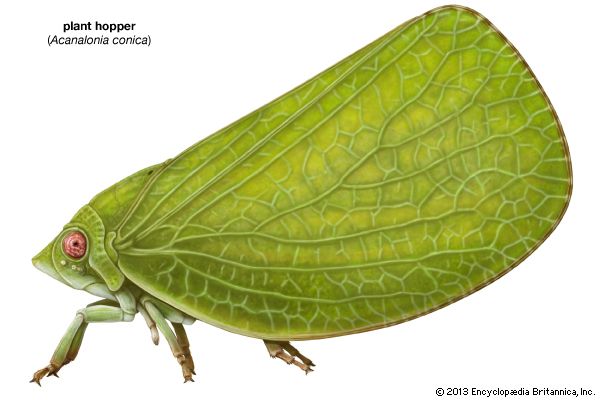
A plant hopper is any member of several insect families within the order Homoptera. They are easily identified by a hollow, enlarged extension of the head…
What is plant hopper?
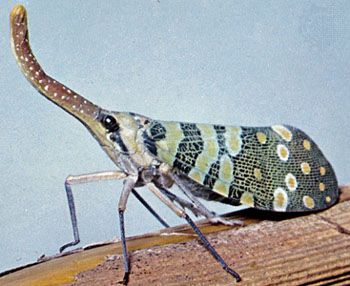
A plant hopper is any member of several insect families within the order Homoptera. They are easily identified by a hollow, enlarged extension of the head, which in some species may appear luminous, such as in the lanternfly.1
These insects range in size from 1 cm (0.4 inch) in cooler climates to approximately 5 cm in tropical regions. They feed on plant juices and excrete honeydew, a sweet byproduct of their digestion. While some species are covered in a mealy substance or waxy filaments, they are generally not considered serious economic pests. Plant hoppers are categorized into various families, including Delphacidae, Derbidae, Cixiidae, Kinnaridae, Dictyopharidae, Fulgoridae, Achilidae, Tropiduchidae, Flatidae, Acanaloniidae, and Issidae.12
It is important to note that plant hoppers are distinct from leafhoppers, which belong to the family Cicadellidae and can be significant economic pests due to their ability to transmit plant diseases.32
What is honeydew and why do planthoppers produce it?
Honeydew is a sweet, saccharine substance excreted by various insects, including planthoppers, aphids, and scale insects.678
Why Planthoppers Produce Honeydew
Planthoppers and other related insects feed exclusively on plant sap, which contains a high volume of water but relatively low concentrations of nutrients. To obtain the necessary amount of sustenance to survive, these insects must ingest large quantities of sap.69
To manage this, their digestive systems are equipped with a specialized structure called a filter chamber. This modification allows the insect to concentrate nutrients in the midgut and small intestine while bypassing the bulk of the excess water, sugar, and waste materials. This surplus fluid is then exuded from the rectum as honeydew.69
Ecological Impact
- Attracting Insects: Because it is rich in sugars, honeydew serves as a food source for other insects, such as ants, which often protect and “herd” the honeydew-producing insects to ensure a steady supply.68
- Fungal Growth: When honeydew lands on plant surfaces, it can facilitate the growth of sooty mold. This fungus can coat leaves and fruit, potentially damaging the plant’s health or rendering crops unmarketable.9
How can you tell the difference between a planthopper and a leafhopper?
Distinguishing between a planthopper and a leafhopper involves examining specific anatomical features, particularly their legs and head structures. Both are members of the order Homoptera, but they belong to different families with distinct characteristics.
Key Differences
- Leg Structure: The most reliable way to differentiate them is by looking at the hind legs. Leafhoppers (family Cicadellidae) have hind tibiae that feature two or more rows of spines. In contrast, planthoppers exhibit varied leg structures depending on the family; for example, the Delphacidae family is characterized by a broad, movable apical spur on the hind tibia.
- Head and Body Shape: Planthoppers often possess a hollow, enlarged extension of the head, which can vary significantly in shape—sometimes appearing as a long, slender snout or a flattened, leaflike structure. Leafhoppers typically have bodies that are dorso-ventrally flattened or cylindrical, with heads ranging from short and rounded to thin and bladelike.
- Economic Impact: Leafhoppers are widely recognized as serious economic pests because they are capable of transmitting over 100 types of plant diseases. Planthoppers are generally not considered major economic pests in the same capacity.
What are some examples of other insects in the order Homoptera?
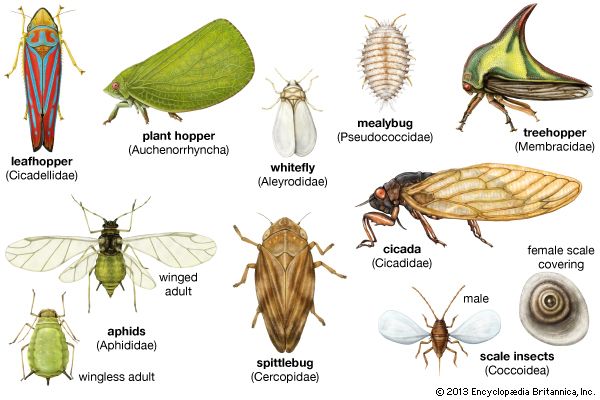
The order Homoptera comprises more than 32,000 species of sucking insects that feed on plant sap. These insects are generally categorized into two large groups: the Auchenorrhyncha and the Sternorrhyncha.12
Auchenorrhyncha
This group includes several well-known insects:
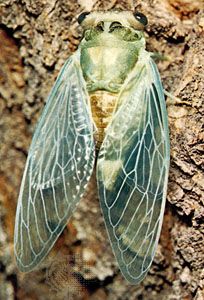
- Cicadas: Large, sound-producing insects, such as the periodical cicadas and annual dog-day cicadas.121314
- Treehoppers: Insects often noted for their unusual, often elaborate, pronotal structures.1213
- Froghoppers: Also known as spittlebugs, named for the frothy mass their nymphs produce.1213
- Leafhoppers: Small, wedge-shaped insects that are significant vectors of plant diseases.1213
- Planthoppers: A diverse group that includes the spotted lanternfly.1213
Sternorrhyncha
This group includes smaller, often sedentary insects:
- Aphids: Also called plant lice, these are common garden pests.1213
- Whiteflies: Small insects that often congregate on the undersides of leaves.1213
- Scale insects: Such as the oystershell scale and San Jose scale.1213
- Mealybugs: Soft-bodied insects often covered in a white, waxy secretion.1213
- Jumping plant lice: Members of the family Psyllidae.13
Sources
- plant hopper — Encyclopædia Britannica
- leafhopper — Encyclopædia Britannica
- homopteran - Annotated classification — Encyclopædia Britannica
- homopteran - Polymorphism — Encyclopædia Britannica
- Orthoptera - Importance — Encyclopædia Britannica
- homopteran - Honeydew — Encyclopædia Britannica
- honeydew — Merriam-Webster
- homopteran - Importance — Encyclopædia Britannica
- ant - Food — Encyclopædia Britannica
- homopteran - Evolution and paleontology — Encyclopædia Britannica
- homopteran - Leafhopper — Encyclopædia Britannica
- homopteran — Encyclopædia Britannica
- list of homopterans — Encyclopædia Britannica
- homopteran - Critical appraisal — Encyclopædia Britannica
- cicada — Encyclopædia Britannica
Published on · 3 min read