Phoebe
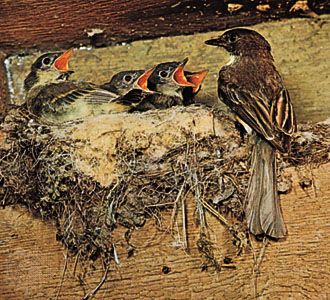
Phoebes, members of the genus Sayornis, exhibit distinct nesting behaviors that reflect their adaptation to various environments. A notable characteristic of…
What are some interesting facts about phoebe birds’ breeding and nesting habits?
Phoebes, members of the genus Sayornis, exhibit distinct nesting behaviors that reflect their adaptation to various environments. A notable characteristic of the eastern phoebe is its construction of a mossy nest reinforced with mud. These birds are known for selecting specific, often sheltered locations for their nests, frequently choosing ledges situated under bridges.1
While general avian reproductive strategies involve diverse methods of incubation and pair bonding, phoebes are recognized for their consistent presence across North and South America. Unlike species that engage in complex lek-type displays or exhibit reversed sex roles in parenting, phoebes maintain their status as stable, widely distributed populations. Their nesting habits, particularly the use of mud and moss, allow them to thrive in both open country and areas near water, contributing to their classification as a species of least concern.12
What are the defining characteristics of phoebe birds?
Phoebes are three species of New World birds belonging to the genus Sayornis within the Tyrannidae family. Found from Alaska to Argentina, these birds are characterized by their habit of twitching or bobbing their tails while perching.13
The three primary species include:
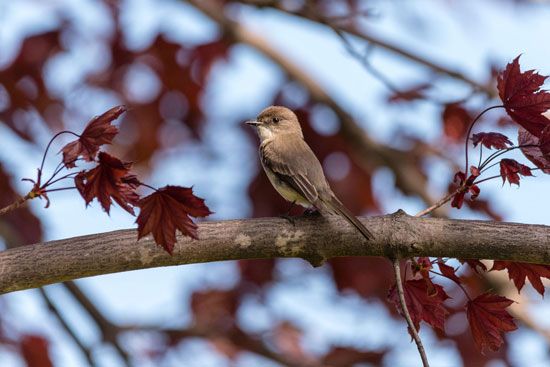
- Eastern phoebe (S. phoebe): A 18-cm-long bird that is brownish gray above and paler below. It is known for its repetitive “fee-bee” call and its tendency to build mossy, mud-strengthened nests on sheltered ledges, such as those under bridges.1
- Say’s phoebe (S. saya): A slightly larger species found in the open country of western North America, distinguished by its buff-hued underparts.1
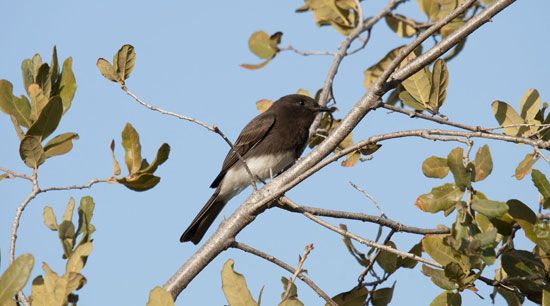
- Black phoebe (S. nigricans): The most widely distributed species, measuring 16 cm. It is dark above with a contrasting white belly and is typically found near water.1
All three species are classified as being of least concern by the IUCN, with their populations currently on the rise.1
How many species of phoebe birds exist, and what are some of the most common ones?
There are exactly three species of phoebe birds, all belonging to the genus Sayornis within the Tyrannidae family. the Tyrannidae family. These birds are found across the Americas, ranging from northern Alaska down to the mountains of northern Argentina.1
The three species are:
- Eastern phoebe (Sayornis phoebe): The most well-known species in North America, measuring 18 cm (7.5 inches) in length. It is characterized by its brownish-gray upper body and paler underparts, as well as its repetitive “fee-bee” call.1
- Say’s phoebe (S. saya): A slightly larger bird found in the open country of western North America, distinguished by its buff-colored underparts.15
- Black phoebe (S. nigricans): The most widely distributed species, typically found near water. It is the smallest of the three at 16 cm (6.3 inches) and features a dark upper body with a contrasting white belly.1
All three species are currently classified as being of least concern by the IUCN, and their populations are continuing to increase.1
Where are phoebe birds typically found, and what are their preferred habitats?
Phoebe birds, belonging to the genus Sayornis, are found across a vast range extending from northern Alaska in the north to the mountains of northern Argentina in the south.1
Their preferred habitats vary by species:
- Eastern phoebe: This species is often found near sheltered ledges, frequently nesting under bridges or similar structures.1
- Say’s phoebe: This bird is typically found in the open country of western North America.1
- Black phoebe: As the most widely distributed species, it is characteristically found in close proximity to water throughout its range from the southwestern United States to Argentina.1
All three species are currently classified as being of least concern by the IUCN, and their populations are on the rise.1
Sources
- Phoebe — Encyclopædia Britannica
- Reproductive behaviour - Birds — Encyclopædia Britannica
- 12 Words for Signs of Spring | Phoebe — Merriam-Webster
- phoebe — Merriam-Webster
- Say's phoebe — Merriam-Webster
Published on · 3 min read