Phytolaccaceae
Phytolaccaceae, commonly known as the pokeweed family, is a group of flowering plants within the order Caryophyllales. This family comprises approximately 18…
What is Phytolaccaceae?
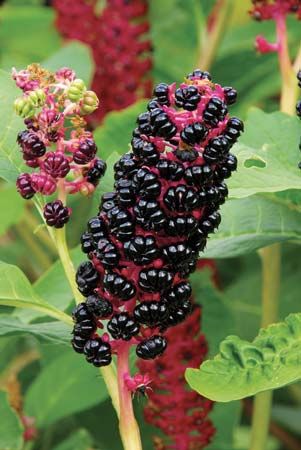
Phytolaccaceae, commonly known as the pokeweed family, is a group of flowering plants within the order Caryophyllales. This family comprises approximately 18 genera and 65 species consisting of herbs, shrubs, trees, and woody climbers, which are primarily native to tropical and subtropical regions of Africa and North America.12
Key characteristics of the family include:
- Leaves: Typically spiral, simple, and entire (smooth-edged).1
- Flowers: Small and arranged in racemose inflorescences. They are usually bisexual and lack petals.12
- Reproductive structure: The female part consists of one to many carpels, each containing a single basal ovule.12
- Fruit: Often a small, fleshy berry.12
Well-known members include the pokeweed (Phytolacca americana), a common North American weed, and the rouge plant (Rivina humilis), which is frequently cultivated in warmer climates.1
What are some other plant families in the order Caryophyllales?
The order Caryophyllales is a diverse group of flowering plants comprising 37 families and approximately 12,000 species. Beyond the Phytolaccaceae, several other notable families belong to this order, many of which exhibit specialized adaptations for survival in harsh environments.4
Key families within the order include:
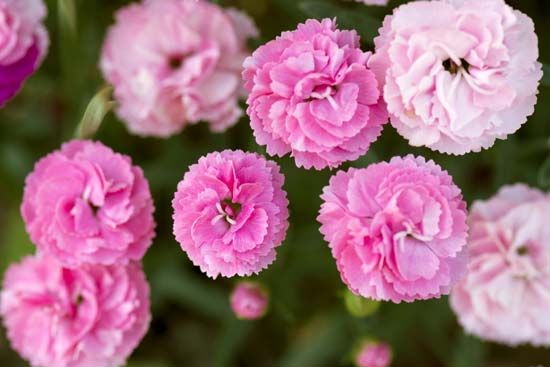
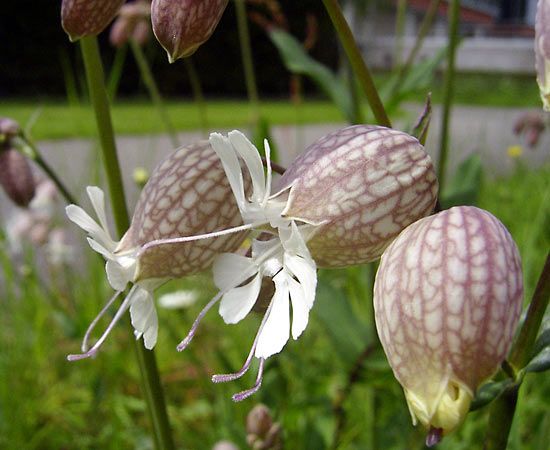
- Caryophyllaceae: Known as the pink or carnation family, these are typically herbaceous plants with opposite leaves joined at the base and bilobed or clawed petals.45
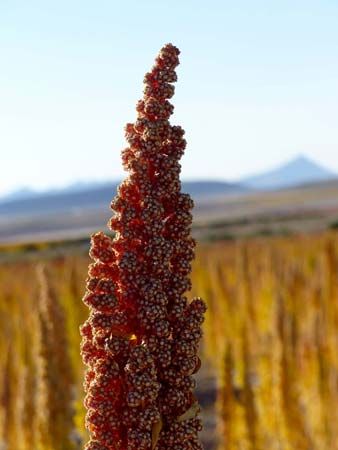
- Amaranthaceae: This family includes many succulent herbs and halophytes (salt-tolerant plants). It encompasses important food crops like spinach, quinoa, and beets.britannica.com/plant/quinoa), and beets.465
- Cactaceae: Distinguished by the presence of spines in areoles, this family is highly adapted to arid conditions, with stems often taking over photosynthetic functions.43
- Aizoaceae: Often called the ice plant family, these are leaf succulents that utilize specialized C4 and CAM photosynthesis pathways.45
- Polygonaceae: This group includes herbs, shrubs, and vines, such as rhubarb, characterized by leaves with stipules that form a sheath around the stem.45
- Plumbaginaceae: Composed of perennial herbs and shrubs, these plants often feature glands on their leaves and flowers with fused petals.45
- Nyctaginaceae: Known for the four-o’clock family, these plants often have swollen nodes and tubular flowers4.5
- Portulacaceae: Primarily composed of annual or perennial succulents with small flowers.45
How do racemose inflorescences differ from other flower arrangements?
Inflorescences are categorized primarily by their growth patterns and the timing of their flowering. The fundamental difference between racemose (indeterminate) and cymose (determinate) arrangements lies in the growth of the main axis and the sequence in which flowers open.7
Racemose (Indeterminate) Inflorescences
In a racemose arrangement, the main axis continues to grow and does not cease at the onset of flowering. The youngest flowers—those that open last—are located at the top of an elongated axis or in the center of a truncated axis.7
- Growth: Monopodial, meaning the main axis continues to extend.7
- Examples: This category includes racemes, spikes, corymbs, umbels, and heads.7
Cymose (Determinate) Inflorescences
In contrast, determinate or cymose inflorescences have a limited growth pattern. At the time of flowering, the apical meristem produces a flower, which causes the entire axis to stop growing.7
- Growth: Sympodial, where the main axis is terminated by a flower.7
- Sequence: The youngest flowers are found at the bottom of an elongated axis or on the outside of a truncated axis.7
- Examples: These include dichasiums, helicoid cymes, and verticillasters.7
What are the primary differences between berries and other types of fleshy fruits?
In botany, a berry is a simple, fleshy fruit derived from the single ovary of an individual flower, typically containing many seeds. While popular usage often labels any small, edible fruit as a berry, true botanical berries are distinguished by their structure and development.910
Primary Differences Between Berries and Other Fleshy Fruits
The classification of fleshy fruits depends on the number of carpels involved, the origin of the fruit tissue, and the texture of the pericarp (fruit wall).1110
- Berries vs. Drupes: Unlike berries, which are fleshy throughout their mesocarp and endocarp, drupes (stone fruits like peaches, cherries, and olives) possess a fleshy mesocarp but a hard, stony endocarp that protects the seed. Drupes also typically contain only one seed per carpel.910
- Berries vs. Pomes: Pomes (such as apples and pears) are accessory fruits. While the central part of the fruit represents the pericarp, the fleshy portion is largely formed by the adnate hypanthium (floral tube) rather than the ovary wall alone.1110
- Berries vs. Aggregate Fruits: Fruits like strawberries, raspberries, and blackberries are not true berries. They are aggregate fruits, which develop from a single flower with multiple separate pistils (carpels), each forming its own fruitlet.91110
Specialized Berries
Certain berries exhibit unique structural modifications:
- Hesperidium: A berry with a leathery rind, characteristic of citrus fruits like oranges and lemons.910
- Pepo: A berry with a hard, tough rind, common in the Cucurbitaceae family, such as watermelons, cucumbers, and pumpkins.910
Sources
- Phytolaccaceae — Encyclopædia Britannica
- Phytolaccaceae — Merriam-Webster
- Caryophyllales - Other families — Encyclopædia Britannica
- Caryophyllales — Encyclopædia Britannica
- list of plants in the family Amaranthaceae — Encyclopædia Britannica
- Caryophyllales - Cactaceae — Encyclopædia Britannica
- angiosperm - Inflorescences — Encyclopædia Britannica
- flower — Encyclopædia Britannica
- berry — Encyclopædia Britannica
- fruit - Types of fruits — Encyclopædia Britannica
- angiosperm - Fruits — Encyclopædia Britannica
Published on · 4 min read