Pieman River
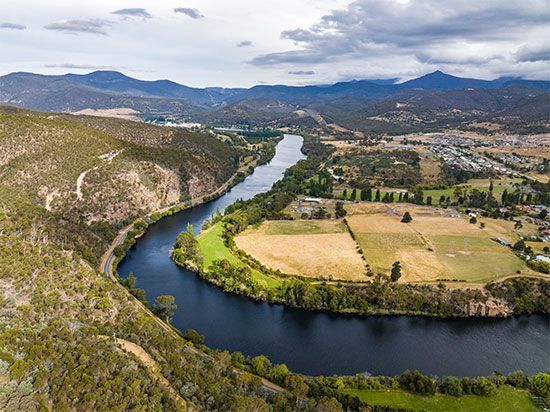
The Pieman River is a 61-mile (98-kilometre) river located in northwestern Tasmania, Australia.
What is Pieman River?
The Pieman River is a 61-mile (98-kilometre) river located in northwestern Tasmania, Australia.1
It originates near Tullah through the confluence of the Macintosh and Murchison rivers. As it flows westward toward its estuary at Hardwicke Bay on the Indian Ocean, it is fed by several tributaries, including the Huskisson, Stanley, Donaldson, Whyte, and Savage rivers.1
Historically, the river was the site of gold and tin mining in the late 19th century. While it was once thought to be named after the convict Alexander Pierce, it is now widely believed to be named for Thomas Kent, a convict who was a baker. In more recent decades, the river has been harnessed for its hydropower potential to support iron-ore and copper-mining operations at the Savage River and Mount Lyell, respectively.1
What is the history of the Savage River iron-ore mine?
The development of the Savage River iron-ore mine began in 1965, marking a significant shift in the economic landscape of northwestern Tasmania, Australia.1
The establishment of this mining operation, alongside increased copper-mining activity at nearby Mount Lyell, served as a primary catalyst for the region’s industrial growth. Specifically, the demand generated by these mining projects provided the necessary impetus for the state to harness the Pieman River’s hydropower potential to support large-scale extraction efforts.1
Today, the Savage River site remains a major deposit of iron ore and continues to be a vital component of Tasmania’s mineral-production industry, which has historically fluctuated based on global market conditions but remains a cornerstone of the state’s economy.2
How is hydropower generated from rivers like the Pieman?
Hydropower generation, such as that utilized by the Pieman River projects in Tasmania, relies on converting the potential energy of water into mechanical energy and finally into electricity.1
The process generally follows these steps:
- Collection and Head: Water is collected or stored at a higher elevation, often behind a dam. The vertical distance between this high-elevation water and the lower-elevation turbine is known as the head. A greater head allows for more potential power generation from a given volume of water.1
- Conveyance: The water is directed downward through large pipes or tunnels called penstocks toward the powerhouse, which contains the generating equipment.1
- Turbine Rotation: As the water exits the penstocks, its force causes hydraulic turbines to rotate. Depending on the specific hydraulic conditions, these may be impulse turbines (for high heads) or reaction turbines (for moderate to high flow rates).13
- Generation: The rotating turbines are coupled to electric generators, which convert the mechanical energy into electricity. Transformers then increase the voltage for efficient long-distance transmission.14
What are some other major rivers in Tasmania?
Tasmania features a diverse network of waterways, with two primary river systems serving as the foundation of its drainage: the Derwent in the southeast and the South Esk in the northeast.8
Other significant rivers in the state include:
- Gordon River: Located in the southwest, this river flows 115 miles (185 km) to the Indian Ocean. Its watershed is a critical part of the Tasmanian Wilderness UNESCO World Heritage site.9
- River Tamar: A tidal estuary in the north formed by the confluence of the North and South Esk rivers. It is a vital shipping route, supporting Australia’s largest aluminum-production complex at Bell Bay.10
- Tributaries of the Derwent: The Jordan, Clyde, Ouse, and Dee rivers are major upper-course tributaries of the Derwent and are extensively developed for hydroelectric power.11
- Tributaries of the Gordon: The Franklin, Serpentine, Wedge, Denison, and Sprent rivers are the principal tributaries of the Gordon River.9
Sources
- Pieman River — Encyclopædia Britannica
- Tasmania - Resources and power — Encyclopædia Britannica
- dam - Rise of environmental and economic concerns — Encyclopædia Britannica
- hydroelectric power — Encyclopædia Britannica
- turbine - Water turbines — Encyclopædia Britannica
- electric generator - Waterwheel generators — Encyclopædia Britannica
- Forth River — Encyclopædia Britannica
- River Derwent — Encyclopædia Britannica
- Tasmania - Drainage — Encyclopædia Britannica
- Gordon River — Encyclopædia Britannica
- River Tamar — Encyclopædia Britannica
- Tasmanian Wilderness — Encyclopædia Britannica
Published on · 3 min read