Pillars of Heracles
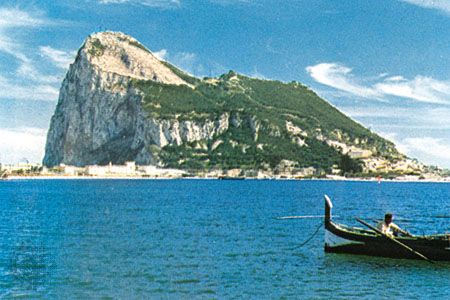
The Pillars of Heracles are two prominent landmarks that define the eastern entrance of the Strait of Gibraltar. The northern pillar is the Rock of…
What is the significance of the Strait of Gibraltar in relation to the Pillars of Heracles?
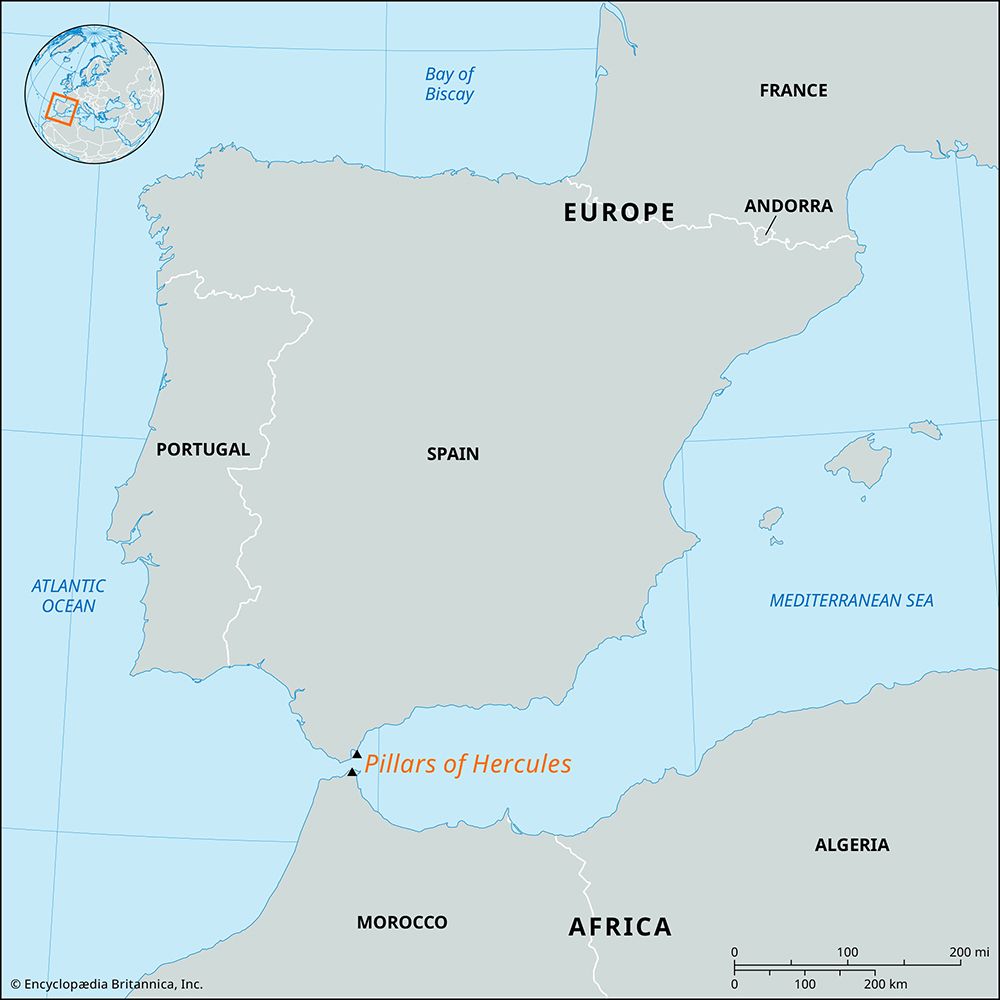
The Pillars of Heracles are two prominent landmarks that define the eastern entrance of the Strait of Gibraltar. The northern pillar is the Rock of Gibraltar, while the southern pillar is identified as either Jebel Moussa in Morocco or Mount Hacho near Ceuta.12
In classical antiquity, these pillars held significant symbolic and geographical importance, marking the western boundary of the known world. Mythologically, they were said to have been placed by Heracles as a memorial to his labor of seizing the cattle of the giant Geryon.21
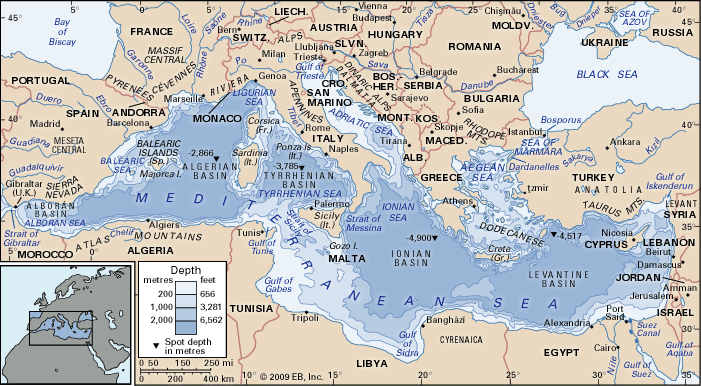
Beyond their mythological status, the strait itself serves as a vital shipping route connecting the Mediterranean Sea to the Atlantic Ocean. Its existence is essential for the ecological health of the Mediterranean, as it allows for a critical exchange of water that prevents the sea from becoming a hypersaline, shrinking lake.2
What is the modern-day importance of the Strait of Gibraltar?
The Strait of Gibraltar remains a waterway of vital modern-day importance, serving as a critical global shipping route that connects the Atlantic Ocean to the Mediterranean Sea.23
Its significance is defined by several key factors:
- Strategic Gateway: As the only entrance to the Mediterranean from the Atlantic, the strait is a major maritime choke point. Gibraltar, a British overseas territory, continues to function as a heavily fortified naval and air base that guards this passage. Its port facilities are frequently utilized for North Atlantic Treaty Organization (NATO) naval operations.4
- Hydrological Necessity: The strait is essential for the environmental health of the Mediterranean. A continuous exchange of water occurs through the channel, where a surface current flows eastward while a deeper, denser flow of saline water exits into the Atlantic. Without this exchange, the Mediterranean would become a shrinking, hypersaline salt lake.2
- Scientific and Environmental Research: The strait is a focal point for oceanographic study. Research is currently examining how changes in the Mediterranean’s hydrological characteristics—driven by factors like dam projects on major rivers—might influence the salinity of the water exiting the strait and, consequently, affect broader Atlantic currents.5
How have the Pillars of Heracles been depicted in ancient literature and art?
In ancient literature and culture, the Pillars of Heracles were primarily depicted as a symbolic boundary marking the western edge of the known world. According to mythology, these two promontories—the Rock of Gibraltar and either Jebel Moussa or Mount Hacho—were placed by Heracles as a memorial to his labor of seizing the cattle of the giant Geryon.16
The pillars were famously associated with the Latin phrase non plus ultra (and later ne plus ultra), which served as a warning to ancient mariners: “(Let there) not (be) more (sailing) beyond.” This inscription reinforced the idea that the pillars represented the absolute limit of the habitable and navigable world.7
While the pillars themselves are geographical features, the labors of Heracles were a recurring theme in ancient art. For example, the metopes of the Temple of Zeus at Olympia feature sculptural depictions of these labors, showcasing the artist’s ability to capture complex human emotions like pain and despair, which was a significant development in early Classical sculpture.8
How have the Pillars of Heracles influenced modern culture and literature?
The Pillars of Heracles have left a lasting imprint on modern culture, primarily through the evolution of the classical warning inscribed upon them. The ancient phrase non plus ultra—meaning “(let there) not (be) more (sailing) beyond”—served as a boundary marker at the Strait of Gibraltar.6
In modern English, this concept evolved into the term ne plus ultra. Rather than signifying a physical limit, the phrase is now used to describe the “highest point attainable,” representing the pinnacle, zenith, or perfection of a quality or state.69
Beyond language, the pillars became a powerful symbol of Spanish imperial identity. During the colonial period, the Pillars of Hercules were a constant element on Spanish-American coinage. These coins featured the pillars alongside the motto Plus Ultra (“Further Beyond”), a deliberate reversal of the ancient warning that celebrated the expansion of the Spanish Empire into the New World.7
Sources
- Pillars of Heracles — Encyclopædia Britannica
- Strait of Gibraltar — Encyclopædia Britannica
- List of Important Straits — Encyclopædia Britannica
- Gibraltar — Encyclopædia Britannica
- Mediterranean Sea - Impact of human activity — Encyclopædia Britannica
- Did you know? — Merriam-Webster
- Pillars of Hercules — Merriam-Webster
- Western sculpture - Early Classical (c. 500–450 bce ) — Encyclopædia Britannica
- ne plus ultra — Merriam-Webster
- coin - The colonial period — Encyclopædia Britannica
Published on · 3 min read