Pineapple
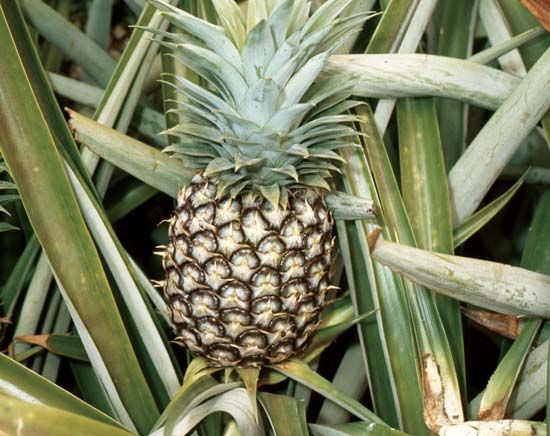
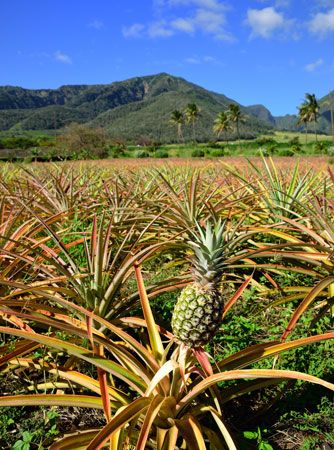
The pineapple (Ananas comosus) is a perennial plant characterized by a rosette of 30 to 40 stiff, succulent leaves growing from a thick, fleshy stem.
How does the pineapple plant grow and produce fruit?
The pineapple (Ananas comosus) is a perennial plant characterized by a rosette of 30 to 40 stiff, succulent leaves growing from a thick, fleshy stem.
Growth and Development
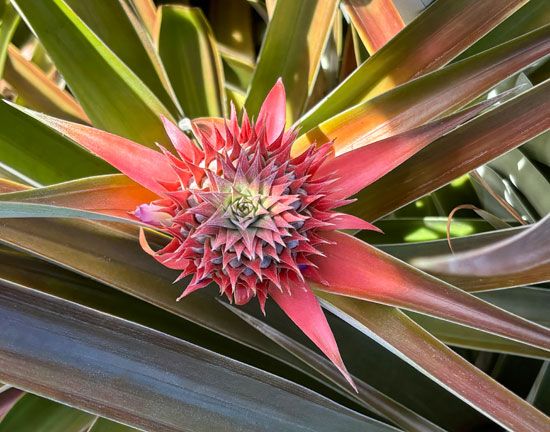
In commercial cultivation, plants are propagated by inserting pieces into the soil through mulch paper. Approximately 15 to 20 months after planting, a flower stalk emerges. This stalk produces a determinate inflorescence consisting of numerous individual light purple flowers and their associated bracts.
Fruit Formation
Botanically, the pineapple is classified as a multiple fruit. As the plant matures, the individual flowers and bracts attached to the central axis core become fleshy and fuse together to form the single, composite fruit. This process takes about five to six months from the onset of flowering until the fruit is fully ripened.1
What is the history of pineapple cultivation and how did it spread around the world?
The pineapple (Ananas comosus) is native to tropical and subtropical regions of the Americas. The earliest written records of the fruit come from explorers such as Christopher Columbus, Gonzalo Fernández de Oviedo y Valdés, and Sir Walter Raleigh, who encountered it in the West Indies being used for food and wine production.1
The global spread of the pineapple was largely driven by the Portuguese. Following their discovery of Saint Helena in 1502, they introduced the plant to the island. Shortly thereafter, they transported it to Africa and, by approximately 1550, to India. By the end of the 16th century, the cultivation of pineapples had expanded across most of the world’s tropical regions, including parts of the South Pacific. Today, major producers include Costa Rica, Brazil, China, India, and Thailand.1
What is the botanical classification of the pineapple plant?
The pineapple (Ananas comosus) is a perennial plant classified within the Bromeliaceae family. Its scientific classification is as follows:
- Kingdom: Plantae
- Division: Angiosperms
- Order: Poales
- Family: Bromeliaceae
- Genus: Ananas5
The family Bromeliaceae consists of approximately 56 genera and over 3,000 species, most of which are native to the tropical regions of the New World and the West Indies. While many members of this family grow as epiphytes on trees or cacti, the pineapple is a terrestrial, herbaceous evergreen perennial known for its stiff, spirally arranged leaves and its unique development into a multiple fruit.615
How has the pineapple influenced culture and cuisine around the world?
The pineapple has become a significant element in global cuisine, valued for its versatility in both savory and sweet applications. In Pan-Asian cooking, it is a characteristic ingredient frequently incorporated into a variety of meat, fish, rice, and vegetable dishes. In the United States and Europe, the fruit is commonly enjoyed fresh or in canned form, and it is frequently utilized as a filling for pastries and various baked desserts.1
Historically, the fruit’s cultural significance began in the West Indies, where it was used by indigenous populations for food and the production of wine. Following its discovery by European explorers, the pineapple was rapidly disseminated across the globe by the Portuguese, eventually becoming a staple crop in tropical regions worldwide.1
Sources
- Pineapple — Encyclopædia Britannica
- pineapple family — Merriam-Webster
- Columbus Day — Encyclopædia Britannica
- Martín Alonso Pinzón and Vicente Yáñez Pinzón — Encyclopædia Britannica
- list of plants in the family Bromeliaceae — Encyclopædia Britannica
- Bromeliaceae — Encyclopædia Britannica
Published on · 3 min read