Pinto
It is a common misconception that Pinto and Paint horses are the same; while both exhibit similar spotted coat patterns, they differ significantly in their…
How do Pinto horses compare to Paint horses in terms of breed classification?
It is a common misconception that Pinto and Paint horses are the same; while both exhibit similar spotted coat patterns, they differ significantly in their classification and registration requirements.
A Pinto is defined by its coat color rather than its lineage. The Pinto Horse Association of America registers horses of various breeds and types based solely on their spotted patterns, such as tobiano or overo. Because it is a color classification, a horse of almost any breed can be considered a Pinto.12
In contrast, the American Paint Horse is a specific, pedigreed breed. To be registered as an American Paint Horse, an animal must meet strict bloodline requirements—typically involving Quarter Horse or Thoroughbred ancestry—and possess a specific stock-horse body type. While the American Paint Horse Association also requires the presence of irregular white markings, the breed’s identity is rooted in its genetic heritage rather than just its appearance.31
What is the origin of the term ‘Pinto’ for this type of horse?
The term “Pinto” is derived from the Spanish word meaning “painted.” Etymologically, it traces back to the obsolete Spanish term pinto (spotted), which itself originated from the Vulgar Latin pinctus.14
In the context of horses, the term describes animals marked with patches of white and another color. Historically, these horses were also referred to by various other names, including paint, particoloured, pied, piebald, calico, and skewbald, depending on the specific variations in their color and markings. While the term was first recorded in English usage around 1860, it remains a descriptive classification based on appearance rather than a specific breed.41
How do breeders selectively breed for Pinto coloration in horses?
Breeders selectively produce Pinto coloration by leveraging the genetic mutations responsible for spotted coat patterns, a practice that has evolved significantly since the domestication of horses. While early variations in coat color likely emerged naturally, the wide array of patterns seen today is largely the result of artificial selection by humans.1
The specific patterns, such as tobiano and overo, are governed by distinct genetic factors. Mutations for the tobiano pattern have been identified in horse populations dating back approximately 3,000 years. Breeders aiming for these specific aesthetics select parent horses that carry these identified genes to increase the likelihood of producing offspring with the desired white-and-dark-color distributions.1
Because the Pinto classification is based on appearance rather than a specific breed lineage, breeders focus on the expression of these patterns across various horse types. While some pure-breed associations historically excluded horses with these markings, organizations like the Pinto Horse Association of America now facilitate the registration of these horses based on their color patterns, encouraging the continued development of the type.3
What are the different types of Pinto patterns, such as Tobiano and Overo?
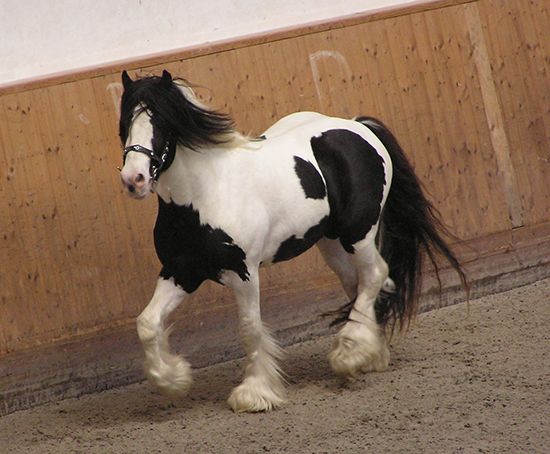
Pinto horses exhibit a variety of spotted coat patterns characterized by white patches combined with another color. The two primary patterns are defined by how the white markings are distributed across the animal’s body:
- Overo: In this pattern, white markings typically spread irregularly upward from the horse’s belly, mixing with a darker base color.1
- Tobiano: This pattern features white that spreads downward from the horse’s back, resulting in smooth, clean-cut, and well-defined patches.1
While these are the two most prominent classifications, the term “Pinto” is a broad descriptor for spotted horses and encompasses various other patterns and terminology, such as piebald, skewbald, and calico, which refer to subtle distinctions in color and marking types. Because Pinto is a classification based on appearance rather than breed, these patterns can be found across many different types of horses.13
Sources
- Pinto — Encyclopædia Britannica
- American paint horse — Merriam-Webster
- horse - Colour and pattern — Encyclopædia Britannica
- pinto — Merriam-Webster
- pinto — Merriam-Webster
- pinto — Merriam-Webster
Published on · 3 min read