Pittosporaceae
Pittosporaceae is a family comprising nine genera of trees, shrubs, and vinelike plants within the order Apiales. While some older classifications may…
What is Pittosporaceae?
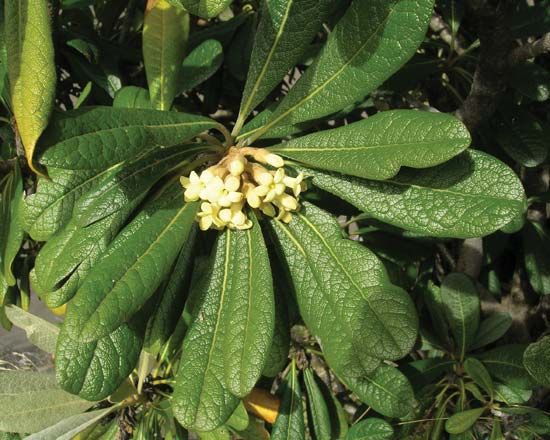
Pittosporaceae is a family comprising nine genera of trees, shrubs, and vinelike plants within the order Apiales. While some older classifications may associate them with other orders, they are primarily distributed from tropical Africa to the Pacific islands.1
These plants are characterized by long, leathery, evergreen leaves, resin-filled stem ducts, and flowers that appear in shades of white, blue, yellow, or red. Several species are valued for their ornamental qualities:1
- Pittosporum: Often called Australian laurel, this genus includes the popular aromatic hedge plant known as tobira or mock orange (P. tobira), as well as the karo (P. crassifolium), which is frequently used as a coastal windbreak.1
- Other Genera: The genera Hymenosporum, Bursaria, and Sollya also contain various ornamental species.1
What are some common characteristics of plants in the order Apiales?
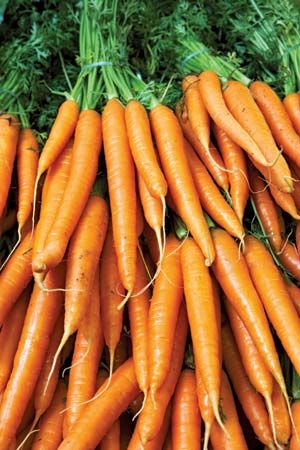
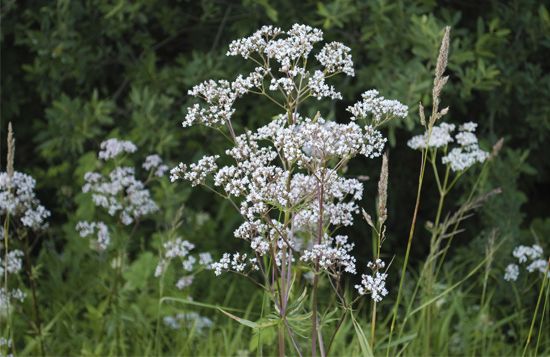
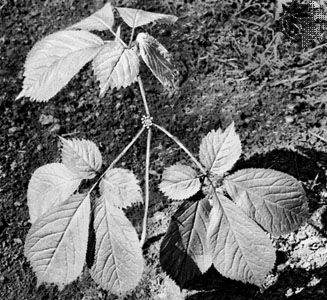
The order Apiales is a diverse group of flowering plants belonging to the core asterid clade. It contains seven families, the most prominent being Apiaceae (the carrot or parsley family), Araliaceae (the ginseng family), and Pittosporaceae.34
While the order encompasses a wide range of growth forms—including herbs, shrubs, trees, and lianas—several common characteristics and trends can be observed across its families:
- Floral Arrangement: Many members of the order, particularly in the Apiaceae and Araliaceae families, are noted for their flowers arranged in umbels (flat-topped or rounded clusters).3
- Chemical Profiles: Aromatic properties are common throughout the order. For example, Apiaceae members are often highly aromatic, while Pittosporaceae species are characterized by distinct odors produced by triterpenoid ethereal oils and specialized compounds like coumarins or polyacetylenes.3
- Leaf Structure: Many species feature alternate, compound, or cleft leaves. In Apiaceae, these leaves are typically sheathed at the base.3
- Diversity of Habitats: The order is distributed worldwide, ranging from tropical regions to the north temperate zone, with various families showing specific regional concentrations, such as the Old World focus of Pittosporaceae or the tropical distribution of Araliaceae.3
How do evergreen plants adapt to different climates?
Evergreen plants adapt to diverse climates primarily through specialized leaf structures that allow them to retain foliage year-round. Because cold conditions are often desiccating, evergreens in both cold-temperate and dry environments frequently exhibit xeromorphic traits—features designed to minimize water loss.56
These adaptations include:
- Protective Coatings: Leaves are often thicker and more leathery than those of deciduous plants, frequently covered by a heavy cuticle and epicuticular wax to prevent moisture loss.56
- Structural Reinforcement: Many evergreens possess hardened, fibrous tissue that provides stiffness and strength.56
- Gas Exchange Regulation: Stomates (openings for gas exchange) are often smaller, more closely spaced, and sometimes sunken below the leaf surface, occasionally protected by hairs or wax to further reduce evaporation.6
- Morphological Variation: In coniferous forests, leaves are typically needlelike or scalelike, which reduces the surface area exposed to the air, helping the plant conserve water and withstand harsh conditions.5
These structural strategies allow evergreens to maintain their leaves for two or more years, enabling them to thrive in environments ranging from tropical rain forests to cold-temperate regions.5
What is the role of resin in plant defense?
While the provided search results identify resin cells as specialized structures for secreting or storing resin, they do not explicitly detail the specific role of resin in plant defense.
However, plants utilize various chemical and physical barriers to protect themselves. For instance, lignin strengthens cell walls against microbial attack, while cutin and suberin act as protective, water-repelling barriers. Suberin, in particular, is synthesized near wound sites to seal surfaces and prevent dehydration, a process that mirrors the protective function often attributed to resin in sealing plant injuries.
Sorry, the Britannica knowledge base does not contain specific information regarding the role of resin in plant defense beyond its storage in specialized cells.
Sources
- Pittosporaceae — Encyclopædia Britannica
- Pittosporaceae — Merriam-Webster
- Apiales — Encyclopædia Britannica
- angiosperm - Annotated classification — Encyclopædia Britannica
- evergreen — Encyclopædia Britannica
- tree - Leaf adaptations — Encyclopædia Britannica
- Tundra - Plant life — Encyclopædia Britannica
- cell wall - Plastics — Encyclopædia Britannica
- resin cell — Merriam-Webster
Published on · 3 min read