Plain of Sharon
The Plain of Sharon is a section of the Mediterranean coastal plain in Israel and serves as its most densely settled natural region.
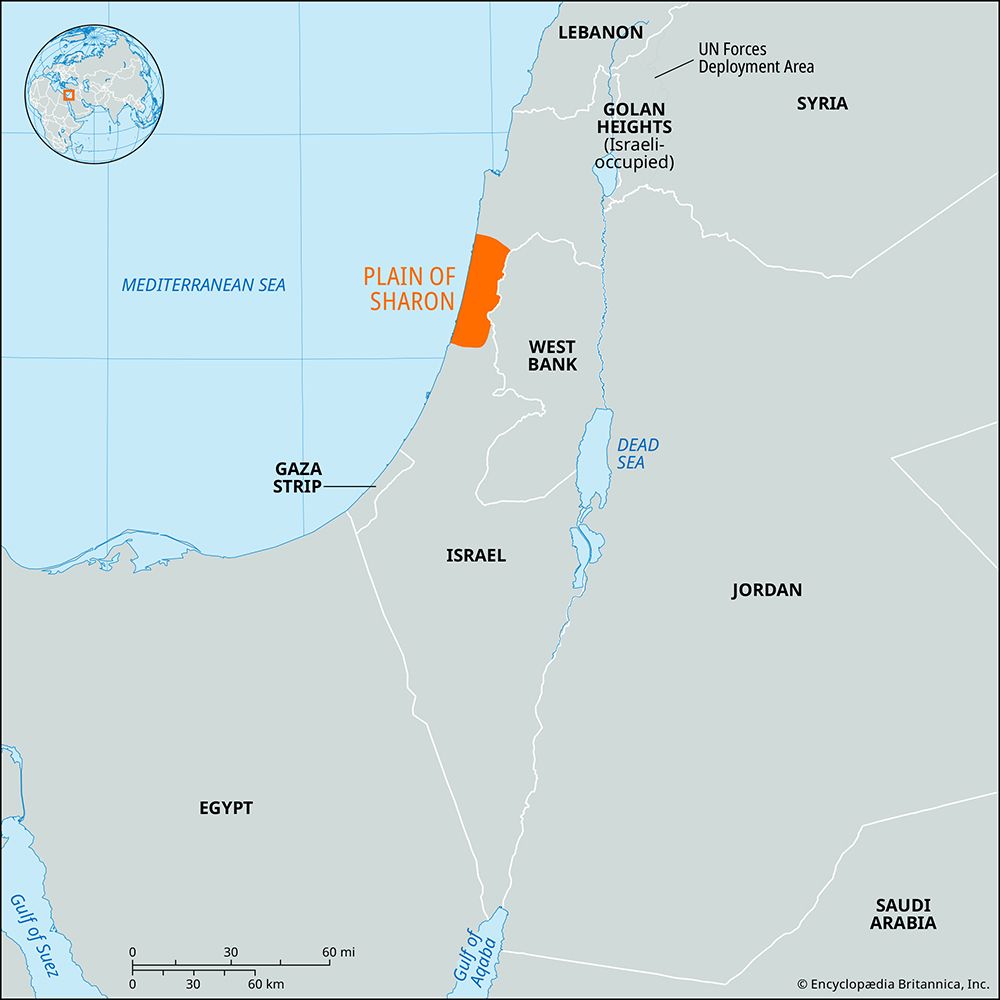
What is the geographical location and extent of the Plain of Sharon in Israel?
The Plain of Sharon is a section of the Mediterranean coastal plain in Israel and serves as its most densely settled natural region.1
Geographical Extent
The plain is roughly triangular in shape and spans approximately 55 miles (89 km) from north to south. It extends from the beach at Mount Carmel in the north to the Yarqon River at Tel Aviv–Yafo in the south. Its width is approximately 8 miles (13 km).12
Boundaries
- East: The plain is bounded by the Carmel range and the hill country of Samaria.1
- West: It is bordered by the Mediterranean coast, which is characterized by sand dunes and a lack of major indentations.1
While the definition above is standard, some biblical geographers and modern experts argue that the “Plain of Sharon proper” extends only as far north as the Tanninim River, designating the area between that river and Mount Carmel as the Plain of ’Atlit or the Plain of Dor.1
How does the Plain of Sharon’s climate and soil composition contribute to its agricultural productivity?
The agricultural productivity of the Plain of Sharon is primarily defined by its specific soil composition and the successful reclamation of its historical landscape.
Soil Composition
The region is characterized by red sandy soils known as hamra. These soils are particularly well-suited for the cultivation of citrus fruits, which became a cornerstone of the area’s agricultural economy following the first orchard planting in 1894. Beyond citrus, the land supports a variety of crops, including fodder, cotton, and vegetables, while viticulture is practiced in the northern sections of the plain.1
Climate and Land Management
Historically, the plain’s productivity was limited by its low relief, which caused numerous small streams and wadis to form swamps during the winter rainy season, leading to endemic malaria. Modern agricultural success was achieved through extensive land reclamation efforts that drained these marshes, transforming the area into a highly productive region. Today, the plain features fields and fruit groves interspersed between sandstone ridges, benefiting from a Mediterranean climate where precipitation is concentrated in the cooler months between October and April.12
What role did the Plain of Sharon play in ancient trade routes?
The Plain of Sharon served as a vital segment of the Via Maris, an ancient trade route that connected Egypt to the Fertile Crescent. Due to its strategic position, the region has been inhabited since remote antiquity and functioned as the primary land invasion route into Palestine from the south throughout history, with military movements recorded from the time of the Egyptian pharaoh Thutmose III through the campaigns of Napoleon in 1799 and the British under General Edmund Allenby during 1917–1918.1
The plain’s historical significance is further evidenced by its mention in various ancient texts, including the Old Testament and inscriptions from the 15th century BCE. Archaeological findings, such as house-urn burials near Hadera dating to the 4th millennium BCE, underscore its long-standing role as a crossroads for human settlement and commerce.1
How has urbanization affected the Plain of Sharon in recent decades?
In recent decades, the Plain of Sharon has undergone significant transformation, evolving into the most densely settled natural region in Israel. Since the country’s independence in 1948, the pace of industrialization and urbanization has accelerated rapidly, fundamentally altering the landscape that was once primarily defined by its agricultural output.
This shift is evidenced by the growth of major urban centers, including Netanya, Herzliyya, H̱adera, and Kefar Sava. While the region remains a hub for agricultural activity—with citrus farming, fodder, cotton, and vegetable production continuing alongside specialized poultry raising—the expansion of these cities has integrated the plain into a more modern, industrial, and service-oriented economy. Additionally, tourism has become an increasingly important component of the region’s economy, driven by the presence of significant historical sites such as the ancient ruins of Caesarea and Dor.1
Sources
- Plain of Sharon — Encyclopædia Britannica
- Palestine - Land — Encyclopædia Britannica
- Plain of Esdraelon — Encyclopædia Britannica
Published on · 3 min read