Platypus
The platypus is one of the few mammals capable of producing venom. This trait is an example of convergent evolution, meaning it developed independently in…
How do platypuses produce venom, and what is it used for?
The platypus is one of the few mammals capable of producing venom. This trait is an example of convergent evolution, meaning it developed independently in the platypus rather than being inherited from a venomous ancestor.1
Male platypuses possess a fanglike spur located on the inner side of each ankle. These spurs are connected to venom glands situated over the thighs.2
Regarding its function, the venom is primarily used for defense. It is potent enough to kill small animals and can cause intense pain in humans if the spur penetrates the skin. While the platypus’s venomous capabilities are often compared to those of venomous reptiles, the mechanism is unique to the species and serves as an adaptation for survival.21
How does the platypus’s reproductive system differ from other mammals?
The platypus belongs to the order Monotremata, a unique group of mammals that exhibit several reproductive characteristics distinct from placental mammals and marsupials.34
Key Reproductive Differences
- Egg-Laying (Oviparity): Unlike the vast majority of mammals that give birth to live young, the platypus is oviparous, meaning it lays small, leathery eggs. These eggs are telolecithal, containing a large amount of yolk similar to those of reptiles and birds.345
- The Cloaca: The name “Monotremata” translates to “one-holed,” referring to the cloaca—a single common chamber and outlet used for both reproduction and excretion. This structure is absent in placental mammals, which have separate openings for these functions.467
- Development: After hatching, young platypuses are altricial, meaning they are born in a relatively early stage of development and are entirely dependent on the parent. They suckle milk from specialized mammary hairs rather than from teats, as they lack the nipples found in other mammalian groups.53
- Evolutionary Retentions: The platypus retains primitive features, such as the use of an egg tooth and a caruncle to hatch, which are considered structural holdovers from a reptilian past.3
While these features are distinct, the platypus’s underlying ovarian cycle remains similar to that of other mammals.5
How has the platypus evolved over time, and what does this tell us about mammalian evolution?
The evolutionary history of the platypus provides profound insights into the origins of mammals. As a member of the order Monotremata, the platypus represents an ancient lineage that diverged from the ancestors of marsupials and placental mammals approximately 166 million years ago.1
Evolutionary Significance
The platypus is a prime example of mosaic evolution, possessing a unique blend of primitive, reptilian-like traits and specialized mammalian adaptations. Its existence helps scientists understand the transition from reptilian ancestors—specifically the therapsids—to modern mammals. Key primitive features retained by the platypus include:316
- Oviparity: The laying of leathery eggs, a trait inherited from reptilian ancestors.19
- Skeletal Structure: Archaic features such as the shoulder girdle that have been lost in other living mammals.3
- Physiology: A lower body temperature and the absence of teats, with milk instead being secreted through specialized mammary hairs.19
Adaptation and Convergence
While some features are ancestral, others demonstrate convergent evolution. For instance, the platypus’s venom and its highly sensitive electroreceptive bill are specialized adaptations that evolved independently to suit its specific ecological niche. The fossil record, including species like Steropodon galmani and Obdurodon, reveals that these monotremes were once more widespread across the supercontinent of Gondwana, confirming their long-standing presence in the evolutionary timeline.193
By studying the platypus, researchers gain a clearer picture of how mammalian characteristics—such as endothermy and complex reproductive strategies—emerged as a system of interrelated traits over millions of years.16
What are the platypus’s habitat preferences and geographic distribution?
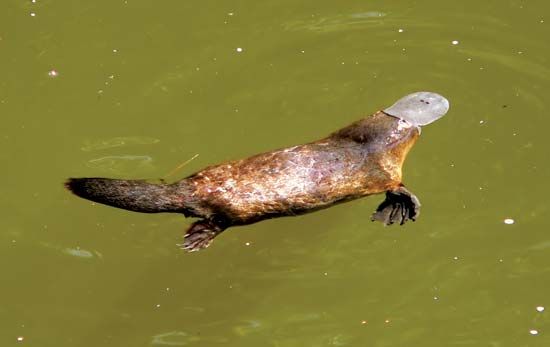
The platypus (Ornithorhynchus anatinus) is a semiaquatic mammal with a specialized habitat and a specific geographic range limited to eastern Australia.
Geographic Distribution
The platypus is found throughout the eastern states of Australia, including Tasmania. Its range extends across both eastward- and westward-flowing river systems, spanning diverse terrain from the high country of the Australian Alps to lowland areas near the coast. Notably, the species is absent from far northern Queensland and has not colonized the island of New Guinea, unlike its relatives, the echidnas.38
Habitat Preferences
As a semiaquatic creature, the platypus is strictly tied to freshwater environments, such as rivers, streams, and lakes. While it may occasionally be seen in salt water, it requires fresh water for its electromechanical navigation system to function during foraging.3
- Foraging: They spend much of their time hunting for invertebrates along the bottoms of these waterways.38
- Sheltering: During the day, they reside in burrows excavated into stream banks. These burrows provide protection and help remove excess moisture from the animal’s fur.3
Sources
- Why Is the Platypus a Mammal? — Encyclopædia Britannica
- What’s the Difference Between Venomous and Poisonous? — Encyclopædia Britannica
- platypus — Encyclopædia Britannica
- mammal - Estrus and other cycles — Encyclopædia Britannica
- mammal: Top Questions — Encyclopædia Britannica
- monotreme — Encyclopædia Britannica
- Cloaca — Encyclopædia Britannica
- What is a platypus’s closest living relative? — Encyclopædia Britannica
- mammal - Implantation, gestation, and birth — Encyclopædia Britannica
- mammal - The evolution of the mammalian condition — Encyclopædia Britannica
Published on · 4 min read