Echidna
Echidnas regulate their body temperature differently than most mammals due to their unusually low and variable baseline, which typically ranges from 29–32 °C…
How does the echidna’s body temperature regulation differ from other mammals?
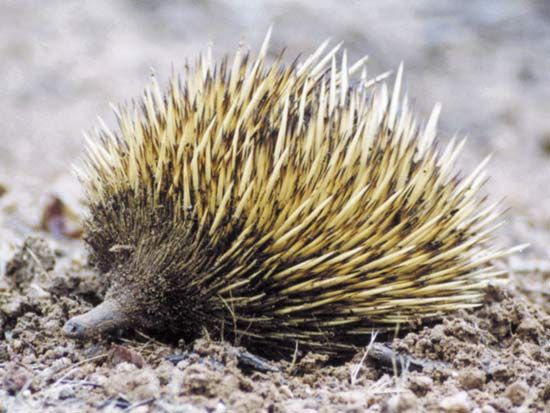
Echidnas regulate their body temperature differently than most mammals due to their unusually low and variable baseline, which typically ranges from 29–32 °C (84–90 °F). Because they possess few sweat glands and cannot pant to shed excess heat, they are highly susceptible to heat stress and must seek cool shelter in burrows or caves during extreme temperatures.1
To assist with thermoregulation, short-beaked echidnas have been observed blowing mucous bubbles from their beaks; as these bubbles burst, the resulting moisture on the beak evaporates, which helps cool the animal. When environmental temperatures drop too low, echidnas do not maintain a constant high body temperature like many other mammals; instead, they enter states of torpor or hibernation. These physiological traits, shared with their relative the platypus, reflect their status as monotremes, a unique order of egg-laying mammals.1
What role does the echidna’s beak play in its survival?
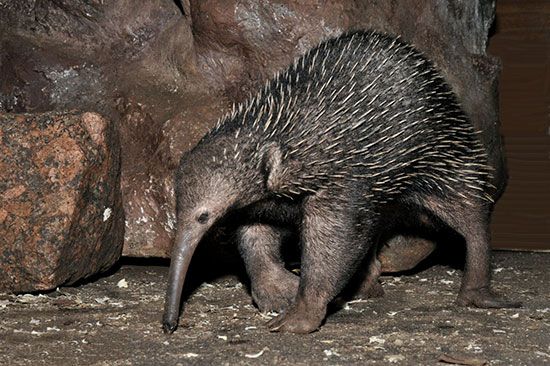
The echidna’s beak is a vital tool for its survival, serving several essential functions:
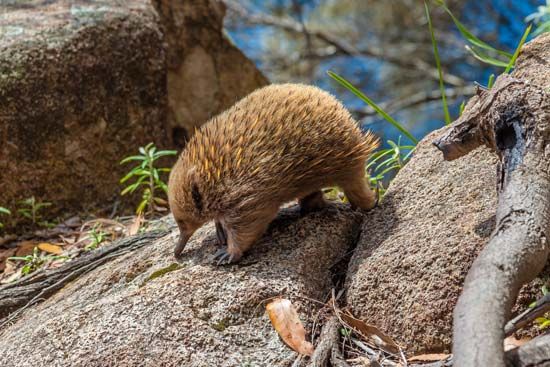
- Sensory Perception: The skin of the beak contains electroreceptors that allow the echidna to detect the faint electrical signals produced by the muscles of its invertebrate prey, such as ants and termites.2
- Foraging and Feeding: Echidnas use their beaks to probe through soil and leaf litter. While they primarily use a long, sticky tongue to catch prey, they can also use their beaks to break larger, soft-bodied prey into smaller, manageable pieces.2
- Thermoregulation: Because echidnas have few sweat glands and cannot pant, they use their beaks to help manage body heat. They blow mucous bubbles from the nares (nostrils) located on the beak; when these bubbles burst, the resulting moisture evaporates, which cools the animal.2
Beyond these roles, the beak serves as the primary site for breathing and eating, supporting the echidna’s specialized diet and lifestyle.2
How does the echidna’s unique egg-laying process work?
Echidnas are monotremes, a unique order of mammals that reproduce by laying eggs rather than giving birth to live young. Their reproductive process follows a specialized cycle:12
- Gestation and Laying: After a gestation period of approximately 23 days, the female typically lays a single leathery egg.1
- Incubation: The female deposits the egg into a temporary pouch formed by her abdominal muscles and subcutaneous mammary tissue. The egg is incubated within this pouch for about 10 days.1
- Hatching: The offspring hatches with the assistance of an egg tooth and a fleshy bulb known as a caruncle—features that are considered evolutionary holdovers from the creature’s reptilian ancestry.1
- Nursing: Once hatched, the young echidna resides in a special nursery burrow. Because echidnas lack teats and nipples, the mother exudes milk from specialized mammary hairs on her skin, which the offspring laps up.31
The young echidna remains in the burrow until it is fully covered in spines and fur and is capable of feeding independently, at which point it begins a solitary life.1
What are the different species of echidnas, and where are they found?
There are four recognized species of echidnas, which are categorized into two groups based on the length and shape of their beaks.21
Short-beaked Echidna
- Species: Tachyglossus aculeatus2
- Distribution: This species is widely distributed throughout Australia and is also found in New Guinea. It is considered one of Australia’s most common native mammals.2
Long-beaked Echidnas
The three species of the genus Zaglossus are found exclusively on the island of New Guinea. All three are currently threatened due to habitat loss and hunting.2
- Eastern long-beaked echidna (Z. bartoni): Classified as vulnerable, this species typically has five claws on its feet.2
- Western long-beaked echidna (Z. bruijnii): Classified as critically endangered, this species inhabits the Indonesian province of West Papua. It is generally larger than the eastern species and typically possesses three claws on its feet.2
- Sir David’s long-beaked echidna (Z. attenboroughi): Also classified as critically endangered, this species is found in a small area of highland forest in the Cyclops Mountains of Indonesia. It is the smallest of the long-beaked species and features a shorter, straighter beak.2
Sources
- Did you know? — Merriam-Webster
- echidna — Encyclopædia Britannica
- Animal reproductive system - Tracts — Encyclopædia Britannica
- What is a platypus’s closest living relative? — Encyclopædia Britannica
- Reproductive behaviour - Parental care — Encyclopædia Britannica
Published on · 3 min read