Monotreme
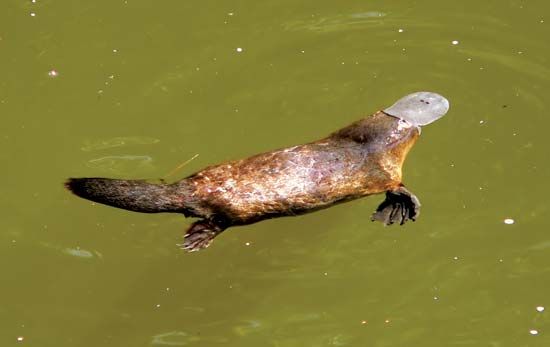
The platypus (Ornithorhynchus anatinus) is a unique venomous mammal. Male platypuses possess a fanglike spur on the inner side of each ankle, which is…
How do the venom glands in male platypuses function, and what is their purpose?
The platypus (Ornithorhynchus anatinus) is a unique venomous mammal. Male platypuses possess a fanglike spur on the inner side of each ankle, which is connected to a venom gland located over the thighs.12
The primary purpose of these glands and their associated spurs is defense. The venom is potent enough to kill small animals and can cause intense pain in humans if the spur penetrates the skin. Additionally, males use these spurs to fight one another during the breeding season, often inflicting wounds in the process.12
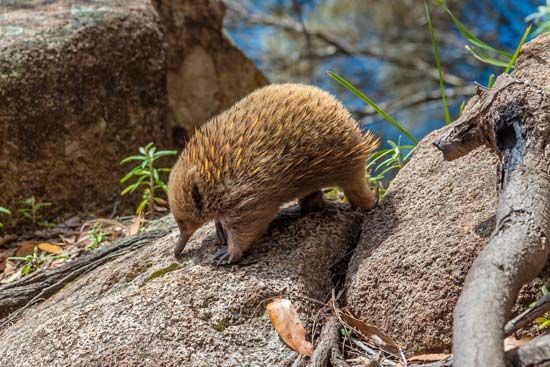
How do monotremes care for their young?
Monotremes—a group that includes the platypus and echidnas—are unique among mammals because they are oviparous, or egg-laying. Their care for their young involves several distinct stages:43
- Incubation: Female platypuses construct specialized nursery burrows to lay their small, leathery eggs. The female incubates these eggs by curling her body around them, often using her tail to hold them against her bill.5
- Development: Young monotremes hatch at an early stage of development and are considered altricial, meaning they are essentially helpless and dependent on the parent.6
- Nourishment: Despite lacking the specialized nipples found in other mammals, monotremes produce milk to feed their young. The hatchlings suckle milk from specialized mammary hairs on the mother’s body.57
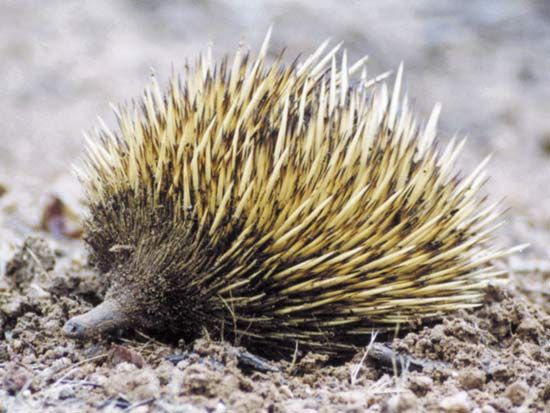
- Protection: In the case of echidnas, the mother develops a simple fold of skin known as a mammary pouch, or marsupium, during the breeding season to protect and carry the developing young. Platypus young remain protected within the nursery burrow for several months until they become independent.85
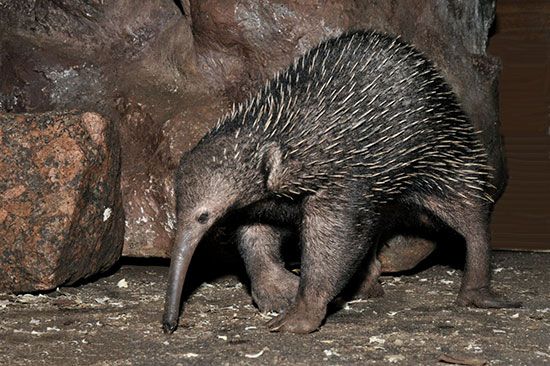
How have monotremes evolved and adapted over time?
Monotremes represent the most ancient living order of mammals, characterized by a unique evolutionary history defined by “mosaic evolution”—a combination of primitive, ancestral traits and highly specialized adaptations.6
Evolutionary Origins
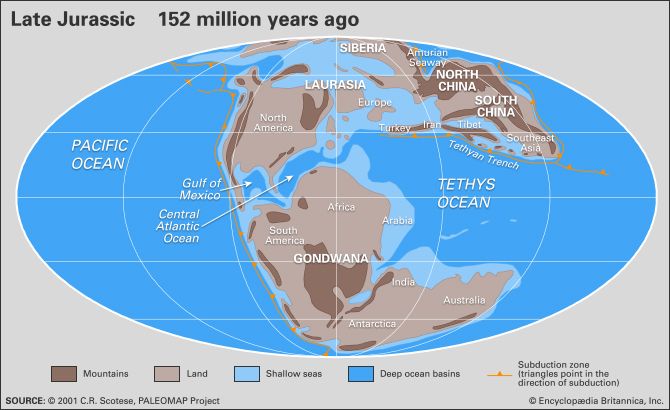
The fossil record indicates that monotremes originated at least as far back as the middle of the Jurassic Period (199.6 to 145.5 million years ago). They retain archaic skeletal features, such as a primitive shoulder girdle, which were lost in other mammalian lineages. During the Cretaceous Period, these animals were widespread across the ancient supercontinent of Gondwanaland, with fossils found in regions ranging from Australia to South America.64
Specialized Adaptations
While retaining primitive traits like egg-laying (oviparity), monotremes have evolved sophisticated adaptations to thrive in specific ecological niches:63
- Sensory Systems: Both platypuses and echidnas possess electroreceptors, allowing them to detect the electrical signals of prey.34
- Divergent Morphology: The platypus evolved into a semiaquatic carnivore with a bill for underwater foraging, while echidnas adapted as terrestrial insectivores with specialized beaks for consuming ants and termites.63
- Physiological Regulation: Despite their ancient lineage, platypuses demonstrate the ability to maintain a constant body temperature, debunking earlier theories that they lacked thermoregulation.4
Which species are classified as monotremes, and where are they found?
Monotremes are the only living egg-laying mammals, belonging to the order Monotremata. There are five extant species classified into two families:6
- Family Ornithorhynchidae: This family includes only one species, the platypus (Ornithorhynchus anatinus). It is found in the waterways of eastern Australia and Tasmania.69
- Family Tachyglossidae: This family comprises four species of echidnas, which are terrestrial insectivores. They are found across Australia, Tasmania, and the island of New Guinea.63
The echidna species include the short-beaked echidna (Tachyglossus aculeatus) and three species of long-beaked echidnas (Zaglossus): the eastern long-beaked echidna (Z. bartoni), the western long-beaked echidna (Z. bruijnii), and Sir David’s long-beaked echidna (Z. attenboroughi).3
Sources
- arachnid - Glands and toxins — Encyclopædia Britannica
- What’s the Difference Between Venomous and Poisonous? — Encyclopædia Britannica
- platypus — Encyclopædia Britannica
- What is a platypus’s closest living relative? — Encyclopædia Britannica
- mammal - Estrus and other cycles — Encyclopædia Britannica
- monotreme — Encyclopædia Britannica
- mammal - Implantation, gestation, and birth — Encyclopædia Britannica
- marsupium — Encyclopædia Britannica
- echidna — Encyclopædia Britannica
- monotreme — Merriam-Webster
- Australia - Animal life — Encyclopædia Britannica
Published on · 3 min read