Plesiosaur
Several significant plesiosaur fossils have shaped our understanding of these Mesozoic marine reptiles:
What are some of the most famous plesiosaur fossils ever discovered?
Several significant plesiosaur fossils have shaped our understanding of these Mesozoic marine reptiles:
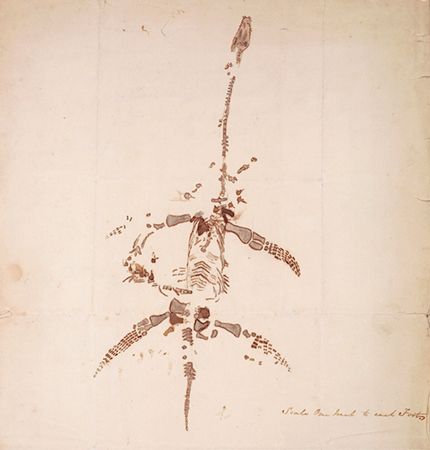
- Plesiosaurus: In 1824, the English fossil hunter Mary Anning discovered the first intact skeleton of this genus in Lyme Regis. This find was pivotal in establishing the scientific recognition of these creatures.1
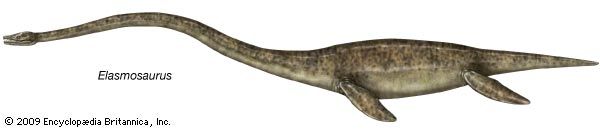
- Elasmosaurus: A notable long-necked plesiosaurid, this genus is famous for its extreme anatomy, possessing as many as 76 vertebrae in its neck alone and reaching lengths of approximately 13 metres (43 feet).2
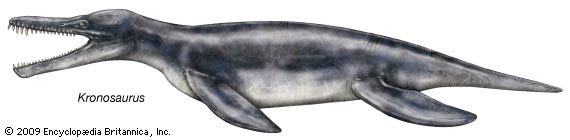
- Kronosaurus: A massive Early Cretaceous pliosaur, this predator reached lengths of 9–12 metres. Its skull alone could measure up to 3.7 metres long, highlighting the immense size these marine reptiles achieved.23
- Pliosaurus funkei: Colloquially known as “Predator X,” this Jurassic pliosaur was unearthed in Svalbard in 2009. Estimated at 15 metres long, it is believed to have possessed one of the most powerful bite forces of any known animal.23
Are there any modern animals that share similarities with plesiosaurs?
While no modern animals are direct descendants of plesiosaurs, paleontologists often compare their unique method of underwater locomotion to that of certain living marine animals.
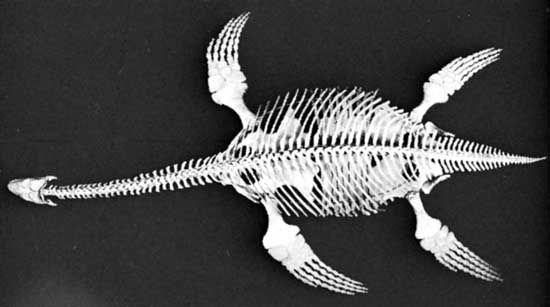
Plesiosaurs possessed a broad, stout torso and four long, narrow flippers. They moved through the water using a modified style of underwater “flight,” a technique that is functionally similar to how modern penguins and sea lions propel themselves today.72
Beyond this shared mechanical approach to swimming, there are no close biological relatives among living species. Plesiosaurs were a distinct group of sauropterygian reptiles that went extinct at the end of the Cretaceous Period approximately 66 million years ago. While some ancient creatures, such as certain placodonts, exhibited physical traits like shells that might superficially resemble those of modern turtles, these similarities are generally attributed to convergent evolution rather than a close evolutionary relationship.72
How are plesiosaurs classified within the broader group of marine reptiles?
Plesiosaurs are classified as a group of marine reptiles belonging to the clade Plesiosauria. Within the broader evolutionary framework of the Mesozoic Era, they are categorized as members of the sauropterygian group.742
Sauropterygians were a diverse assemblage of aquatic reptiles that appeared in the Early Triassic Period and persisted until the end of the Cretaceous Period. Within this lineage, plesiosaurs are distinguished by their broad, stout trunks, short tails, and four long, narrow flippers used for underwater “flight”.427
Early in their evolutionary history, the group diverged into two primary lineages:7
- Plesiosauroids (suborder Plesiosauroidea): Characterized by relatively small heads and elongated, flexible, snakelike necks.7
- Pliosaurs (suborder Pliosauroidea): Distinguished by their relatively shorter necks and significantly larger, elongated skulls.47
While they share the sauropterygian classification with other ancient marine forms, plesiosaurs represent a highly specialized evolutionary branch with no modern-day analogs.2
What are the key physical characteristics of plesiosaurs?
Plesiosaurs were highly specialized marine reptiles characterized by several distinct physical features that enabled their aquatic lifestyle:
- Body Structure: They possessed a broad, stout torso. The ventral bones of their shoulder and pelvic girdles were greatly expanded to anchor powerful limb muscles, while their ventral ribs (gastralia) formed an interlocking “basket,” making the torso relatively inflexible.7
- Locomotion: They featured four long, narrow flippers with numerous joints for flexibility. They moved through the water using a modified style of underwater “flight,” similar to modern penguins or sea lions.72
- Neck and Head: Plesiosaurs generally had short tails and elongated necks. The group diverged into two main forms: plesiosauroids, which had small heads and long, flexible, snakelike necks, and pliosaurs, which had relatively short necks and massive, elongated skulls.72
- Feeding: Their jaws were lined with many pointed teeth, ideal for seizing fish7.2
- Buoyancy: They are known to have swallowed stones of various sizes, likely to help decrease buoyancy.7
Sources
- Mary Anning — Encyclopædia Britannica
- plesiosaur — Encyclopædia Britannica
- pliosaur — Encyclopædia Britannica
- reptile - Fossil distribution — Encyclopædia Britannica
- plesiosaurus — Merriam-Webster
- Cretaceous Period - Marine life — Encyclopædia Britannica
- sauropterygian — Encyclopædia Britannica
- fish - Placodermi: plate-skin fishes — Encyclopædia Britannica
- turtle - Origin and evolution — Encyclopædia Britannica
Published on · 3 min read