Pliosaur
Pliosaurs, ichthyosaurs, and plesiosaurs were distinct groups of Mesozoic Era marine reptiles with unique evolutionary adaptations.
How do pliosaurs differ from other marine reptiles of their time, such as ichthyosaurs and plesiosaurs?
Pliosaurs, ichthyosaurs, and plesiosaurs were distinct groups of Mesozoic Era marine reptiles with unique evolutionary adaptations.12
Pliosaurs vs. Plesiosaurs
Pliosaurs and plesiosaurs both belong to the clade Plesiosauria. They are distinguished primarily by their body proportions:
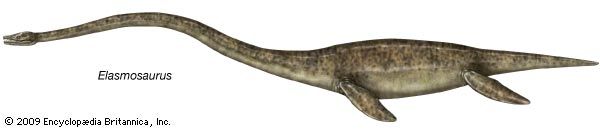
- Plesiosaurs (Plesiosauroidea): Characterized by relatively small heads and exceptionally long, flexible necks.31
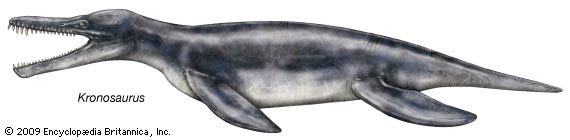
- Pliosaurs (Pliosauroidea): A lineage of plesiosaurs that evolved shorter necks and elongated, massive skulls. They were apex predators, with some species, such as Pliosaurus funkei, estimated to have possessed one of the largest bite forces of any known animal.31
Pliosaurs vs. Ichthyosaurs
Ichthyosaurs differed significantly from pliosaurs in both form and locomotion:
- Body Shape: Ichthyosaurs were highly streamlined and fishlike, often resembling modern porpoises, with no distinct neck. In contrast, pliosaurs maintained the broader, flatter body plan typical of sauropterygians.431
- Locomotion: Ichthyosaurs propelled themselves using a well-developed, fishlike tail and body undulation. Pliosaurs and other plesiosaurs “flew” through the water using four paddle-like flippers.431
- Specialization: Ichthyosaurs were specialized for high-speed pursuit, whereas pliosaurs were often ambush predators that relied on immense jaw strength to capture prey, including other marine reptiles.4
How have pliosaur fossils contributed to our understanding of prehistoric marine life?
Pliosaur fossils have significantly advanced our understanding of Mesozoic Era marine ecosystems by revealing the existence of apex predators with extreme physical specializations. These fossils demonstrate that pliosaurs occupied a distinct ecological niche compared to their long-necked plesiosaur relatives, utilizing massive, elongated skulls and powerful jaws to dominate their environments.15
Key insights gained from these discoveries include:
- Extreme Predatory Capability: Analysis of specimens like Pliosaurus funkei indicates that some pliosaurs possessed a bite force of approximately 33,000 psi, potentially the highest of any known animal, highlighting their role as top-tier hunters.15
- Evolutionary Diversity: Fossils such as those of Kronosaurus and Liopleurodon provide evidence of significant size variation and taxonomic complexity, prompting ongoing scientific debate regarding the classification and growth limits of these marine reptiles.15
- Global Distribution: The discovery of remains in diverse locations, including Australia, Colombia, and Svalbard, confirms that pliosaurs were widely distributed across ancient seas.15
Are there any modern animals that share similarities with pliosaurs?
While no modern animal is a direct descendant or a biological equivalent to the pliosaur, some contemporary marine animals share certain functional similarities in how they move or occupy ecological niches.
Locomotion
Pliosaurs and other members of the order Plesiosauria propelled themselves through the water using four large, paddle-like flippers. This method of underwater “flight” is functionally similar to the swimming style of modern sea lions and penguins, which also use their limbs to generate thrust in a sweeping, wing-like motion rather than relying on the lateral tail undulation seen in fish or ichthyosaurs.52
Ecological Role
In terms of their role as apex predators, pliosaurs occupied a position in Mesozoic Era marine ecosystems comparable to that of modern top-tier carnivores like the killer whale or the extinct megalodon. Like these modern predators, pliosaurs were large-bodied carnivores that sat at the top of the food chain, preying on a variety of marine life. However, pliosaurs were distinct in their specific anatomical adaptations, such as their massive, elongated skulls and immense bite forces, which allowed them to dominate their environments in ways unique to their lineage.162
What were some of the largest known pliosaur species, and how big did they get?
Several pliosaur species reached impressive sizes, establishing them as some of the most formidable predators in Mesozoic seas. Because many fossils are incomplete or vary in quality, size estimates for these marine reptiles are often subject to scientific debate and reclassification.58
Notable large pliosaur species include:
- Predator X (Pliosaurus funkei): Unearthed in Svalbard, this Jurassic-era predator is estimated to have reached lengths of 15 metres (about 50 feet) and weighed approximately 45 tonnes. It is renowned for having a bite force of 33,000 pounds per square inch, potentially the highest of any known animal.58
- Kronosaurus: An Early Cretaceous pliosaur found in Australia and Colombia, this genus reached lengths of approximately 9 to 12 metres (about 30 to 40 feet). Its massive skull alone could measure between 2.2 and 3.7 metres (7.2 to 12.1 feet) in length.58
- Liopleurodon: Found in Middle Jurassic deposits, this genus has been the subject of significant taxonomic uncertainty. While some specimens have been estimated at lengths ranging from 5 to 25 metres (16 to 85 feet), many experts question these figures and suggest that such fossils may belong to different genera.5
- Unnamed Southern England Specimen: A massive skull measuring 2.4 metres (7.8 feet) found off the coast of southern England suggests the existence of a pliosaur that may have reached between 10 and 16 metres (33 to 53 feet) in total length.5
Sources
- plesiosaur — Encyclopædia Britannica
- sauropterygian — Encyclopædia Britannica
- reptile - Fossil distribution — Encyclopædia Britannica
- ichthyosaur — Encyclopædia Britannica
- pliosaur — Encyclopædia Britannica
- megalodon - Predators and prey — Encyclopædia Britannica
- reptile - Swimming — Encyclopædia Britannica
- Triassic Period - Fishes and marine reptiles — Encyclopædia Britannica
Published on · 4 min read