Plume Moth
While plume moths (family Pterophoridae) are known for their distinct, lobed wings and larval habits—which include leaf mining, stem boring, and leaf…
Are there any plume moth species that are considered pests to agriculture?
While plume moths (family Pterophoridae) are known for their distinct, lobed wings and larval habits—which include leaf mining, stem boring, and leaf rolling—the provided search results do not identify any specific species within this family as significant agricultural pests.
It is important to distinguish these from other moths often associated with agricultural damage, such as the bollworm (family Gelechiidae or Noctuidae) or the Indian-meal moth, which are well-documented threats to various commercial crops and stored products. While plume moth larvae do interact with plants, the available data does not categorize them as agricultural pests.
How does the wingspan of plume moths compare to other moth species?
Plume moths (family Pterophoridae) are generally small, with wingspans ranging from 6 to 50 mm (0.25 to 2 inches). Compared to the broader diversity of the order Lepidoptera, this size range is relatively modest.1
Many other moth families exhibit significantly larger dimensions. For instance:
- Noctuidae (owlet moths): Species in this family can reach wingspans of up to 275 mm (10.8 inches).4
- Saturniidae (giant silkworm moths): This family includes some of the largest moths, such as the hercules moth (Coscinoscera hercules), which also reaches wingspans up to 275 mm (10.8 inches).4
- Cossidae (carpenter moths): These are among the heaviest lepidopterans, with wingspans reaching up to 25 cm (10 inches).4
In contrast, plume moths are characterized by their delicate, slender bodies and unique wing structure, where the wings are deeply cleft into two or three narrow plumes. While they are small, they occupy a distinct niche compared to the larger, more robust species found in other superfamilies.15
How do plume moths differ from other moth groups in terms of their flight behavior?
Plume moths (family Pterophoridae) are distinguished from many other moth groups primarily by their limited flight capabilities. While many moths are robust fliers capable of complex aerial maneuvers, plume moths are characterized as weak fliers.1
This difference in flight behavior is closely linked to their unique morphology. Unlike the broad, solid wings found in many other lepidopterans, the wings of a plume moth are deeply cleft into two or three narrow, plume-like lobes. While these structures are highly specialized, they do not provide the same aerodynamic efficiency as the more conventional wing shapes found in other moth families.14
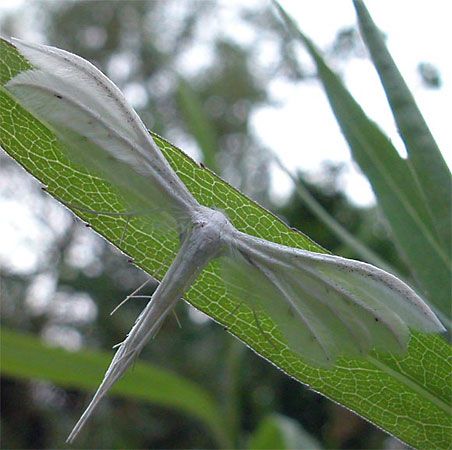
Furthermore, while many moths have evolved sophisticated flight-related behaviors—such as the ability to detect and initiate evasive maneuvers in response to the echolocation signals of hunting bats—plume moths rely on different strategies for survival. During the day, rather than remaining active or relying on rapid flight to escape predators, they typically rest on plants with their wings stretched out and rolled into a rod-like shape, which helps them blend into their environment.41
How did plume moths get their name, and what does it refer to?
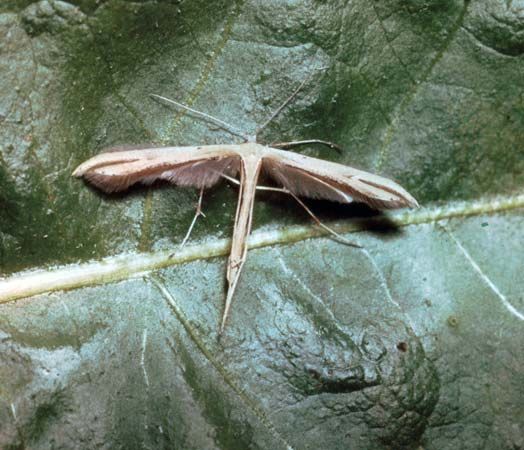
Plume moths (family Pterophoridae) derive their common name from the distinctive structure of their wings, which are deeply divided into narrow, lobe-like sections that resemble plumes.1
These clefts typically extend for about half the length of the wing. In most species, the forewings are divided into two such plumes, while the hindwings are divided into three. This unique morphology distinguishes them from other groups, such as the many-plumed moths (family Alucitidae), which feature wings cleft nearly to the base into six distinct plumes.14
Sources
- plume moth — Encyclopædia Britannica
- Bollworm — Encyclopædia Britannica
- Agricultural technology - Mechanical and cultural controls — Encyclopædia Britannica
- Lepidoptera - Thorax — Encyclopædia Britannica
- Lepidoptera - Annotated classification — Encyclopædia Britannica
- Pterophoridae — Merriam-Webster
- pterophorid — Merriam-Webster
Published on · 3 min read