Saturniid Moth
The life cycle of a saturniid moth follows the four-stage process of metamorphosis common to Lepidopteran species: egg, larva, pupa, and adult.
What is the life cycle of a saturniid moth?
The life cycle of a saturniid moth follows the four-stage process of metamorphosis common to Lepidopteran species: egg, larva, pupa, and adult.12
- Egg: The cycle begins when eggs are laid on the leaves of a host tree, which serves as the primary food source for the developing insect.2
- Larva: Upon hatching, the caterpillar consumes foliage to build up the fat stores necessary for its transformation. These larvae are often large and may feature defensive spines, knots, or irritant barbs.12
- Pupa: Once fully grown, the larva spins a silken cocoon to protect itself during its transition into an adult. While many species spin these cocoons within leaves or on trees, some species pupate in the ground.12
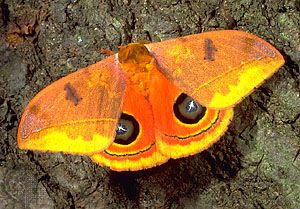
- Adult: Emerging adults possess stout, hairy bodies and often exhibit vivid wing patterns with eyespots. Because they have reduced or vestigial mouthparts, most adults do not feed and live only a week or two, relying on stored larval fat to survive while they locate mates using pheromones.12
What are the defining characteristics of saturniid moths?
Saturniid moths, belonging to the family Saturniidae, are a widely distributed group of approximately 3,400 species that include some of the largest and most visually striking Lepidopterans on Earth.13
Physical Characteristics
- Adults: These moths are characterized by stout, hairy bodies and broad, often vividly colored wings. A defining feature for many species is the presence of a central eyespot on each wing, which is thought to serve a protective function by startling predators.13
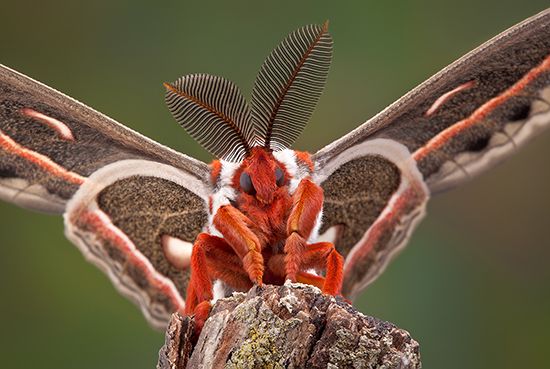
- Antennae: Males possess large, feathery (bipectinate) antennae, which are highly sensitive organs used to detect the pheromones of distant females.13
- Mouthparts: Adults typically have reduced or vestigial mouthparts, meaning many species do not feed at all during their short adult lives, which may last only a week or two.1
- Larvae: The caterpillars are generally large and fleshy, often featuring colorful knobs, spines, or irritant barbs for defense.14
Life Cycle and Behavior
Saturniids undergo complete metamorphosis. Most species spin firm, silken cocoons to protect themselves during the pupal stage, though some pupate in the ground. Their cocoons are sometimes harvested for commercial silk production.143
What are some notable species of saturniid moths?
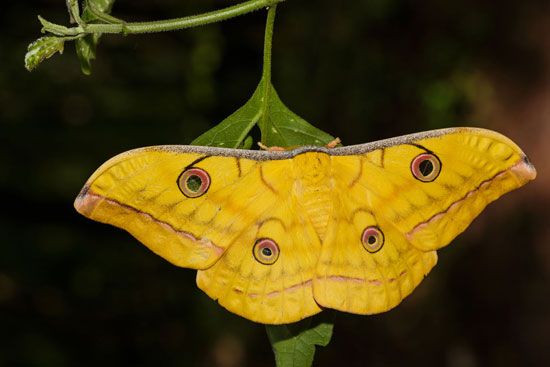
The family Saturniidae includes approximately 3,400 species of moths, many of which are noted for their impressive size, vivid wing patterns, and silk production. Notable species include:1
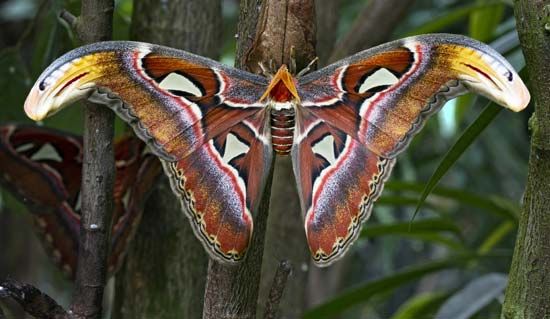
- Atlas moth (Attacus atlas): Native to Southeast Asian rainforests, it is one of the world’s largest moths, with a wingspan often exceeding 25 cm (10 inches). Its wingtips resemble a snake’s head to deter predators.17
- Cecropia moth (Hyalophora cecropia): The largest moth native to North America, reaching a 15 cm (6 inch) wingspan. It is recognized by its brown wings with white, red, and gray markings and crescent-shaped eyespots.12
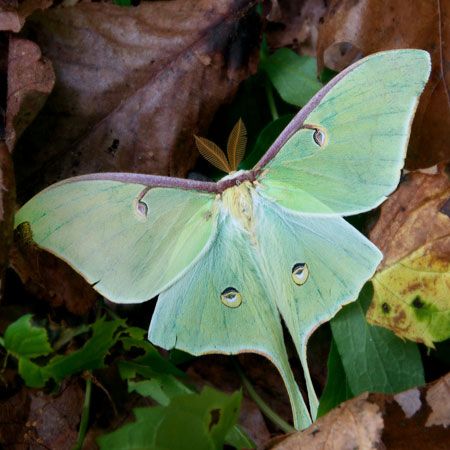
- Luna moth (Actias luna): A showy North American species known for its pale green wings, thin brown borders, and long, tail-like projections on the hindwings.18
- Polyphemus moth (Antheraea polyphemus): A common species whose larvae feed on oak, maple, and birch. It is also a source of commercial silk.1
- Hercules moth (Coscinocera hercules): Found in tropical Australia, it possesses a massive wing surface area and a wingspan of about 28 cm (11 inches).1
- Io moth (Automeris io): Notable for its bright green, stinging caterpillars and the large, dark eyespots on the hindwings of the adults.1
How do saturniid moths differ from other moth families?
Saturniid moths (family Saturniidae) are distinguished from other moth families by several unique biological and physical traits:
- Vestigial Mouthparts: Unlike many other moths that feed as adults, adult saturniids possess reduced or vestigial mouthparts and typically do not feed at all, relying entirely on fat stores accumulated during their larval stage to survive their short adult lives.14
- Antennae Structure: Males are characterized by large, feathery (bipectinate) antennae, which are highly specialized for detecting the pheromones of females from great distances.134
- Size and Appearance: This family includes some of the largest and most showy Lepidopterans on Earth. They are known for their stout, hairy bodies and broad wings, which frequently feature prominent central eyespots used to startle predators.12
- Larval Defense: Their larvae are typically large and fleshy, often adorned with colorful knobs, spines, or irritant barbs for protection.12
- Silk Production: Many species are notable for spinning firm, silken cocoons, which are sometimes harvested for commercial silk production, distinguishing them from families like the Geometridae, which typically pupate in the soil without a cocoon.12
Sources
- saturniid moth — Encyclopædia Britannica
- atlas moth — Encyclopædia Britannica
- Saturniidae — Merriam-Webster
- Lepidoptera - Annotated classification — Encyclopædia Britannica
- Chemoreception - Sex-attractant pheromones — Encyclopædia Britannica
- pheromone — Encyclopædia Britannica
- luna moth — Encyclopædia Britannica
- cecropia moth — Merriam-Webster
Published on · 4 min read