Pocket Gopher
There are 38 recognized species of pocket gophers, which are classified into five distinct genera. These rodents are primarily found in North and Central…
How many species of pocket gophers exist, and how do they differ across regions?
There are 38 recognized species of pocket gophers, which are classified into five distinct genera. These rodents are primarily found in North and Central America, with a range extending from southern Canada and the United States down to northwestern Colombia.
The species are categorized by their regional and physical characteristics:
- Genus Orthogeomys (Giant pocket gophers): Includes 11 species found in Central and South America.
- Genus Thomomys (Western pocket gophers): Comprises 9 species typically found in western regions.
- Genus Pappogeomys (Mexican pocket gophers): Consists of 9 species native to Mexico.
- Genus Geomys (Eastern pocket gophers): Includes 8 species generally associated with eastern territories.
- Genus Zygogeomys (Michoacan pocket gopher): A single species located in the Michoacan region.
While they vary in coat color—ranging from white to yellow, brown, or black—all species share specialized adaptations like fur-lined cheek pouches and powerful claws for excavating soil. They inhabit diverse environments, from tropical lowlands to high-altitude mountain meadows.
What are the distinguishing physical characteristics of pocket gophers?
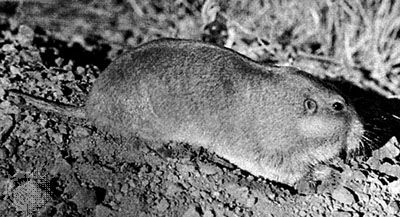
Pocket gophers (family Geomyidae) are characterized by a thickset, cylindrical body ranging from 12 to 35 cm (4.7 to 13.8 inches) in length. Their physical structure is highly specialized for a fossorial (burrowing) lifestyle:1
- Cheek Pouches: They are named for their large, fur-lined external cheek pouches that extend from the face to the shoulders. These pouches can be everted for cleaning and are used to transport food.1
- Head and Teeth: They have small eyes and ears, and a short neck. Their lips can close behind their protruding, chisel-like upper front teeth, which allows them to excavate soil without ingesting it.1
- Limbs and Claws: They possess short legs, with the five front digits on each muscular foreleg bearing long, powerful claws adapted for digging. Their forelegs show significant modification for this purpose, often utilizing a breaststroke motion to move earth.12
- Tail: The tail is short and sparsely haired; it is highly sensitive and well-supplied with nerves and blood vessels, allowing the gopher to navigate backward through tunnels with speed.1
- Coat: Fur color varies widely among species, ranging from almost white to yellow, brown, or black.1
How did pocket gophers get their name, and what unique adaptations do they have for their lifestyle?
Pocket gophers (family Geomyidae) are named for the large, fur-lined cheek pouches that open externally on each side of their mouth. These “pockets” extend from the face to the shoulders and can be everted for cleaning, serving as a vital tool for transporting food.1
These rodents possess several unique adaptations for their fossorial (burrowing) lifestyle:
- Excavation: They dig using powerful claws on their front digits. Their lips can close behind their protruding, chisel-like upper front teeth, allowing them to cut roots and loosen soil without ingesting it.1
- Navigation: Their short, sparsely haired tails are highly sensitive. When moving backward through tunnels, they arch the tail to touch the tunnel wall, enabling them to navigate in reverse nearly as quickly as they move forward.1
- Survival: They do not hibernate, relying instead on food stored in deep, extensive burrows to survive the winter.1
How do pocket gophers’ burrowing habits affect ecosystems and agriculture?
Pocket gophers significantly influence their environments through their extensive burrowing activities. While the provided information does not explicitly detail the agricultural impact, it notes that these rodents excavate long, winding tunnels to forage for roots and tubers, and construct deep, extensive chambers for nesting and food storage marked by conspicuous mounds of earth.1
These habits have several ecological implications:
- Soil Aeration: By constantly digging and moving earth to create their tunnel systems, gophers contribute to the aeration and turnover of soil.1
- Foraging Behavior: Their reliance on roots, tubers, and succulent herbs means they actively interact with the vegetation in their habitats, which range from grasslands and meadows to coniferous forests.1
- Agricultural Interaction: Because they feed on roots and tubers and create mounds that disrupt the surface, they are often considered pests in agricultural settings, though the specific economic impact is not detailed in the provided text.1
Sources
- pocket gopher — Encyclopædia Britannica
- Locomotion - Fossorial vertebrates — Encyclopædia Britannica
- gopher — Merriam-Webster
Published on · 3 min read