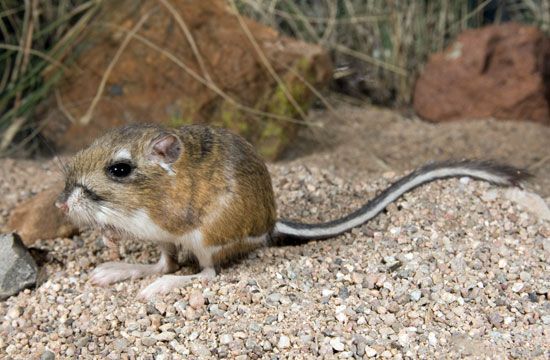
Pocket Mouse
Pocket mice are nocturnal, burrowing rodents belonging to the family Heteromyidae. They are primarily found in the following regions and habitats:
Where are pocket mice typically found in the wild?
Pocket mice are nocturnal, burrowing rodents belonging to the family Heteromyidae. They are primarily found in the following regions and habitats:
- Western North America: Silky and coarse-haired pocket mice inhabit open desert country, ranging from western Canada and the United States into southern Mexico.12
- Mexico to Central America: Spiny pocket mice are found in extreme southern Texas and throughout Mexico southward to Panama, typically in semiarid brushy and rocky environments.2
- Southern Mexico to South America: Forest spiny pocket mice have a broader range, extending from southern Mexico into northern South America. They occupy diverse elevations, living from sea level up into mountainous regions.2
These rodents are well-adapted to their environments, often storing seeds in their fur-lined cheek pouches to survive in arid or semiarid conditions.2
What role do pocket mice play in their ecosystem?
Pocket mice play a significant role in their ecosystems primarily as seed consumers and hoarders. By foraging for seeds, nuts, and succulent plant parts, they help manage plant distribution within their habitats. These rodents utilize their fur-lined external cheek pouches to transport food back to their burrows, where they create caches. This hoarding behavior is a key aspect of their natural history, as it allows them to survive in arid or semiarid environments where food availability may fluctuate.4
Additionally, pocket mice serve as a food source for various predators within their respective desert, brushy, and rocky environments. As members of the family Heteromyidae, they are well-adapted to nocturnal life, which helps them avoid certain daytime threats while they maintain their burrows. By living in these underground structures, they also contribute to soil aeration in the regions they inhabit, ranging from North America to South America.4
What are the defining characteristics of pocket mice?
Pocket mice are a diverse group of 36 species of rodents belonging to the family Heteromyidae. While they are often compared to “true” mice (family Muridae), they possess distinct evolutionary and physical traits.154
Key Characteristics
- Cheek Pouches: Their most defining feature is the presence of fur-lined external cheek pouches that open alongside the mouth. These are used to transport seeds and other food items back to their burrows for storage.64
- Locomotion: Unlike their relatives the kangaroo mice and kangaroo rats, which are bipedal hoppers, pocket mice travel on all four limbs along the ground.4
- Behavior: They are nocturnal and generally solitary animals. Most remain active throughout the year, though some may become torpid during extreme temperatures rather than entering true hibernation.4
- Physical Diversity: They range from the very small, soft-furred silky pocket mice to the larger, bristly-haired forest spiny pocket mice. Depending on the species, their tails may be hairy or scantily haired, and their size varies significantly from 5 to 85 grams.4
What is the significance of the cheek pouches in pocket mice?
The significance of the cheek pouches in pocket mice lies in their role as a specialized tool for survival and resource management. These fur-lined, external pouches open alongside the mouth and serve as a dedicated transport system for foraging.1
By using these pouches to carry food—primarily seeds, but also nuts and succulent plant parts—pocket mice can efficiently gather resources while minimizing their exposure to predators in open environments. Once the pouches are filled, the rodents transport the collected food back to their burrows to create caches. This hoarding behavior is essential for their survival, as it provides a reliable food supply in the arid and semiarid habitats where they live, allowing them to sustain themselves during periods when fresh food is scarce.1
Sources
- pocket mouse — Merriam-Webster
- pocket mouse — Encyclopædia Britannica
- sand pocket mouse — Merriam-Webster
- kangaroo mouse — Encyclopædia Britannica
- Heteromyidae — Merriam-Webster
- kangaroo rat — Encyclopædia Britannica
- pocket rat — Merriam-Webster
- cheek pouch — Merriam-Webster
Published on · 3 min read