Podostemaceae
The Podostemaceae family, or riverweeds, presents a significant challenge to traditional classification because their bodies are highly modified for life in…
How do scientists study and classify Podostemaceae plants given their unique habitat?
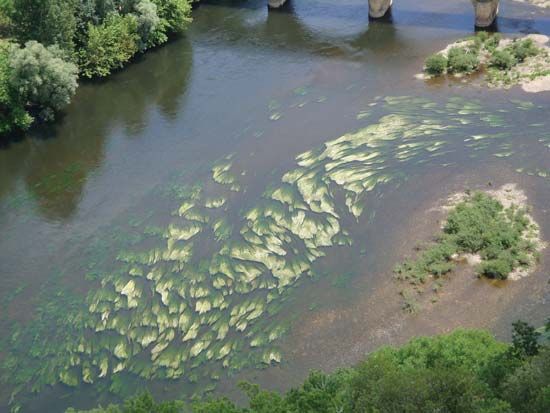
The Podostemaceae family, or riverweeds, presents a significant challenge to traditional classification because their bodies are highly modified for life in fast-flowing water. These plants often lack standard stems and leaves, instead utilizing a ribbonlike thallus to anchor themselves to rocks via holdfasts or haptera. Because their morphology is so distinct—often resembling algae, mosses, or lichens—botanists cannot rely on conventional botanical terminology to describe them.12
To overcome these difficulties, scientists utilize molecular data to determine their evolutionary relationships. Modern DNA analysis has been crucial in clarifying their position within the order Malpighiales, revealing a surprisingly close association with the Clusiaceae family and Hypericaceae4. Researchers also examine shared anatomical and chemical traits, such as the presence of xanthones and specific secretory cells, to group these species despite their extreme physical adaptations.3
What are some of the most well-known or studied species within the Podostemaceae family?
The Podostemaceae family comprises approximately 48 genera and 270 species of aquatic plants. Because these plants are highly adapted to life on rocks in rushing rivers and waterfalls, they often lack traditional stems and leaves, making them difficult to classify using standard botanical terminology.21
Some of the most notable genera, categorized by their species diversity and geographic distribution, include:
- Apinagia: The largest genus in the family, containing about 50 species primarily found in tropical South America.21
- Ledermanniella: Comprises 43 species distributed across tropical Africa and Madagascar.2
- Rhyncholacis: Includes 25 species native to northern tropical South America.2
- Marathrum: Consists of 25 species found throughout Central America and northwestern tropical South America.2
- Podostemum: A widespread genus with 17 species found in tropics and subtropics worldwide. This includes the riverweed (Podostemum ceratophyllum), which is notable for its presence in North America, ranging from Quebec to Arkansas.2
- Dicraea: Contains 12 species located in the tropics of Asia and Africa.2
- Hydrobryum: Includes 10 species found in regions such as eastern Nepal, Assam, and southern Japan.2
How many genera and species are included in the Podostemaceae family?
The Podostemaceae family, commonly known as the riverweed family, consists of approximately 48 genera and 270 species of aquatic herbs.12
These plants are primarily found in tropical and subtropical regions, where they have evolved to thrive on rocks in fast-flowing water and waterfalls. Due to their extreme morphological adaptations—often resembling algae, mosses, or lichens—the exact number and limits of these genera remain a subject of ongoing study among botanists.12
What is the evolutionary history of the Podostemaceae family?
The evolutionary history of the Podostemaceae family has long been a subject of botanical intrigue due to the extreme morphological modifications these plants have undergone to survive in fast-flowing water. Because their bodies are so highly specialized—often resembling algae, mosses, or lichens—their evolutionary relationships remained unclear for many years.16
Modern molecular data and DNA analysis have provided significant clarity, revealing that Podostemaceae is closely associated with the Clusiaceae and Bonnetiaceae families. These groups share several anatomical and chemical features, including the presence of xanthones and specific ovule structures. Furthermore, research indicates a particularly close evolutionary link between Podostemaceae and Hypericaceae, suggesting that these aquatic herbs are highly derived members of the order Malpighiales.2
Before these molecular insights, the family’s unique, thallus-like body structure made it difficult to classify using traditional botanical terminology, leading to historical uncertainty regarding its placement within the plant kingdom.12
Sources
- Malpighiales - Podostemaceae — Encyclopædia Britannica
- Podostemaceae — Encyclopædia Britannica
- Biosphere - Water currents — Encyclopædia Britannica
- Malpighiales - The Clusiaceae group — Encyclopædia Britannica
- podostemonaceous — Merriam-Webster
- Podostemonaceae — Merriam-Webster
- Podostemonales — Merriam-Webster
Published on · 3 min read