Queen Anne’s Lace
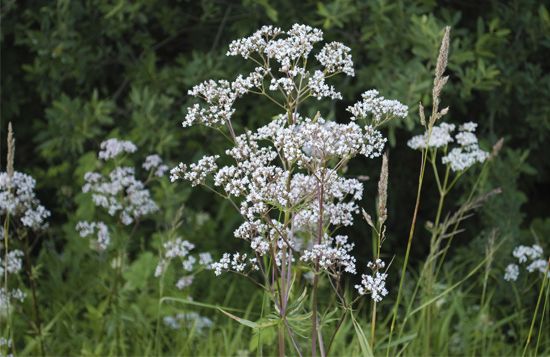
Queen Anne’s lace (Daucus carota carota) is a biennial plant belonging to the parsley family (Apiaceae). Often referred to as wild carrot, it is the ancestor…
What is Queen Anne’s lace?
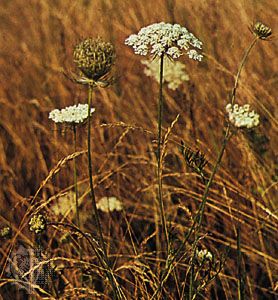
Queen Anne’s lace (Daucus carota carota) is a biennial plant belonging to the parsley family (Apiaceae). Often referred to as wild carrot, it is the ancestor of the common cultivated carrot.12
The plant typically grows up to 1.5 meters (5 feet) tall and features bristly, divided leaves. Its most recognizable characteristic is its flat-topped flower clusters, known as umbels, which consist of tiny white or pink flowers; frequently, a single dark purple flower sits at the center. While its enlarged root is technically edible, it is known for being acrid in taste.1
Native to Eurasia, the plant has become widely naturalized across the globe and is sometimes grown as an ornamental.12
How is Queen Anne’s lace related to the common garden carrot?
Queen Anne’s lace (Daucus carota carota) is the wild ancestor of the common garden carrot (Daucus carota sativus). Both plants belong to the Apiaceae family and share the same species name, Daucus carota.13
While Queen Anne’s lace is a wild biennial subspecies native to Eurasia, the garden carrot is a domesticated subspecies. Historical evidence suggests that the wild plant was used medicinally before its root was domesticated for consumption in Central Asia around 1000 CE.13
The primary differences lie in their roots and cultivation:
- Queen Anne’s Lace: Produces an edible but acrid, thin, and woody taproot. It is often considered a weed in regions where it has naturalized.123
- Garden Carrot: Specifically bred for a fleshy, palatable, and nutrient-rich taproot that comes in various colors, including orange, yellow, and purple.3
Both plants share similar botanical features, such as finely divided leaves and flat-topped flower clusters known as umbels.13
What are some other plants in the parsley family?
The Apiaceae family is a diverse group of approximately 3,820 species, ranging from common culinary staples to highly toxic plants. Because this family includes both edible and poisonous members, it is essential to exercise extreme caution when foraging, as some toxic species can be fatal if ingested.4
Edible Plants
Many members of this family are widely cultivated for their roots, leaves, or seeds:
- Vegetables: Carrot, celery, parsnip, lovage, and fennel.4
- Herbs and Spices: Parsley, anise, angelica, dill, coriander, caraway, and cumin.4
Poisonous Plants
Several species contain harmful alkaloids and should be avoided:
- Poison hemlock and water hemlock are notably toxic.4
- Giant hogweed and other cow parsnip species can cause severe skin blistering.4
Ornamentals
Beyond food and medicine, some species are grown for their aesthetic appeal, such as masterwort, blue lace flower, and sea holly.4
Why is this plant considered an invasive species in some areas?
Queen Anne’s lace (Daucus carota carota) is considered an invasive species in many regions, particularly in the United States, because it was unintentionally introduced as a weed during European colonization.1
As a hardy biennial plant, it has successfully established a nearly cosmopolitan range outside of its native Eurasia. Its ability to spread is aided by the production of numerous seeds, which are contained in small, spiny fruits that can easily attach to surfaces or be transported by environmental factors. Once introduced to new areas, its aggressive growth allows it to outcompete native vegetation, leading to its classification as an invasive weed in various environments.31
Sources
- Queen Anne’s lace — Encyclopædia Britannica
- Queen Anne's lace — Merriam-Webster
- Carrot — Encyclopædia Britannica
- Apiaceae — Encyclopædia Britannica
- parsley — Encyclopædia Britannica
Published on · 3 min read