Portuguese Man-of-war
The Portuguese man-of-war (Physalia physalis) is frequently mistaken for a jellyfish, but it is biologically distinct. While jellyfish are individual…
How do Portuguese men-of-war compare to other cnidarians in terms of their biology and ecological impact?
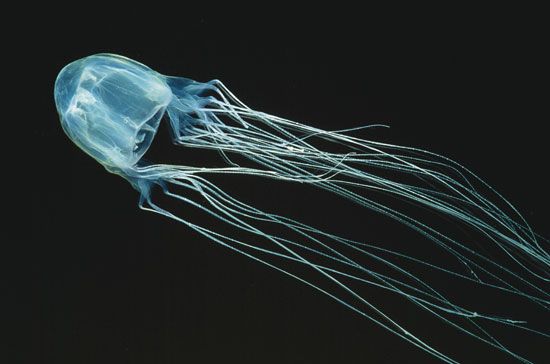
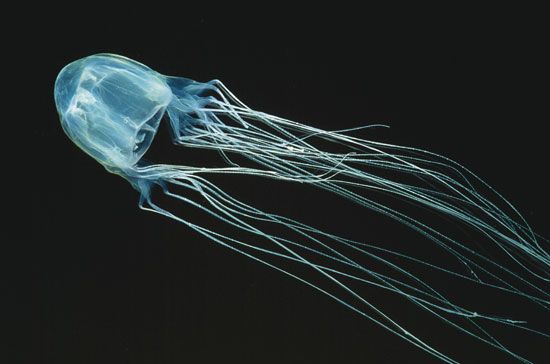
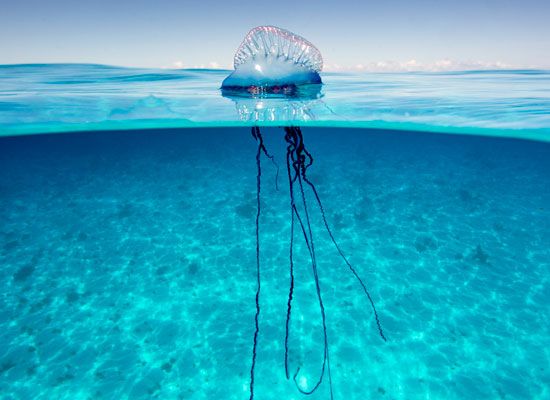
The Portuguese man-of-war (Physalia physalis) is frequently mistaken for a jellyfish, but it is biologically distinct. While jellyfish are individual organisms capable of independent movement, the Portuguese man-of-war is a colonial siphonophore composed of four specialized types of polyps that function as a single unit.12
Biological Differences
- Structure: The man-of-war features a gas-filled bladder called a pneumatophore, which acts as a sail for surface drifting. In contrast, most jellyfish possess a bell-shaped body (medusa) and rely on muscular contractions for movement.12
- Mobility: The man-of-war is a member of the pleuston, relying entirely on wind and ocean currents for travel, whereas many jellyfish are active swimmers.12
- Reproduction: Each man-of-war colony is either entirely male or female and reproduces via broadcast spawning. Many jellyfish species follow a complex life cycle involving both sessile polyp and free-swimming medusa stages.12
Ecological Impact
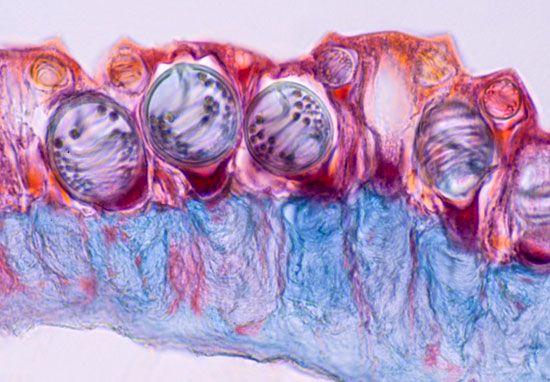
Both organisms utilize nematocysts—venomous stinging cells—to capture prey. The man-of-war’s sting is notoriously painful and hazardous to humans, potentially causing shock or cardiovascular distress. Because they drift in large swarms, they can cause significant disruptions to tourism, often forcing beach closures.13
How do Portuguese men-of-war move in the water and what factors influence their distribution?
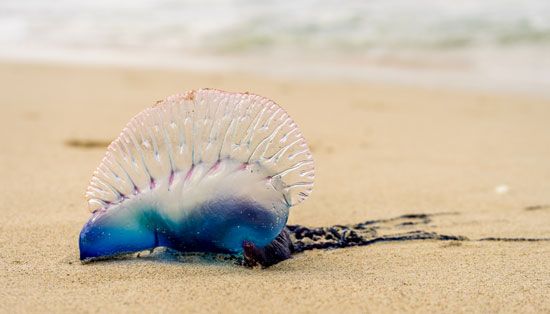
The Portuguese man-of-war (Physalia physalis) is a colonial organism that lacks the ability to move independently through the water. Instead, it is a member of the pleuston, a group of organisms that live at the ocean surface, and it relies entirely on ocean currents and wind for locomotion.1
Mechanisms of Movement
- The Pneumatophore: The animal’s primary means of travel is its gas-filled bladder, or pneumatophore, which acts as a sail. By catching the wind, the colony achieves maximum drift across the water’s surface.1
- Submergence: While the colony cannot swim, it possesses a limited defensive mechanism: it can quickly deflate its pneumatophore to submerge. This allows the organism to escape predators or prevent itself from drying out when exposed to intense sun.1
Factors Influencing Distribution
The distribution of the Portuguese man-of-war is highly variable and dictated by environmental conditions:
- Wind and Currents: Because they are subject to the movement of the water and air, their territory can shift dramatically from year to year. Large numbers are frequently pushed onto beaches by these forces.1
- Climate Trends: Warming ocean temperatures and decreased oxygen levels are contributing to an expansion of their range. Sightings are increasingly reported in cooler regions, such as Canada and Scotland, where the species was previously uncommon.1
- Environmental Volatility: Their presence in specific areas can fluctuate wildly; for example, a region might record fewer than 60 colonies one year and over 100,000 the next, depending on how weather patterns and currents transport the swarms.1
How does the Portuguese man-of-war reproduce and what is its life cycle?
The Portuguese man-of-war (Physalia physalis) is a colonial organism that reproduces through a process known as broadcast spawning. Because the colony is composed of specialized polyps, it includes specific reproductive structures called gonozooids.1
Reproduction and Life Cycle
- Colonial Sex: Each individual colony is either entirely male or entirely female.1
- Spawning: In the fall, colonies gather in groups. Females release eggs into the water while males release sperm, allowing fertilization to occur near the surface of the ocean.1
- Life Span: The Portuguese man-of-war has an estimated life span of approximately one year.1
Unlike many jellyfish species, which undergo complex life cycles involving both sessile (attached) and free-swimming stages, the Portuguese man-of-war functions as a single, integrated unit throughout its existence.18
What are the dangers of a Portuguese man-of-war sting to humans and other animals?
The Portuguese man-of-war (Physalia physalis) possesses tentacles equipped with nematocysts, which are venom-filled stinging structures used to paralyze prey such as small fish, crustaceans, and plankton. These structures pose significant risks to humans and other animals.12
Dangers to Humans
Stings from a Portuguese man-of-war are notoriously painful, typically resulting in red welts and blisters on the skin. Beyond localized pain, the venom can cause severe systemic reactions, including:1
- Fever and Shock: The body may experience a systemic inflammatory response or go into shock.12
- Organ Interference: The toxins can interfere with vital heart and lung activity.1
- Severe Complications: While fatalities are rare, they can occur due to extreme allergic reactions or cardiovascular failure.12
It is important to note that the animal remains dangerous even after death. Detached tentacles or the bodies of deceased specimens washed up on beaches are still capable of delivering painful, venomous stings upon contact.1
Dangers to Other Animals
The venom is highly effective at immobilizing the man-of-war’s natural prey. However, some marine species have evolved to coexist with or consume them. While the man-of-war fish lives among the tentacles, it is not immune to the venom and must rely on agility to avoid being stung and consumed. Conversely, animals like the loggerhead sea turtle and certain sea slugs are known to feed on the colony without suffering the same ill effects.1
Sources
- Portuguese man-of-war — Encyclopædia Britannica
- nematocyst — Encyclopædia Britannica
- jellyfish — Encyclopædia Britannica
- man-of-war fish — Encyclopædia Britannica
- Portuguese man-of-war — Merriam-Webster
- cephalopod - Locomotion — Encyclopædia Britannica
- Locomotion - Swimming — Encyclopædia Britannica
- siphonophore — Merriam-Webster
Published on · 4 min read