Obelia
Obelia is a genus of invertebrate marine animals belonging to the class Hydrozoa within the phylum Cnidaria. These organisms are widely distributed…
What is Obelia?
Obelia is a genus of invertebrate marine animals belonging to the class Hydrozoa within the phylum Cnidaria. These organisms are widely distributed throughout the world’s oceans and are characterized by their tree-like, branched colonial structures.123
The life cycle of Obelia is a classic example of the alternation of generations found in many hydroids:2
- Polyp Stage: The animal begins as a sessile, tentacled polyp attached to a solid surface. These polyps form branching colonies.12
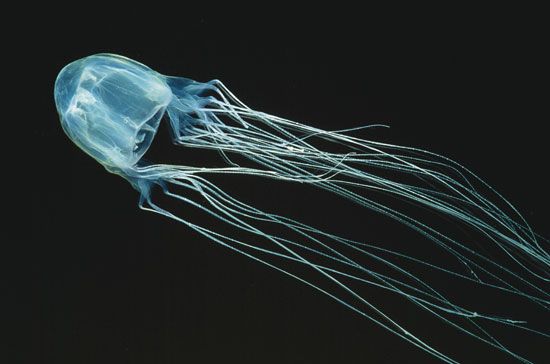
- Medusa Stage: The colony asexually produces free-swimming medusae, or jellyfish.12
- Reproduction: The medusae release sperm or eggs into the water. The resulting ciliated larva eventually settles and metamorphoses to start a new colony of polyps.12
The name Obelia is thought to derive from the Greek word obelós, referring to a pillar or spit, potentially describing a conical structure found on the medusa.3
What is the difference between a polyp and a medusa?
In the phylum Cnidaria, the polyp and medusa represent two distinct body forms that often alternate within a single life cycle.45
Key Differences
Feature
Polyp
Medusa
Shape
Cylindrical, stalked body
Bell- or umbrella-shaped
Mobility
Sessile (attached to a surface)
Free-swimming (planktonic)
Orientation
Mouth and tentacles face upward
Mouth and tentacles hang downward
Primary Role
Often the juvenile or asexual stage
Typically the adult or sexual stage
Functional Distinctions
- Polyp: These organisms are typically attached to a firm substratum at their lower end. Their upper end features a mouth surrounded by tentacles used to capture prey. Polyps often reproduce asexually, sometimes forming large, complex colonies such as corals or hydroids.457
- Medusa: Commonly known as a jellyfish, the medusa moves through the water via rhythmic muscular contractions of its bell. It possesses a central, stalklike manubrium that bears the mouth. Medusae are generally responsible for sexual reproduction, releasing gametes into the water to produce larvae that eventually settle and transform into polyps.567
While many cnidarians alternate between these forms, some groups, such as the Anthozoa, exist exclusively as polyps throughout their lives.45
How do colonial hydroids share food among their polyps?
Colonial hydroids share food among their individual polyps, or zooids, through a common living tube known as the stolon.3
In these colonies, the zooids are joined basally to this shared living tube, which runs the length of the colony. While the entire structure is protected by a tough, chitinous sheath called the perisarc, the internal living tube is assumed to facilitate the exchange of nutrients between the various individuals within the colony. This interconnected system allows the colony to function as a unified organism, distributing resources gathered by feeding polyps (gastrozooids) to other parts of the colony.38
What are some other examples of animals in the phylum Cnidaria?
The phylum Cnidaria is a diverse group of over 9,000 species, primarily found in marine environments. Beyond the well-known jellyfish and hydroids, other notable examples include:
- Corals: These include stony corals, which build the frameworks of reefs, as well as soft, black, thorny, and horny corals (such as sea fans and sea whips).
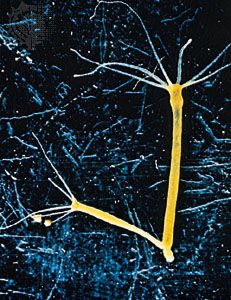
- Sea Anemones: Solitary, polyp-form cnidarians that lack a skeleton and are often found attached to rocks or other surfaces.
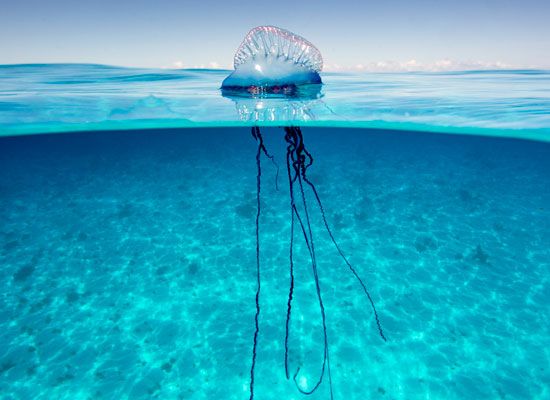
- Portuguese men-of-war: Colonial organisms often mistaken for single jellyfish, but actually composed of specialized groups of individuals.
- Sea Pens: Colonial anthozoans that typically have a featherlike appearance and live anchored in soft sediments.
- Hydras: Small, solitary freshwater organisms that exist only in the polyp stage.
These animals are categorized into four main classes: Hydrozoa, Scyphozoa, Anthozoa, and Cubozoa. A defining characteristic shared by all these creatures is the presence of nematocysts, which are specialized stinging capsules used for defense and capturing prey.11
Sources
- Obelia — Encyclopædia Britannica
- obelia — Merriam-Webster
- hydroid — Encyclopædia Britannica
- polyp — Encyclopædia Britannica
- cnidarian - Size range and diversity of structure — Encyclopædia Britannica
- medusa — Encyclopædia Britannica
- cnidarian - Reproduction and life cycles — Encyclopædia Britannica
- Circulatory system - Echinodermata — Encyclopædia Britannica
- Circulatory system - Annelida — Encyclopædia Britannica
- Hydractinia — Encyclopædia Britannica
- cnidarian — Encyclopædia Britannica
- jellyfish — Encyclopædia Britannica
- coral — Encyclopædia Britannica
Published on · 3 min read