Pribilof Islands
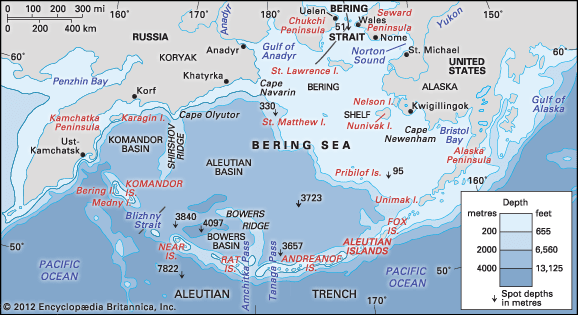
The Pribilof Islands are an archipelago located in the Bering Sea, situated approximately 300 miles west of the Alaska mainland and 240 miles north of the…

Where are the Pribilof Islands located, and what is their geographical significance?
The Pribilof Islands are an archipelago located in the Bering Sea, situated approximately 300 miles west of the Alaska mainland and 240 miles north of the Aleutian Islands.12
Geographically and ecologically, the islands are significant for several reasons:
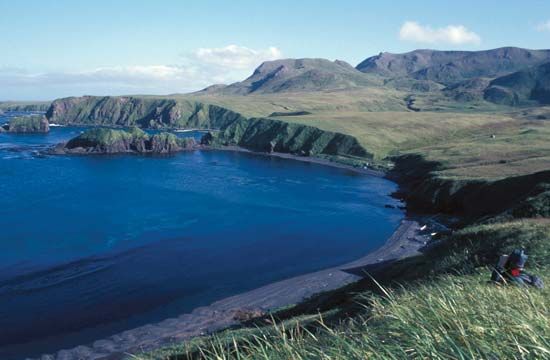
- Volcanic Origin: Formed by basaltic lava eruptions, the archipelago consists of two main islands, St. Paul and St. George, along with two smaller islets.1
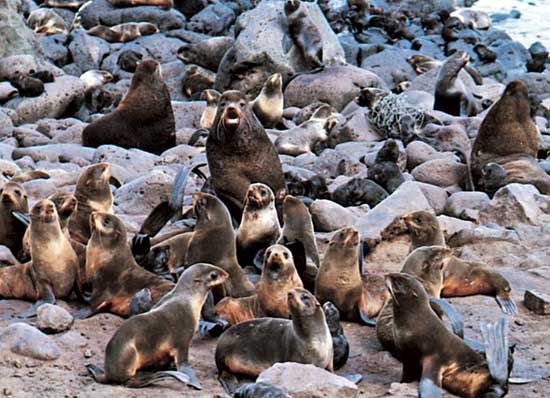
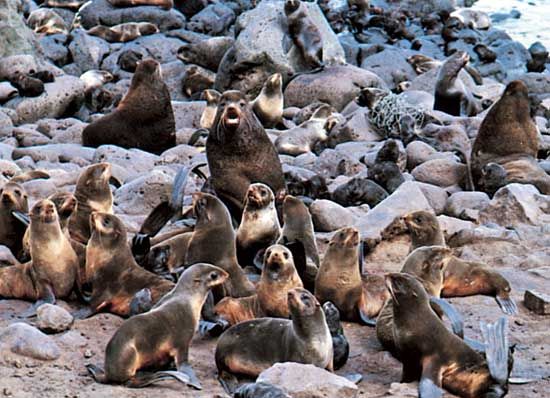
- Wildlife Sanctuary: The islands serve as a critical breeding ground for approximately 800,000 northern fur seals, representing about two-thirds of the world’s population. They are also a vital habitat for diverse wildlife, including reindeer, Arctic blue foxes, and various marine life.1
- Avian Hub: The islands are a major migratory stopover, hosting nearly three million birds across roughly 220 species.1
- Conservation Status: Due to their ecological importance, the islands were incorporated into the Alaska Maritime National Wildlife Refuge in 1984.1
What is the historical importance of the Pribilof Islands, particularly in relation to the fur seal trade?
The Pribilof Islands hold significant historical importance as a primary site for the commercial fur seal trade, a role that shaped the islands’ demographics and sparked international diplomatic conflict.
Discovery and Exploitation
The islands were discovered in 1786 by Russian sea captain Gavril Pribylov, who identified them as a major breeding ground for northern fur seals. Although the islands were uninhabited, Russian traders forcibly relocated Aleut people to the archipelago in 1788 to serve as forced labor for the seal hunt. Following the Alaska Purchase in 1867, control passed to the United States, and in 1870, the Alaska Commercial Company was granted a lease for sealing rights.1
International Controversy and Conservation
The 19th-century practice of “pelagic sealing” (hunting seals at sea) led to the severe depletion of the herds, as it allowed for no selectivity in the animals killed. This resulted in international tensions, notably between the United States and other nations, leading to the North Pacific Sealing Convention in 1911. This landmark treaty abolished pelagic sealing and established a framework for sharing the harvest.
Modern management, overseen by the North Pacific Fur Seal Commission, eventually shifted toward conservation. Commercial harvesting was prohibited by 1985, and since 1986, hunting has been restricted to subsistence use by Native Alaskans.1
What unique cultural traditions and practices are maintained by the Aleut community on the Pribilof Islands?
The Aleut people, who refer to themselves as the Unangan, are the Indigenous population of the Pribilof Islands. While their traditional lifeways were severely disrupted following their forced relocation by Russian fur traders in 1788, the community has engaged in a significant cultural revitalization since the late 20th century.41
Key aspects of their cultural identity and practices include:
- Language: The community maintains the Unangam Tunuu language, which is a distinct branch of the Eskimo-Aleut language family. It survives today in two primary dialects: Eastern Unangam Tunuu and Atkan Unangam Tunuu.56
- Subsistence Practices: A central pillar of modern cultural life is the continuation of traditional hunting and gathering practices. Since 1986, the harvesting of northern fur seals has been legally restricted to subsistence use by Native Alaskans, allowing the community to maintain this vital ancestral connection to the land and sea.41
- Crafts and Arts: Historically, Unangan culture was defined by skilled craftsmanship, including the weaving of fine grass basketry and the creation of tools and containers from stone, bone, and ivory. These traditional arts are among the practices being revitalized today.4
- Political and Social Structure: Following the Alaska Native Claims Settlement Act of 1971, the community established local tribal councils and school boards, strengthening their self-governance and political agency within the United States.1
How did the Pribilof Islands get their name, and who first discovered them?
The Pribilof Islands are named after the Russian sea captain Gavril Pribylov, who first visited and discovered the archipelago in 1786.8
Pribylov identified the islands as a major breeding ground for northern fur seals, a discovery that led to the islands’ subsequent exploitation for the fur trade. Although the islands were uninhabited at the time of their discovery—known to the Aleut people as Amiq—Russian traders forcibly relocated Aleuts to the islands in 1788 to serve as labor for the seal hunt.8
Sources
- Pribilof Islands — Encyclopædia Britannica
- Pribilof Islands — Merriam-Webster
- Aleutian Islands — Encyclopædia Britannica
- Aleut — Encyclopædia Britannica
- Aleut language — Encyclopædia Britannica
- Arctic - Linguistic composition — Encyclopædia Britannica
- Central Asian arts - Arctic regions — Encyclopædia Britannica
- Bering Sea and Strait - Study and exploration — Encyclopædia Britannica
Published on · 3 min read