Langur
Langurs are a group of Asian monkeys characterized by their slender bodies, long tails, and complex, multi-chambered stomachs adapted for a diet of leaves…
What are langurs and which family of primates do they belong to?
Langurs are a group of Asian monkeys characterized by their slender bodies, long tails, and complex, multi-chambered stomachs adapted for a diet of leaves, fruit, and other vegetation. They are generally gregarious, diurnal, and arboreal, with many species featuring long fur and distinctive crests or caps of hair.12
These primates belong to the family Cercopithecidae (Old World monkeys) and are specifically classified within the subfamily Colobinae. This subfamily also includes the African colobus monkeys1. Unlike the other subfamily of Cercopithecidae, the Cercopithecinae, colobines lack cheek pouches and instead rely on their specialized stomachs to ferment cellulose and hemicellulose, which helps them extract nutrients from their leafy diet.12
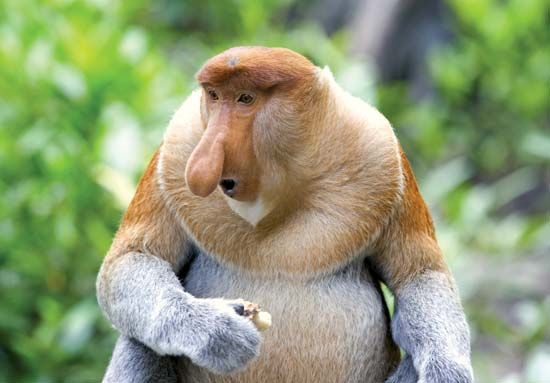
Common genera of langurs include Semnopithecus, Trachypithecus, and Presbytis, though the term is also applied to other members of the Colobinae subfamily, such as the proboscis monkey.1
What are the physical characteristics that distinguish langurs from other primates?
Langurs are distinguished from other primates, particularly other Old World monkeys, by several key physical and physiological adaptations:
- Digestive System: Unlike the subfamily Cercopithecinae (which includes macaques and baboons), langurs belong to the subfamily Colobinae and lack cheek pouches. Instead, they possess large, complex, multi-chambered stomachs designed for the bacterial fermentation of cellulose and hemicellulose, allowing them to efficiently process a diet rich in leaves, seeds, and fruit.123
- Body Build: Langurs are characterized by their slender bodies, long limbs, and long, slender hands and feet. They typically possess very long tails, which are significantly longer than their head and body length.13
- Pelage and Appearance: Many langur species are noted for their long fur and often feature distinctive crests or caps of hair on their heads. While adult coloration varies—commonly gray, red, brown, or black—they frequently have black faces. Notably, the coloration of infants often differs significantly from that of adults, which is thought to help elicit protective behaviors from other troop members.1
- General Morphology: As Old World monkeys, they share the family trait of having narrow noses with downward-facing nostrils and ischial callosities (hard, bare “sitting pads”) on their buttocks, features that distinguish them from New World monkeys.2
What is the diet of langurs, and how does it vary among different species?
Langurs, which belong to the subfamily Colobinae, are often referred to as “leaf-eating monkeys” due to their specialized digestive systems. They possess large, complex, multi-chambered stomachs that allow them to ferment cellulose and hemicellulose, enabling them to extract nutrients from a diet of leaves, fruit, and other vegetation.13
While they are frequently associated with leaf consumption, langurs are not exclusively leaf eaters. Their diet is generally flexible and varies according to the season and availability of food sources. In addition to leaves, they consume:
- Flowers and Fruit: These are common dietary components for many species.3
- Seeds: Depending on the species and environmental conditions, seeds can be a significant part of their intake.3
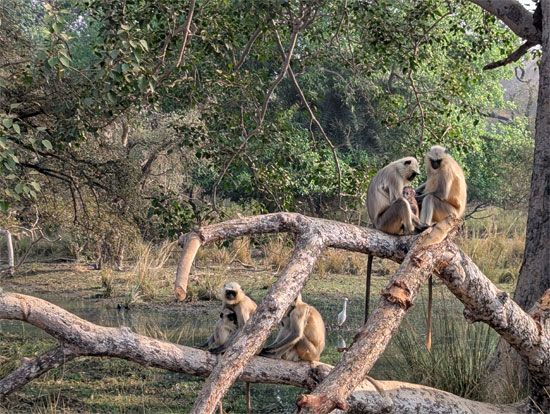
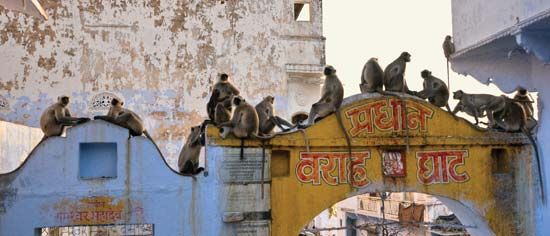
- Opportunistic Feeding: Some species, such as the Hanuman langur, are known to spend time on the ground and may raid crops or human food stores in villages and temples.1
Overall, while the Colobinae subfamily is characterized by this dietary preference, langurs exhibit a degree of catholicity in their food choices rather than strict dietary specialization.3
How many species of langurs exist, and what are some examples of different langur types?
The term “langur” is a general name applied to numerous Asian monkey species within the subfamily Colobinae. While the name is often restricted to nearly two dozen species of leaf monkeys, it is also used to describe various other members of the subfamily, totaling several distinct genera.1
Primary Langur Genera
The three genera most commonly referred to as leaf monkeys include:
- Semnopithecus: Includes the Hanuman langur (S. entellus), a species native to the Indian subcontinent that is often found in villages and temples.1
- Trachypithecus: Known as brow-ridged langurs, this group includes 10 to 15 species found across Southeast Asia, such as the golden langur (T. geei), the spectacled langur (T. obscurus), and François’ langur (T. francoisi).1
- Presbytis: Confined to Malaysia and western Indonesia, these species are often called surili. This genus includes about 10 species, such as the joja (P. potenziani), which is notable for living in monogamous pairs.1
Other Related Species
Beyond the leaf monkeys, the broader category of langurs includes other members of the Colobinae subfamily, such as the proboscis monkey and the simakobu, which fall under the genera Pygathrix, Rhinopithecus, Nasalis, and Simias.1
We could dive deeper into the specific conservation status of these primates or explore the unique social behaviors of different genera.
Sources
- langur — Encyclopædia Britannica
- monkey - Old World monkeys versus New World monkeys — Encyclopædia Britannica
- primate - Diet — Encyclopædia Britannica
- colobus — Encyclopædia Britannica
- macaque — Encyclopædia Britannica
Published on · 4 min read