Pteranodon
Pteranodon was a highly specialized flying reptile whose anatomy was uniquely adapted for aerial locomotion. Its ability to fly was supported by several key…
How did Pteranodon’s anatomy enable it to fly, and what made it different from modern flying animals?
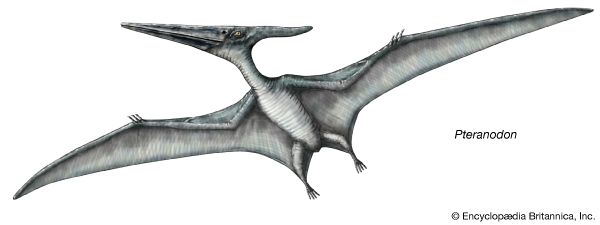
Pteranodon was a highly specialized flying reptile whose anatomy was uniquely adapted for aerial locomotion. Its ability to fly was supported by several key structural features:
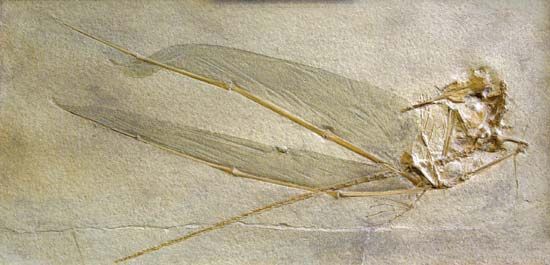
- Lightweight Skeleton: Despite their robust appearance, Pteranodon bones were completely hollow with walls only about one millimetre thick, significantly reducing body weight.1
- Flight Power: It possessed a large breastbone and reinforced shoulder girdles, providing the necessary attachment points for the powerful muscles required for flight.1
- Wing Structure: Unlike modern birds, which use feathers, Pteranodon utilized a wing membrane of skin supported primarily by an elongated fourth finger. This membrane was reinforced by internal keratinous fibers that enhanced strength and maneuverability.2
- Aerodynamics: An accessory membrane between the shoulder and wrist helped reduce turbulence during flight.2
Pteranodon differed from modern flying animals in several ways. While modern birds rely on sustained wing flapping, the massive size of Pteranodon made this energetically impractical, suggesting it primarily soared. Furthermore, its wing anatomy—specifically the reliance on a single elongated finger rather than the entire forelimb or multiple digits—distinguishes it from both birds and bats.12
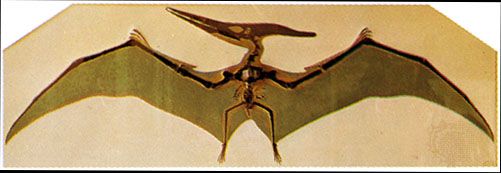
How did Pteranodon’s skull structure differ from other pterosaurs?
The skull of Pteranodon was distinguished by several key features that set it apart from other pterosaurs:
- Toothless Jaws: Unlike many earlier pterosaurs that possessed sharp, pointed teeth for capturing prey, Pteranodon featured very long, toothless, pelican-like jaws.1
- Prominent Cranial Crest: While a crest at the back of the skull was a common feature among various pterosaurs, Pteranodon is particularly noted for its distinct, large crest. This structure exhibited sexual dimorphism, with males possessing significantly larger crests than females.1
- Functional Specialization: Paleontologists suggest the Pteranodon crest may have served as a visual aid for species recognition. While some theories proposed the crest acted as a counterbalance to its long jaws or aided in steering during flight, these remain speculative, especially given that many other pterosaur species functioned effectively without any crest at all.1
- General Morphology: Like other pterodactyloids, Pteranodon possessed a skull that was delicate yet strong, with most component bones fused together. Its large eyes were reinforced by a bony sclerotic ring, indicating a heavy reliance on sight while hunting for fish.21
When and where did Pteranodon live, and what was its habitat like?
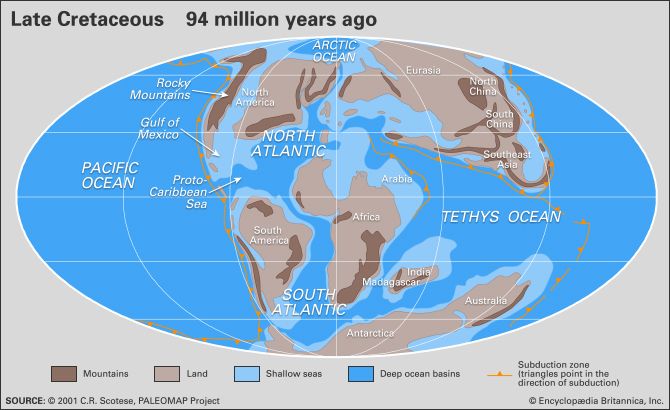
Pteranodon lived during the Late Cretaceous Period, approximately 90 million to 100 million years ago. Its fossils have been primarily recovered from North American deposits, though related forms have been discovered in Europe, South America, and Asia.1
The habitat of Pteranodon was distinctly marine. The rocks in which its fossils are found were formed in ancient marine environments, supporting the conclusion that the animal lived a lifestyle similar to that of a modern pelican. During the Cretaceous, the global climate was generally warmer and more humid than today, with no polar ice sheets. Pteranodon likely spent much of its time soaring over the sea, relying on its keen eyesight to hunt for fish. It is believed that the animal utilized sea breezes to assist in taking off from the water’s surface, where it may have skimmed or dove to capture prey.14
What did Pteranodon eat, and how did it hunt or gather food?
Pteranodon was a specialized carnivore that primarily fed on fish. Evidence for this diet is supported by the discovery of fossilized fish bones and scales found in association with Pteranodon specimens, as well as the unique, toothless, and elongated shape of its jaws, which resemble those of a modern pelican.1
Regarding its hunting behavior, paleontologists rely on the animal’s physical characteristics to form several theories:
- Visual Hunting: Pteranodon possessed relatively large eyes, suggesting it relied heavily on sight to locate prey while soaring above the sea.1
- Foraging Techniques: Because of its large size, Pteranodon likely soared more than it flapped its wings. Experts speculate that it may have captured fish by skimming the water’s surface during flight, landing on the water to snatch prey, or diving after fish in a manner similar to modern diving birds.1
- Takeoff Strategy: To return to the air after hunting on the water, it is believed that Pteranodon faced into sea breezes, using the wind to provide the necessary lift for its large wingspan.1
Sources
- Pteranodon — Encyclopædia Britannica
- pterosaur — Encyclopædia Britannica
- dinosaur - Ornithopoda — Encyclopædia Britannica
- A Journey Through Time Since the Precambrian - Cretaceous Period: 145 million to 66 million years ago — Encyclopædia Britannica
Published on · 3 min read