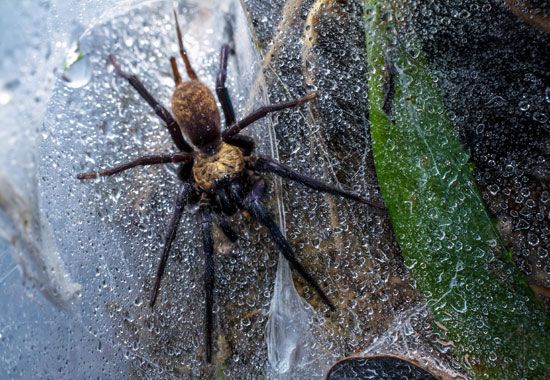
Purseweb Spider
The purseweb spider belongs to the family Atypidae, a group comprising about 50 species of stout-bodied, burrowing spiders. These spiders are named for their…
What is purseweb spider?
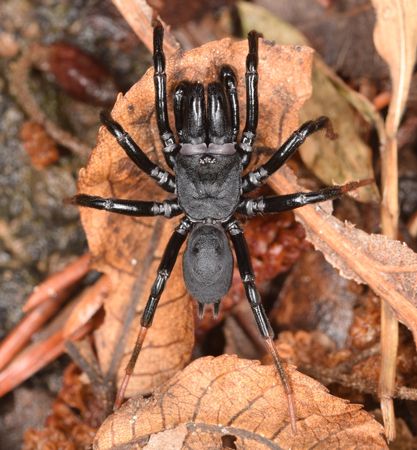
The purseweb spider belongs to the family Atypidae, a group comprising about 50 species of stout-bodied, burrowing spiders. These spiders are named for their unique webs, which consist of long, silk-lined tubes that protrude from their burrows, resembling an old-fashioned pull-string purse or a stocking.1
Physical Characteristics and Habitat
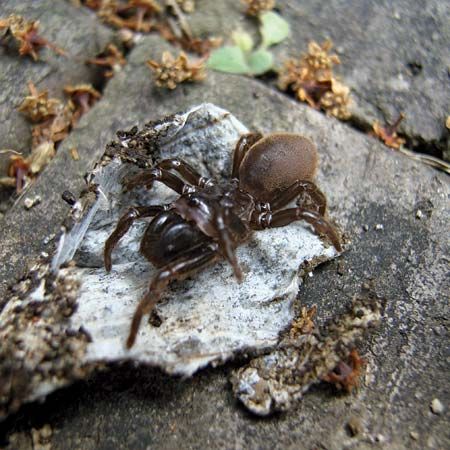
Purseweb spiders are typically black or dark brown to tan, with shiny bodies and body lengths ranging from 1 to 4 cm (0.4 to 1.5 inches). Like other mygalomorphs, they possess powerful, downward-stabbing fangs and two pairs of book lungs. They inhabit damp woodlands in temperate to tropical regions across Europe, Japan, Africa, and the United States.1
Hunting and Behavior
These spiders spend most of their lives alone underground. They camouflage their silk tubes with debris, often making them resemble twigs or roots. When an insect lands on the tube, the spider senses the vibrations, rushes up, and impales the prey through the silk with its venomous fangs before pulling it inside to feed.12
How do purseweb spiders use their silk tubes to catch prey?
Purseweb spiders utilize their specialized silk tubes as both a home and a highly effective hunting tool. These tubes, which extend from their underground burrows, are camouflaged with debris to resemble natural objects like twigs or roots, allowing them to blend into their environment.2
When an insect lands on or walks across the exterior of the silk tube, the spider detects the resulting vibrations from within the safety of its burrow. Upon sensing the prey, the spider performs the following actions:24
- Impaling: The spider rushes up the inside of the tube and uses its powerful, downward-stabbing fangs to pierce through the silk wall, injecting neurotoxic venom into the prey.24
- Retrieval: Using the serrated edges of its chelicerae, the spider tears a hole in the silk and pulls the immobilized victim inside the tube.24
- Consumption: Once inside, the spider secretes digestive juices to liquefy the prey’s tissues, consumes the nutrients, and eventually discards the remains before repairing the damaged web.2
What are some other types of burrowing spiders?
Beyond the purseweb spider, there are several other types of spiders that exhibit burrowing behaviors as a primary means of survival and hunting:
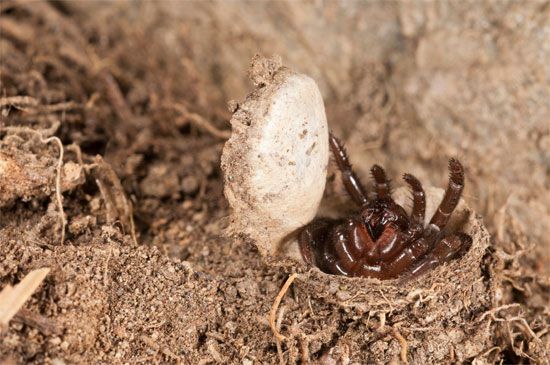
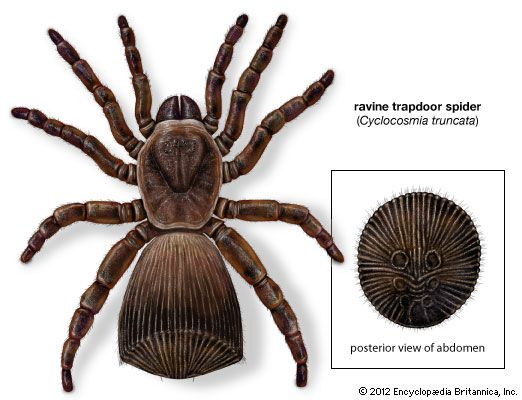
- Trapdoor spiders: These spiders are well-known for constructing burrows in the ground that feature a silken-hinged door. They remain hidden inside, waiting for prey to pass close by before quickly opening the door to grab their victim. Some species, such as the ravine trapdoor spider, use their uniquely shaped abdomens as a plug to seal the burrow entrance against predators.
- Desert tarantulas: These large, hairy spiders construct burrows that can reach 20 cm (8 inches) in length. They line the top of their burrows with silk and often cover the entrance with a thin layer of silk during the day to avoid heat and predators. At night, they emerge to ambush passing insects, lizards, or other small animals.
- Burrowing wolf spiders: While many wolf spiders are active hunters that roam for prey, members of the genus Geolycosa spend most of their lives in burrows. These spiders have heavy front legs specifically adapted for digging and may conceal their burrow entrances with debris or build turretlike structures above them.
What is the difference between mygalomorphs and other spider groups?
The primary difference between mygalomorphs (Infraorder Mygalomorphae) and araneomorphs (Infraorder Araneomorphae) lies in the orientation of their chelicerae (jaws) and their internal anatomy.93
Key Distinctions
- Jaw Movement: Mygalomorphs are orthognath, meaning their fangs move in a forward-and-down (paraxial) motion. In contrast, araneomorphs are labidognath, with fangs that move sideways and together (diaxial).93
- Respiratory Organs: Mygalomorphs typically possess two pairs of book lungs, whereas araneomorphs usually have only one pair, which may sometimes be replaced by tracheae.31011
- Anatomy and Life History: Mygalomorphs are generally larger, longer-lived, and often ground-dwelling, frequently constructing silk-lined burrows. Females of this group lack an epigynum (a sclerotized plate used for mating), and the male pedipalps are relatively simple in structure. Araneomorphs, which comprise the vast majority of spider species, exhibit more diverse reproductive structures, including the presence of an epigynum in females.3109
While mygalomorphs are often considered “primitive” due to these conserved anatomical traits, both groups have evolved specialized behaviors to thrive in diverse environments worldwide.310
Sources
- purseweb spider — Merriam-Webster
- purseweb spider — Encyclopædia Britannica
- spider - Annotated classification — Encyclopædia Britannica
- purseweb spider: Top Questions — Encyclopædia Britannica
- trapdoor spider — Encyclopædia Britannica
- wolf spider — Encyclopædia Britannica
- spider - Stalking prey — Encyclopædia Britannica
- desert tarantula — Encyclopædia Britannica
- spider - Distinguishing taxonomic features — Encyclopædia Britannica
- mygalomorph — Merriam-Webster
- Mygalomorphae — Merriam-Webster
Published on · 3 min read