Rafflesiaceae
The evolutionary history of the Rafflesiaceae family is defined by a transition from autotrophy to complete heterotrophy. As angiosperms, members of this…
What is the evolutionary history of the Rafflesiaceae family?
The evolutionary history of the Rafflesiaceae family is defined by a transition from autotrophy to complete heterotrophy. As angiosperms, members of this family evolved from nonparasitic ancestors, eventually losing their photosynthetic capacity and traditional vegetative structures like leaves, roots, and stems.12
Today, these plants exist as endoparasites, living almost entirely within the tissues of their host plants as threadlike cellular strands. They rely on a specialized organ called a haustorium to penetrate the host and establish a vascular connection for nutrients. This extreme specialization is an evolutionary adaptation to their parasitic lifestyle, where the plant only emerges from the host to produce flowers.12
Taxonomically, the family’s history has been contentious due to the difficulty of studying these highly modified organisms. Molecular evidence has led to significant reorganizations, moving several genera—such as Apodanthes and Pilostyles—into different families and orders, leaving only Rafflesia, Rhizanthes, and Sapria within the Rafflesiaceae.1
What are some common misconceptions about Rafflesiaceae plants?
Common misconceptions about the Rafflesiaceae family often stem from their unusual appearance and extreme parasitic lifestyle. Here are some of the most frequent points of confusion:
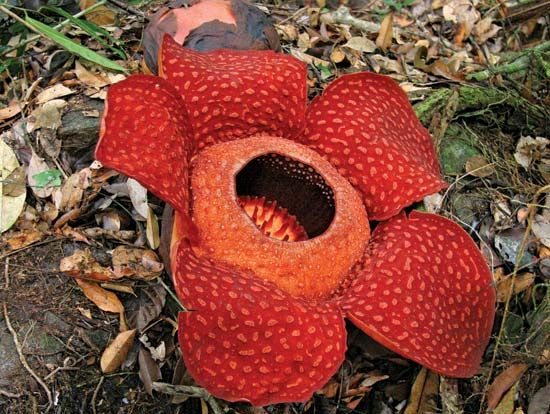
- Confusion with the “Corpse Flower”: The term “corpse flower” is frequently applied to Rafflesia arnoldii due to its fetid odor and massive size. However, this name is also commonly used for the titan arum (Amorphophallus titanum), which is an entirely different plant that produces the world’s largest unbranched inflorescence rather than a single giant flower.1
- Misidentification as Mycoheterotrophs: Because they lack chlorophyll and photosynthetic tissues, Rafflesiaceae are sometimes confused with mycoheterotrophs. Unlike mycoheterotrophs, which obtain nutrients through symbiotic associations with fungi, Rafflesiaceae are true parasitic plants that use a specialized organ called a haustorium to directly extract nutrients from a host plant.32
- Misconceptions about Plant Structure: It is a common error to assume these plants have traditional vegetative parts. In reality, they are endoparasites; their vegetative body is reduced to a network of threadlike cellular strands living entirely within the host’s tissues. They possess no true leaves, roots, or stems, appearing only as flowers when they emerge from the host.31
- Taxonomic Misclassification: Historically, many genera were grouped into the Rafflesiaceae based on superficial morphological similarities. Modern molecular evidence has corrected this, showing that several previously included genera (such as Pilostyles) actually belong to different families and orders.3
Are there any medicinal or cultural uses for Rafflesiaceae plants?
While there is no scientific evidence supporting the efficacy of Rafflesia for health purposes, the illegal harvest of these plants for their purported medicinal properties is a significant threat to their survival. In some local traditions, parts of the plant have been harvested for use in traditional medicine, though such practices are often unsustainable and contribute to the decline of these rare species.3
Because Rafflesia plants are obligate endoparasites that lack traditional vegetative structures like roots or stems, they are extremely difficult to cultivate outside of their natural habitat. Their complete dependence on specific Tetrastigma host vines makes them highly vulnerable to extinction when their rainforest environments are disturbed by logging or land-use changes. Consequently, the harvesting of these flowers for medicinal or commercial use is considered a major conservation concern, as it further pressures populations that are already struggling to survive in the wild.3
How do scientists study and classify Rafflesiaceae plants?
Studying and classifying the Rafflesiaceae family presents unique challenges to botanists, primarily because these plants are endoparasites that lack traditional vegetative structures like leaves, roots, or stems. Because their body exists only as a network of threadlike cellular strands hidden within the tissues of a host Tetrastigma vine, they are notoriously difficult to locate and study until their flowers emerge.15
Taxonomic Classification
The classification of this family has historically been contentious. Early systems grouped genera based on superficial morphological similarities, but modern science has relied on molecular evidence to reorganize the group. This led to a significant revision by the Angiosperm Phylogeny Group III (APG III), which moved several genera—such as Pilostyles—into different families and orders, leaving the current family to consist of only three genera: Rafflesia, Rhizanthes, and Sapria.1
Research Challenges
- Limited Availability: The extreme rarity of these plants and their dependence on specific host environments make obtaining specimens for study difficult.1
- Cultivation Barriers: Because they are obligate parasites, they cannot be grown outside of their natural habitat, preventing traditional laboratory cultivation.5
- Conservation Status: Scientists use field observations to monitor populations, though many species remain under-evaluated. Currently, the IUCN Red List of Threatened Species is used to track the status of these plants, with many species considered endangered due to habitat loss.15
Sources
- Rafflesiaceae — Encyclopædia Britannica
- parasitic plant — Encyclopædia Britannica
- rafflesia — Encyclopædia Britannica
- 5 Awesome Parasitic Plants — Encyclopædia Britannica
- Rafflesiaceae — Merriam-Webster
Published on · 4 min read