Quelea
The Quelea quelea, commonly known as the quelea, is a small, brownish songbird native to Africa. Belonging to the Ploceidae family, these birds are…
What are the physical characteristics of the Quelea quelea bird?
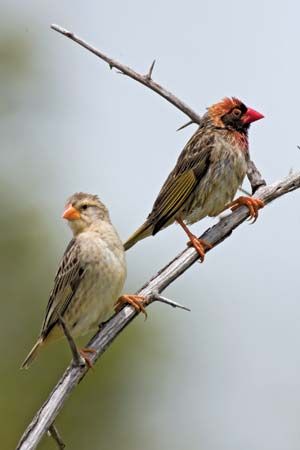
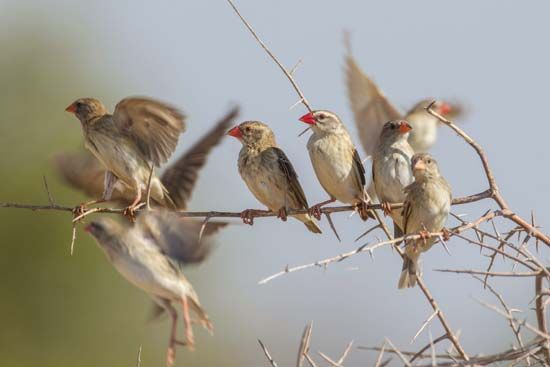
The Quelea quelea, commonly known as the quelea, is a small, brownish songbird native to Africa. Belonging to the Ploceidae family, these birds are recognized for their red bills.12
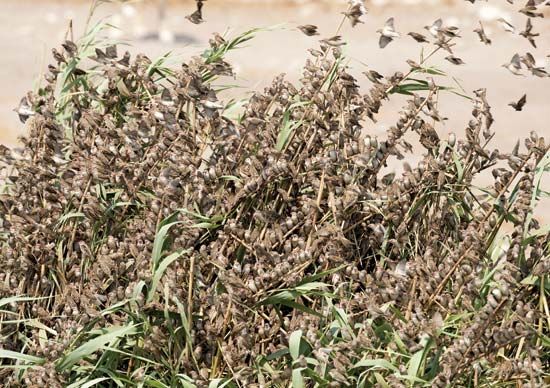
During the breeding season, the appearance of the males changes; they develop a black face and exhibit pinkish coloration on their foreparts. These birds are considered one of the most populous species of birds in the world, often gathering in massive colonies.1
Where is the natural habitat of Quelea quelea, and how widespread is their distribution?
The Quelea quelea, or quelea, is a small songbird native to the African continent.12
Regarding their habitat and distribution, these birds are primarily found in thorn-scrub country, where they establish massive breeding colonies. Their population density is extraordinary; a single colony can contain more than two million pairs within an area of less than 50 hectares (125 acres).1
The quelea is considered one of the most populous bird species in the world. Their widespread presence and ability to travel hundreds of miles within a single year have been significantly influenced by human activity, specifically the large-scale cultivation of grains and the exploitation of marginal land for stock raising. These environmental changes have provided the resources necessary for their populations to thrive, often leading to their characterization as a “locust bird” plague due to the damage they cause to crops.1
How do Quelea quelea reproduce, and what is their breeding cycle like?
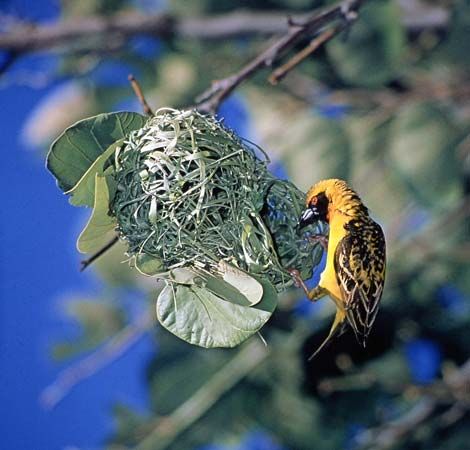
The reproduction of the Quelea quelea is characterized by high-density colonial nesting and rapid maturation. These birds breed in thorn-scrub environments, where they construct globular nests in dense clusters. During the breeding season, the males—which develop a distinct black face and pinkish foreparts—are responsible for building these nests.1
The breeding cycle is highly efficient, with each pair typically producing two or three young. The species is remarkably prolific; within a single year, the offspring are capable of wandering hundreds of miles and reaching sexual maturity to breed in their turn. These colonies are among the most densely populated in the avian world, with some sites estimated to contain over one million individuals, or more than two million pairs within an area of less than 50 hectares (125 acres).13
What conservation efforts or control measures are in place for managing Quelea quelea populations?
Managing Quelea quelea populations is a significant challenge due to their status as one of the most populous bird species in the world. Because these birds often destroy grain crops and damage trees by roosting in massive numbers, various control measures have been attempted to mitigate their impact.1
Historically, efforts to manage their populations have included the use of:
- Poisons: Chemical agents designed to reduce colony numbers.1
- Napalm: Used in attempts to destroy nesting sites.1
- Pathogens: Biological methods intended to target the birds.1
- Electronic devices: Various technological interventions aimed at deterrence.1
According to available data, these methods have generally met with poor success. The most effective approach for achieving local control has been the use of dynamite to target the dense, high-density breeding colonies, which can contain over two million pairs in an area of less than 50 hectares (125 acres).1
It is important to note that the “locust bird” plague is largely an indirect consequence of human activities, such as the large-scale cultivation of grains and the exploitation of marginal land for livestock.1
Sources
- Quelea — Encyclopædia Britannica
- quelea — Merriam-Webster
- Reproductive behaviour - Birds — Encyclopædia Britannica
Published on · 3 min read