Woodcreeper
Information regarding the specific breeding and nesting behaviors of woodcreepers is limited, as their reproductive habits remain largely unstudied. Current…
What are some unique behavioral adaptations of woodcreepers for nesting and breeding?
Information regarding the specific breeding and nesting behaviors of woodcreepers is limited, as their reproductive habits remain largely unstudied. Current scientific knowledge confirms that some species construct nests using plant materials within tree cavities.
It is important to clarify that woodcreepers belong to the family Furnariidae (or sometimes classified as Dendrocolaptidae), which is distinct from the order Piciformes—the group that includes woodpeckers and other birds known for specialized cavity-excavation behaviors. While woodpeckers are well-documented for their complex nesting adaptations, such as excavating their own holes in trees or banks, these behaviors should not be attributed to woodcreepers.
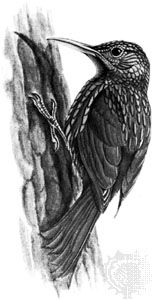
Because woodcreepers are solitary forest birds primarily identified by their vocalizations and climbing adaptations, such as their stiff, broad tail feathers used for propping against tree trunks, their specific nesting strategies remain a subject for future research.
What are some of the most common woodcreeper species, and how do they differ?
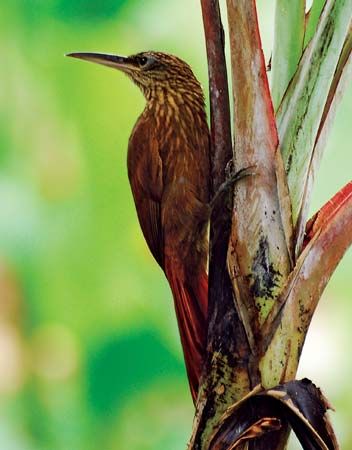
Woodcreepers are a diverse group of approximately 50 species within the subfamily Dendrocolaptinae. While they share a general appearance—typically brownish plumage with streaks or bars—they exhibit notable differences in size, bill shape, and foraging behavior.1
Common Species and Distinctions
- Barred Woodcreeper (Dendrocolaptes certhia): A typical, heavy-billed species reaching about 28 cm (11 inches) in length. It is easily identified by the distinct scalloped black markings on its plumage.1
- Ivory-billed Woodcreeper (Xiphorhynchus flavigaster): Found in Central America, this species is representative of the Xiphorhynchus genus, which is characterized by more prominent streaking compared to other woodcreepers.1
- Plain-brown Woodcreeper (Dendrocincla fuliginosa): Ranging from Honduras to Argentina, this species is known for its specialized foraging strategy. It frequently follows marching ant columns to consume insects and other small creatures flushed out by the ants.1
Shared Characteristics
Most woodcreepers are solitary forest birds that climb tree trunks using broad, stiff tail feathers as a prop. Their bills vary by species; while most are stout and moderately long, some possess specialized downcurved or wedge-shaped bills to assist in probing bark and leaves for insects.1
How many species of woodcreepers are there, and are any of them endangered?
There are approximately 50 species of woodcreepers belonging to the subfamily Dendrocolaptinae. These birds are native to the tropical forests of the Americas and are members of the family Furnariidae within the order Passeriformes.
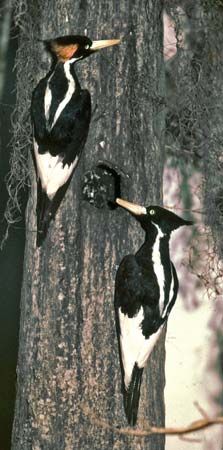
Regarding their conservation status, the provided information does not specify which, if any, of the approximately 50 woodcreeper species are currently endangered. It is important to distinguish these birds from the ivory-billed woodpecker, a separate species in the family Picidae that is noted for being critically endangered and possibly extinct. While the names may sound similar, woodcreepers and woodpeckers belong to different biological families and have distinct evolutionary histories.
How do woodcreepers communicate with each other?
Woodcreepers are primarily solitary forest birds, and they are most frequently detected by their vocalizations rather than visual displays. While their specific social communication methods remain understudied, they are known to produce distinct sounds to signal their presence within their environment.1
These vocalizations vary by species: some woodcreepers repeatedly utter harsh or sad-sounding notes, while others communicate through trills. Because they are solitary, these calls serve as a primary means of identifying and locating individuals within the dense forest canopy.1
Sources
- Woodcreeper — Encyclopædia Britannica
- Piciform - Reproduction — Encyclopædia Britannica
- Pileated woodpecker: Top Questions — Encyclopædia Britannica
- Woodpecker — Encyclopædia Britannica
- Piciform - Form and function — Encyclopædia Britannica
- Coraciiform - Social behaviour — Encyclopædia Britannica
Published on · 3 min read