Weaver
Weaver birds are small, finchlike songbirds belonging to the family Ploceidae. They are primarily native to Africa and are characterized by their compact…
What are the defining characteristics of weaver birds?
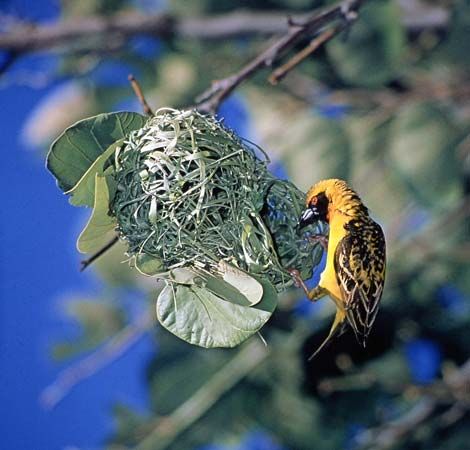
Weaver birds are small, finchlike songbirds belonging to the family Ploceidae. They are primarily native to Africa and are characterized by their compact bodies and short, stout bills.12
Key defining characteristics include:
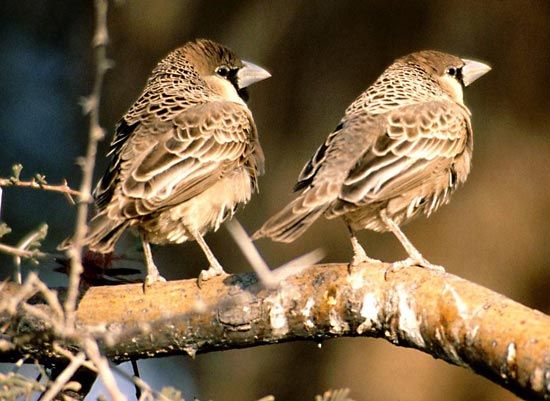
- Nest-Building: They are renowned for their sophisticated nest-building techniques, using grass stems and plant fibers to create covered, often hanging, structures. While most build individual nests in colonies, some species, such as the social weaver, construct massive communal nests.123
- Social Behavior: Many species are highly gregarious and breed colonially.12
- Appearance and Breeding: In many species, males exhibit bright, colorful plumage during the breeding season, often contrasting with the duller appearance of females. Many are polygynous, with males performing elaborate displays—such as hanging upside down from nests while fluttering wings—to attract mates.12
- Diet: They are generally insectivores or seed-eaters that forage on the ground.12
While most weavers build their own nests, some, like the whydahs, are social parasites that lay eggs in the nests of other weaver species.13
How do weaver birds construct their unique nests?
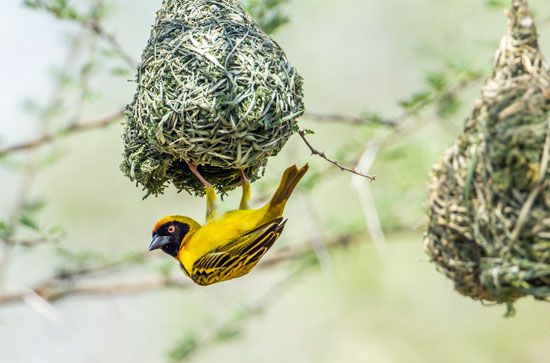
Weaver birds, members of the family Ploceidae, are renowned for their sophisticated nest-building abilities, which involve the use of grass stems and plant fibers to create exceptionally tight and compact structures.45
The construction process typically involves the following techniques:
- Weaving and Knotting: Unlike many birds that build open, cup-shaped nests, weavers are capable of tying knots with strips of grass or palm leaves. This allows them to weave firm, durable chambers.45
- Structural Design: Many species, particularly those in the genus Ploceus, construct hanging, roofed nests that often resemble an upside-down flask. These nests frequently feature a bottom entrance, which may be extended into a tube to provide additional protection.5
- Communal Engineering: Some species, such as the social weaver, engage in cooperative construction. They build massive, thatchlike “apartment houses” in trees that can contain hundreds of individual chambers, all protected by a large, shared roof and accessed via common tunnel entrances.15
- Variation: While many weavers create complex hanging structures, others, like bishop birds, weave nests with side entrances, typically situated in grassy habitats.5
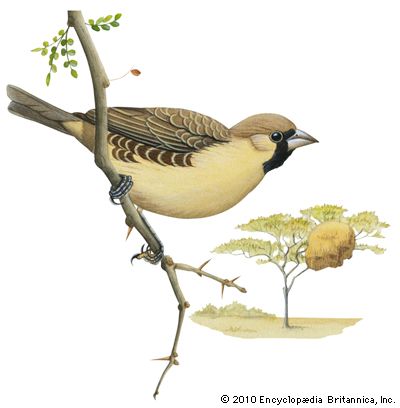
What are some common species of weaver birds and where are they found?
Weaver birds, belonging to the family Ploceidae, are primarily native to Africa, though some species are found elsewhere. They are generally found in hot, dry regions, where they forage on the ground for seeds and insects.126
Common species and their distributions include:
- Village weaver (Ploceus cucullatus): A familiar species widely distributed across Africa.1
- Baya weaver (Ploceus philippinus): Abundant in regions ranging from Pakistan to Sumatra.1
- Social weaver (Philetairus socius): Found in the dry regions of southwestern Africa.1
- Red-billed weaver, or quelea (Quelea quelea): Inhabits the African savannas, often forming massive colonies.1
- Cassin’s weaver (Malimbus cassini): Found in the lowland rain forests of central Africa.1
- Buffalo weaver: Includes the black buffalo weaver, found in dry African regions, and the white-headed buffalo weaver, which is confined to eastern Africa.7
- Bishop birds (Euplectes): Typically found in wet, grassy areas.1
How do social weavers build their massive communal nests?
Social weavers (Philetairus socius) are highly gregarious birds that construct massive, communal “apartment houses” in trees, typically acacia trees. Unlike many other weaver species that build individual hanging nests, these birds cooperate year-round to maintain a single, large structure.51
The construction process involves several key features:
- Thatchlike Roof: The colony works together to build and maintain a massive, shared roof made of grass and plant fibers. This protective covering can reach up to 7.5 meters (25 feet) in width and 1.5 meters in height.5
- Individual Chambers: Beneath this shared roof, the colony creates numerous separate nest chambers, with some structures containing over 100 to 300 individual compartments—one for each breeding pair.51
- Common Access: Each cluster of chambers is accessed through a common tunnel entrance located at the bottom of the nest structure.51
These impressive engineering feats provide a stable, protected environment for the entire colony.5
Sources
- Weaver — Encyclopædia Britannica
- Ploceidae — Encyclopædia Britannica
- Passeriform - Territoriality and courtship — Encyclopædia Britannica
- Passeriform - Nesting — Encyclopædia Britannica
- Social weaver — Encyclopædia Britannica
- Buffalo weaver — Encyclopædia Britannica
- Ploceidae — Merriam-Webster
- weaver ant: Top Questions — Encyclopædia Britannica
Published on · 3 min read