Quillwort
Scientists classify the approximately 250 species of quillwort (Isoetes) by navigating a complex taxonomic history that was long obscured by the prevalence…
How do scientists study and classify different quillwort species?
Scientists classify the approximately 250 species of quillwort (Isoetes) by navigating a complex taxonomic history that was long obscured by the prevalence of interspecific hybridization. Because many quillworts are sterile hybrids with abortive spores, they can be difficult to categorize using traditional methods. However, some of these hybrids have regained fertility through chromosome doubling, leading to the proliferation of reproductively competent polyploid species.1
To standardize the classification of these plants, the Pteridophyte Phylogeny Group—an international collective of taxonomists—published a consensus known as PPG I in 2016, which currently recognizes about 250 distinct species.1
Beyond genetic and chromosomal analysis, researchers observe physical characteristics to differentiate species, such as:
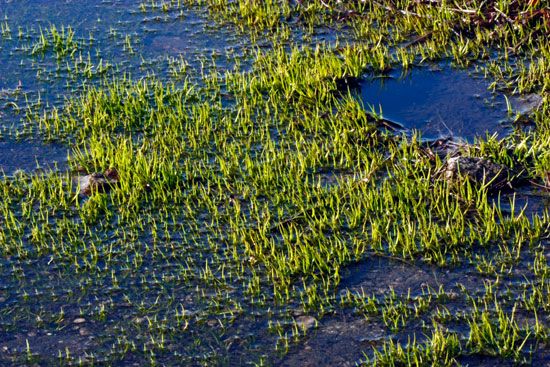
- Leaf morphology: The shape, length, and growth pattern of the spiky, quill-like leaves (e.g., the spiraling leaves of the Italian quillwort versus the narrow, curling leaves of the sand quillwort).1
- Habitat: Whether the species is aquatic, semi-aquatic, or terrestrial, and how it responds to seasonal changes in water availability.1
- Reproductive structures: As heterosporous plants, quillworts produce both megaspores and microspores within specialized sporangia located at the base of their leaves.2
How do quillworts reproduce and what is special about their life cycle?
Quillworts (Isoetes) reproduce through a process involving alternation of generations, cycling between a conspicuous, spore-producing sporophyte and a microscopic, sex-cell-producing gametophyte5.
Heterospory and Reproduction
Unlike homosporous plants that produce one type of spore, quillworts are heterosporous, meaning they produce two distinct types of spores within specialized sporangia located at the concave bases of their quill-like leaves:25
- Microsporangia: These produce an enormous number of tiny microspores—sometimes up to 1,000,000 per plant—which develop into male gametophytes.25
- Megasporangia: These produce significantly fewer, larger megaspores (typically 50 to 300), which develop into female gametophytes.25
The Life Cycle
A unique aspect of the quillwort life cycle is that, unlike some related plants, their spores do not germinate until they have been shed from the parent plant. Once released into the environment, the spores develop into unisexual gametophytes. The male gametophytes produce multiflagellate sperm, which must swim to the female gametophyte to achieve fertilization.25
Following fertilization, the resulting embryo is nourished by food stored within the megaspore, which is transported to the developing sporophyte through a structure called a massive foot. Eventually, the young sporophyte becomes physiologically independent, and the gametophyte dies.25
What are some common and scientific names for different quillwort species?
There are approximately 250 species of quillwort belonging to the genus Isoetes. Because of their complex history of hybridization, many species are identified by their specific environmental adaptations and physical traits.
Below are some notable examples of quillwort species:
Common Name
Scientific Name
Characteristics
Eurasian quillwort
Isoetes lacustris
An aquatic species with stiff, dark green, recurved leaves.
North American quillwort
Isoetes macrospora
Similar to
I. lacustris
; an aquatic species with a stumpy corm.
Italian quillwort (or Piedmont quillwort)
Isoetes malinverniana
Features long, spiraling leaves that float on the water surface.
Sand quillwort
Isoetes histrix
A terrestrial European species with narrow, curling leaves.
Pindus quillwort
Isoetes heldreichii
A critically endangered species native to Macedonia.
—
Isoetes stephansenii
A critically endangered species found in southern Africa.
—
Isoetes wormaldii
A critically endangered species found in southern Africa.
These plants are primarily found in swampy, cooler regions of North America and Eurasia, often growing submerged in fresh water or in seasonally wet terrestrial habitats.1
How many species of quillwort are known to exist worldwide?
There are approximately 250 known species of quillwort worldwide. These plants belong to the family Isoetaceae and are the only living members of the order Isoetales, typically classified within the single genus Isoetes.16
The exact number of species was historically difficult to determine due to frequent interspecific hybridization, which often created sterile hybrids. However, many of these hybrids have regained fertility through chromosome doubling, leading to the development of new, reproductively competent polyploid species. In 2016, the Pteridophyte Phylogeny Group (PPG I) established a taxonomic consensus that recognizes this count of about 250 species.1
Sources
- quillwort — Encyclopædia Britannica
- Plant reproductive system - Lycopsids — Encyclopædia Britannica
- Isoetales — Merriam-Webster
- quillwort — Merriam-Webster
- lycophyte - Life cycle — Encyclopædia Britannica
- lycophyte - Annotated classification — Encyclopædia Britannica
- isoetes — Merriam-Webster
Published on · 3 min read