Lycophyte
Lycophytes, belonging to the class Lycopodiopsida, are a group of spore-bearing vascular plants defined by several key characteristics:
What are the main characteristics that define lycophytes as a plant class?
Lycophytes, belonging to the class Lycopodiopsida, are a group of spore-bearing vascular plants defined by several key characteristics:
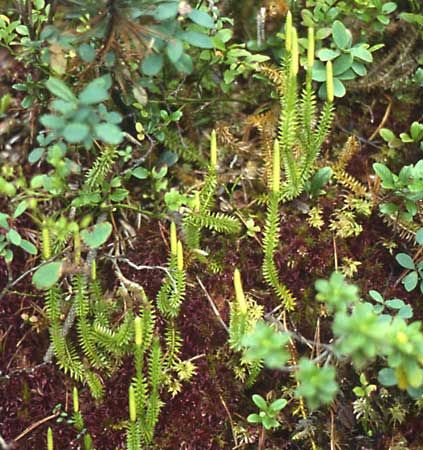
- Morphology: They are differentiated into stems, roots, and leaves. Their leaves, known as microphylls, are generally small and characterized by a single, unbranched midvein.123
- Branching: The shoot systems typically exhibit dichotomous branching, where the tip forks into two branches.12
- Reproductive Structures: Sporangia are borne singly on the adaxial (upper) surface of specialized leaves called sporophylls. These sporophylls are often aggregated into tight, cone-like structures known as strobili.123
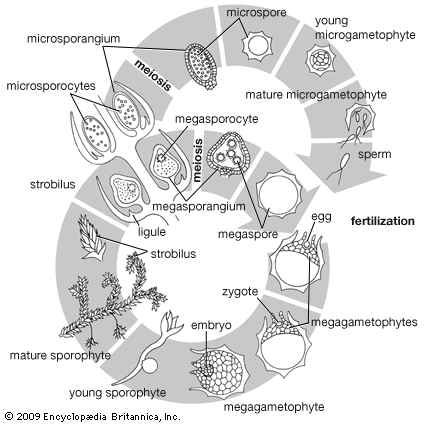
- Life Cycle: Like other vascular plants, they undergo an alternation of generations between a spore-producing sporophyte and a sex-cell-producing gametophyte. Extant species include both homosporous (producing one type of spore) and heterosporous (producing two types of spores) varieties.4
While modern lycophytes are small herbaceous plants, the class includes extinct, tree-like forms that were dominant during the Carboniferous Period.53
How have lycophytes evolved since their appearance in the fossil record?
Lycophytes have a long evolutionary history, appearing in the fossil record as early as the Devonian Period (approximately 419 million years ago) and possibly the Silurian.1 Their evolutionary trajectory is marked by a transition from small, herbaceous forms to massive, tree-like structures, followed by a decline in diversity among the arborescent lineages.17
- Early Forms: The earliest known lycophytes, such as Baragwanathia and Protolepidodendron, were small, herbaceous plants.17
- Arborescent Peak: During the Carboniferous Period, the group reached a height of complexity with the emergence of the Lepidodendrales. These were massive, tree-like lycophytes capable of secondary growth, such as Lepidodendron and Sigillaria, which dominated swampy environments and contributed significantly to the world’s coal beds.8197
- Modern Survivors: Today, the arborescent forms are extinct. The surviving members of the class Lycopodiopsida are exclusively herbaceous and include club mosses, spike mosses, and quillworts.87
What are microphylls, and how are they significant in lycophyte structure?
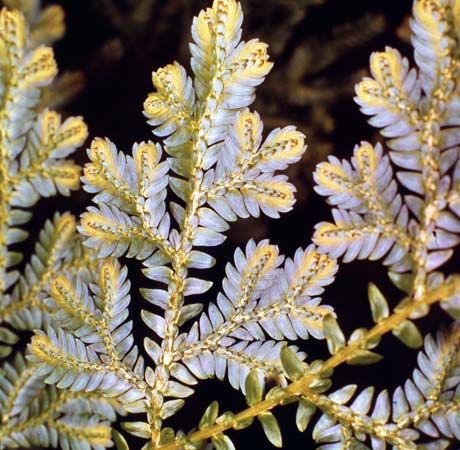
Microphylls are small, simple leaves characterized by a single, unbranched midvein. Unlike the leaves of ferns and seed plants, which possess complex, branched venation, the microphyll represents a distinct evolutionary path in plant anatomy.26
Their significance in lycophyte structure is profound:
- Evolutionary Origin: Microphylls are thought to have evolved from multicellular tissue emergences, known as enations, that appeared along the aboveground axes of early Devonian plants. These structures increased the light-capturing surface area for photosynthesis, allowing for more efficient energy production.5
- Structural Differentiation: The development of microphylls was a critical step in the evolution of the first well-differentiated shoot systems, consisting of distinct stems and leaves. This differentiation allowed lycophytes to become the most ancient group of vascular plants with living representatives.5
- Reproductive Role: In many lycophytes, these leaves serve a specialized reproductive function. When they bear sporangia on their adaxial (upper) surface, they are referred to as sporophylls. These sporophylls are often tightly aggregated into cone-like structures called strobili, which are central to the reproductive strategy of the class Lycopodiopsida.210
What role did lycophytes play in the formation of coal deposits during the Carboniferous period?
During the Carboniferous Period, lycophytes played a foundational role in the creation of the world’s coal deposits. This era, particularly the Pennsylvanian subperiod, saw more coal formation than any other time in the geologic record, driven by the proliferation of diverse vascular plants in vast, swampy environments.1112
The most significant contributors to these deposits were arborescent (tree-like) lycopsids, specifically the genera Lepidodendron and Sigillaria. These plants reached impressive heights of up to 30 meters (about 100 feet) and grew in such profusion that their accumulated organic remains form the bulk of many major coal beds globally. While other flora, such as sphenopsids, true ferns, and seed ferns, also inhabited these swampy ecosystems and contributed to the biomass, the massive, dense growth of the tree lycophytes was the primary driver of the extensive carbon sequestration that eventually transformed into coal.118112
Sources
- lycophyte — Encyclopædia Britannica
- lycophyte - General features — Encyclopædia Britannica
- lycophyte - Life cycle — Encyclopædia Britannica
- lycophyte - Form and function — Encyclopædia Britannica
- Plant - Class Lycopodiopsida — Encyclopædia Britannica
- microphyllous — Merriam-Webster
- lycophyte - Fossil forms — Encyclopædia Britannica
- Carboniferous Period - Plants — Encyclopædia Britannica
- lycophyte - Annotated classification — Encyclopædia Britannica
- Plant - Evolution of land plants from the Ordovician Period through the middle Devonian — Encyclopædia Britannica
- coal - The fossil record — Encyclopædia Britannica
- Carboniferous Period - Distinctive features — Encyclopædia Britannica
Published on · 3 min read