Raccoon Dog
The raccoon dog (Nyctereutes procyonoides) is a member of the dog family (Canidae) that is often mistaken for a member of the raccoon family due to its…
What are the key physical characteristics of raccoon dogs?
The raccoon dog (Nyctereutes procyonoides) is a member of the dog family (Canidae) that is often mistaken for a member of the raccoon family due to its appearance1.
Key physical characteristics include:
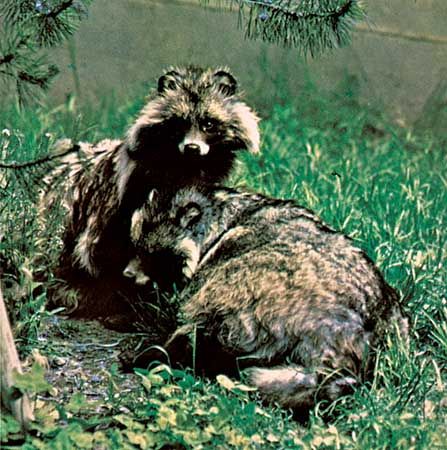
- Coat and Markings: It features a yellowish-brown coat and distinct dark facial markings that resemble those of a raccoon. Unlike a raccoon, however, it does not have a ringed tail.12
- Body Structure: The animal has a heavy body, rounded ears, and short, brown or blackish limbs.1
- Size: The head and body typically measure 50–65 cm (20–26 inches) in length, with a tail length of 13–18 cm.1
- Weight: An adult raccoon dog generally weighs about 7.5 kg (16.5 pounds).1
The species is also known as the tanuki, and its long fur is sometimes sold commercially under that name or as “Ussuri raccoon”.12
Where are raccoon dogs native to, and how has their range expanded?
The raccoon dog (Nyctereutes procyonoides) is native to eastern Asia. While it is indigenous to that region, the species has been introduced into Europe, where it has since expanded its range.1
How do raccoon dogs differ from true canines and raccoons?
The raccoon dog (Nyctereutes procyonoides) is a member of the dog family (Canidae), though it is frequently confused with members of the raccoon family (Procyonidae) due to its physical appearance.1
Differences from True Canines
While raccoon dogs are classified as canines, they differ from many other members of the family in their dietary and social habits:
- Diet: Unlike strictly carnivorous canines (such as wolves or African hunting dogs), the raccoon dog is omnivorous, consuming fruits, berries, insects, and small animals.2
- Social Behavior: Because of their varied diet, they do not require the complex, organized pack-hunting strategies seen in strictly carnivorous canines, often living and hunting in a more solitary manner or in pairs.2
- Habitat: They are known to inhabit tree hollows with entrances near the ground, a behavior distinct from many other canines that den in burrows or crevices.2
Differences from Raccoons
Despite their name and superficial resemblance, raccoon dogs are not raccoons. They lack the characteristic ringed tail found on true raccoons and are biologically distinct, belonging to the family Canidae rather than Procyonidae.1
What is the scientific name of the raccoon dog, and what does it mean?
The scientific name of the raccoon dog is Nyctereutes procyonoides.1
The genus name, Nyctereutes, is derived from the Greek word nyktereutēs, which translates to “one who hunts or fishes by night”. This reflects the animal’s nocturnal behavior. The specific epithet, procyonoides, refers to its physical resemblance to the raccoon, as Procyon is the genus name for raccoons.51
Sources
- raccoon dog — Encyclopædia Britannica
- raccoon dog — Merriam-Webster
- canine - Natural history — Encyclopædia Britannica
- canine - Paleontology and classification — Encyclopædia Britannica
- Nyctereutes — Merriam-Webster
Published on · 2 min read