Rambutan
The rambutan (Nephelium lappaceum) is a tree belonging to the soapberry family (Sapindaceae). It is native to Malaysia, where it is widely cultivated for its…
What is a rambutan and where does it originate?
The rambutan (Nephelium lappaceum) is a tree belonging to the soapberry family (Sapindaceae). It is native to Malaysia, where it is widely cultivated for its fruit.1
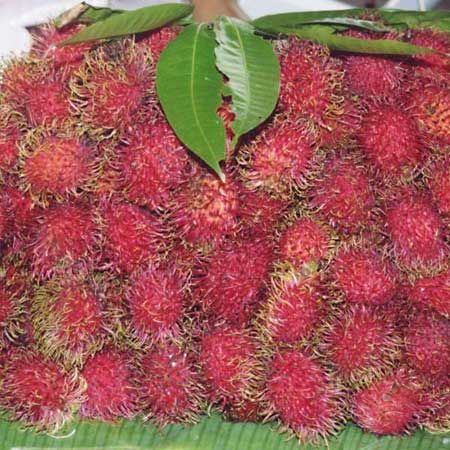
The fruit itself is oval-shaped, roughly the size of a small hen’s egg, and is characterized by its bright-red skin covered in long, soft spines. Inside, it contains a tasty, acidic pulp. The rambutan is closely related to the lychee and typically grows on trees reaching heights of 10.5 to 12 metres (35 to 40 feet).12
How does the rambutan tree grow and what are its characteristics?
The rambutan (Nephelium lappaceum) is a member of the soapberry family (Sapindaceae) that typically reaches heights of 10.5 to 12 metres (35 to 40 feet).1
As a tree, it is primarily cultivated for its fruit, which shares its name. The fruit is characterized by the following features:
- Appearance: It is oval-shaped and roughly the size of a small hen’s egg.1
- Exterior: The skin is bright red and covered in long, soft spines.1
- Interior: The fruit contains a flavorful, acidic pulp.1
Native to Malaysia, the tree thrives in environments suitable for its specific growth requirements.1
Can rambutan be grown outside of its native region, and if so, where?
While the rambutan (Nephelium lappaceum) is native to Malaysia, it is a tree that can be cultivated in other tropical regions with suitable climates. Although the provided information focuses on its native origins, the species is grown in various parts of Southeast Asia and other tropical areas globally where environmental conditions mimic its natural habitat.
The tree is a member of the soapberry family and requires specific tropical conditions to thrive and produce its characteristic bright-red, spiny fruit.1
How is the rambutan related to the lychee?
The rambutan (Nephelium lappaceum) is closely related to the lychee because both species belong to the soapberry family (Sapindaceae).312
This large, diverse family consists primarily of tropical, woody plants. As members of the same botanical family, both the rambutan and the lychee share structural characteristics common to the Sapindaceae, such as their classification as flowering plants that produce distinct, often fleshy fruits. While the rambutan is native to Malaysia and recognized for its unique, soft-spined red exterior, its taxonomic placement within the soapberry family confirms its close evolutionary link to the lychee.312
Sources
- rambutan — Encyclopædia Britannica
- rambutan — Merriam-Webster
- Sapindaceae — Merriam-Webster
Published on · 2 min read