Ranidae
Ranidae is a large, wide-ranging family of frogs belonging to the order Anura, commonly referred to as the "true frogs". This family encompasses more than…
What is Ranidae?
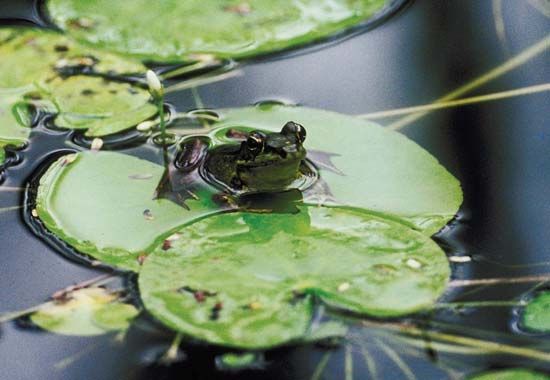
Ranidae is a large, wide-ranging family of frogs belonging to the order Anura, commonly referred to as the “true frogs”. This family encompasses more than 600 species and is found on every continent except Antarctica.12
While most members of this group are aquatic or semiaquatic, some species are arboreal or ground-burrowing. They are characterized by slightly dilated transverse sacral processes. The most prominent genus within the family is Rana, which includes well-known species such as the North American bullfrog. Generally, these frogs lay their eggs in water, where they develop into tadpoles before undergoing metamorphosis, though some species are known to be live-bearers.12
Because of their physiological adaptations, members of the genus Rana are highly resilient and can even be found living north of the Arctic Circle.3
What is the process of metamorphosis in frogs?
Metamorphosis in frogs is a complex, hormone-driven process that transforms an aquatic, gill-breathing tadpole into a terrestrial or semiaquatic adult amphibian.45
The process is initiated by the thyrotropic hormone, which stimulates the thyroid gland to release thyroxine. This hormone circulates through the blood, triggering coordinated structural and physiological changes:45
- Limb Development: Hind limb buds appear and develop into functional legs, while forelimbs eventually emerge through the operculum. through the operculum.56
- Resorption of Larval Features: The tail is gradually resorbed by the body, and the internal gills disappear as lungs and pulmonary ventilation develop. gills disappear as lungs and pulmonary ventilation develop.576
- Digestive and Sensory Changes: The long, coiled intestine of the herbivorous tadpole shortens to accommodate an adult diet. Additionally, the mouthparts change, jaws and teeth develop, and eyelids form.56
- Systemic Shifts: The urogenital system matures, and the kidney shifts from excreting dilute ammonia to concentrated urea.5
These radical modifications facilitate the transition from an aquatic life to a terrestrial mode of existence.5
How do true frogs differ from toads?
Distinguishing between “true frogs” and toads can be challenging because both are tailless amphibians belonging to the order Anura. In fact, there is no strict taxonomic basis for these labels; all toads are technically classified as frogs.8
However, people often use the following superficial characteristics to differentiate them:8
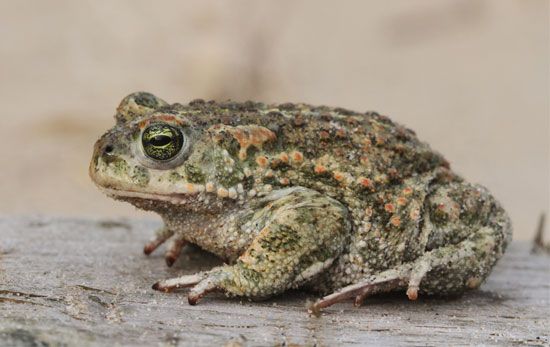
- Skin: Frogs typically have smooth, moist skin, which helps them stay hydrated. Toads, particularly “true toads” of the family Bufonidae, generally have dry, rough, and bumpy skin covered in tubercles.87
- Habitat: Because their skin requires moisture, frogs are frequently found near bodies of water like ponds, lakes, or streams. Toads are often better at retaining moisture and can be found in drier environments further from water.8
- Legs and Locomotion: Frogs usually possess long, powerful hind legs adapted for leaping and swimming. Toads often have shorter hind legs, giving them a squat, rotund appearance; they typically move by taking small hops or even walking.87
Ultimately, these categories are “wobbly” descriptors, and some species may be referred to by both names depending on the region or common usage.8
What adaptations help frogs survive in different environments?
Frogs exhibit remarkable structural, physiological, and behavioral adaptations that allow them to thrive in diverse environments, ranging from aquatic habitats to arid regions.910
Morphological and Structural Adaptations
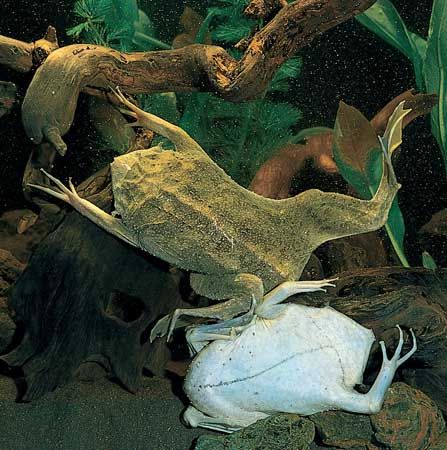
- Locomotion: Many frogs possess long, powerful hind limbs for leaping, while aquatic species often have webbed feet to aid in swimming. Arboreal species frequently feature adhesive disks on their fingers and toes to navigate branches.9
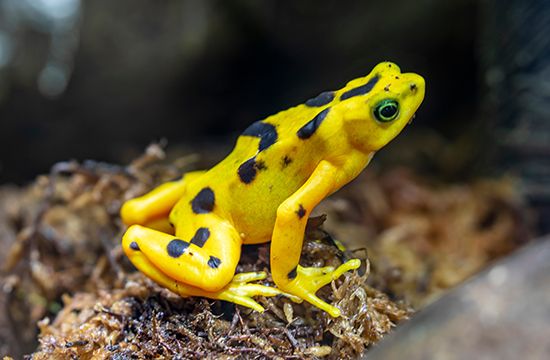
- Camouflage: To escape predators, many frogs utilize concealing coloration or skin textures that mimic their surroundings, such as leaf litter or lichens. Some species also employ “flash colors”—bright patterns on hidden body surfaces—to startle or confuse predators.911
- Specialized Features: Certain frogs have evolved unique head shapes, such as bony casques to plug tree holes or pointed snouts for burrowing.912
Physiological and Respiratory Adaptations
- Respiration: Frogs are highly adaptable, utilizing both lungs and cutaneous respiration (breathing through the skin). This allows them to absorb oxygen directly from water or moist soil, which is particularly vital during hibernation or when submerged.10
- Water Conservation: In dry environments, many species have developed waxy or mucous skin secretions to reduce water loss. Some desert-dwelling frogs can even secrete a protective cocoon made of hardened skin layers to survive long dry periods.12
Sources
- Ranidae — Encyclopædia Britannica
- Ranidae — Merriam-Webster
- frog and toad - Distribution and abundance — Encyclopædia Britannica
- Animal development - Metamorphosis — Encyclopædia Britannica
- amphibian - Metamorphosis — Encyclopædia Britannica
- tadpole — Encyclopædia Britannica
- frog and toad - From tadpole to adult — Encyclopædia Britannica
- What’s the Difference Between a Frog and a Toad? — Encyclopædia Britannica
- frog and toad - Size range and diversity of structure — Encyclopædia Britannica
- frog and toad - Coloration — Encyclopædia Britannica
- How do frogs breathe? — Encyclopædia Britannica
- frog and toad - Structural modifications — Encyclopædia Britannica
Published on · 3 min read