Leptodactylidae
The evolutionary history and classification of the family Leptodactylidae remain subjects of ongoing scientific study, as modern authorities continue to…
How did the Leptodactylidae family evolve, and what are its closest relatives?
The evolutionary history and classification of the family Leptodactylidae remain subjects of ongoing scientific study, as modern authorities continue to refine anuran taxonomy using DNA evidence and cladistics.1
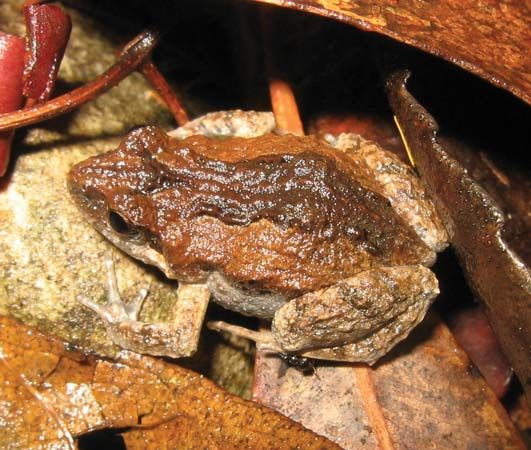
Historically, the definition of this family has shifted significantly. While some earlier classifications grouped various Australian frogs within the Leptodactylidae, current consensus restricts the family to the New World (South and Central America). Consequently, the families Myobatrachidae and Limnodynastidae, which contain many Australian species, are now recognized as distinct from the Leptodactylidae.21
Because taxonomic systems are transitioning from traditional Linnean methods to node-based classifications, the specific evolutionary relationships and closest relatives of the Leptodactylidae are still being clarified by researchers. The family currently encompasses over 900 species, including diverse groups such as robber frogs, nest-building frogs, and horned frogs.12
How do Leptodactylidae frogs reproduce, and what is special about their reproductive strategies?
Leptodactylidae frogs exhibit a remarkable diversity of reproductive strategies, ranging from specialized nest-building to the complete elimination of the aquatic larval stage.56
Foam Nesting
Some leptodactylids, such as those in the genus Physalaemus, are known for constructing unique foam nests. During axillary amplexus, the pair floats on the water while the female releases eggs and the male emits semen. The male then uses his hind legs to vigorously whip the mixture of water, air, eggs, and semen into a frothy, meringuelike mass. This nest floats on the surface, where the outer layer hardens to protect the moist interior. Upon hatching, the tadpoles wriggle through the decaying foam to enter the water.78
Direct Development
Many species, particularly within the genus Eleutherodactylus (robber frogs), have evolved direct development. This strategy completely severs the frog’s dependence on an aquatic environment for reproduction. During amplexus, the female deposits eggs in moist terrestrial locations, such as leaf litter, moss, or rotting stumps. The larvae undergo their entire development within the egg membranes, eventually hatching as tiny, fully formed froglets rather than tadpoles.16
What role do Leptodactylidae frogs play in their ecosystems?
Leptodactylidae frogs play diverse and significant roles within their ecosystems, primarily acting as both predators and components of the food web in the tropical regions of South and Central America where they are most abundant.110
As invertebrate predators, these frogs help regulate populations of insects, worms, and other small arthropods. Their ecological impact varies by species size and behavior:1011
- Generalist Insectivores: Most species feed on a wide variety of small invertebrates, contributing to the balance of their local habitats.1011
- Vertebrate Predators: Larger members of the family, such as the horned frogs (Ceratophrys), occupy a higher trophic level. These aggressive predators consume other frogs and small rodents, demonstrating their role as significant carnivores within their environment.111
- Resource Partitioning: In complex environments like tropical rainforests, the high density of leptodactylid species allows them to partition resources through spatial and temporal separation, which minimizes competition and maintains ecosystem stability.10
What are some of the most unusual species within the Leptodactylidae family?
The Leptodactylidae family contains a diverse array of species that have evolved unique structural and behavioral adaptations to survive in various environments. Some of the most notable include:
- Robber Frogs (Eleutherodactylus): This genus is highly unusual for its reproductive strategy; the young bypass the aquatic tadpole stage entirely, hatching from eggs as fully formed, miniature frogs.1
- Horned Frogs (Ceratophrys): These aggressive, frog-eating predators are easily identified by the projecting, hornlike flaps of skin above their eyes. They possess wide heads and mouths, and larger species, such as the Amazonian C. cornuta, can reach lengths of over 15 cm (6 inches).1
- Nest-Building Frogs (Leptodactylus): This group is recognized for its varied reproductive modes, most notably the construction of foam nests. Some species whip a mixture of water, air, and eggs into a frothy mass, which protects the developing young until they are washed into pools by rain.1
- Eyespot Frogs (Eupsophus): These frogs utilize a clever defensive display. When threatened, they lower their heads and elevate their rumps to reveal brightly colored “eyespots,” creating the illusion of a much larger head to confuse potential predators.12
Sources
- Leptodactylidae — Encyclopædia Britannica
- Leptodactylidae — Merriam-Webster
- leptodactylid — Merriam-Webster
- frog and toad - Critical appraisal — Encyclopædia Britannica
- frog and toad - Egg laying and hatching — Encyclopædia Britannica
- frog and toad - Direct development from egg to froglet — Encyclopædia Britannica
- amphibian - Reproduction — Encyclopædia Britannica
- tungara frog — Encyclopædia Britannica
- frog and toad - Annotated classification — Encyclopædia Britannica
- frog and toad - Distribution and abundance — Encyclopædia Britannica
- frog and toad - Feeding habits — Encyclopædia Britannica
- frog and toad - Coloration — Encyclopædia Britannica
- frog and toad - Size range and diversity of structure — Encyclopædia Britannica
Published on · 3 min read