Myobatrachidae
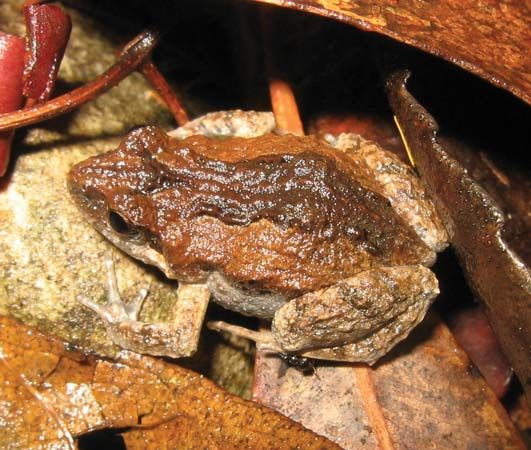
The family Myobatrachidae consists of approximately 21 genera of frogs native to the Australo-Papuan region. While the family is sometimes classified as part…
What are some notable genera within the Myobatrachidae family?
The family Myobatrachidae consists of approximately 21 genera of frogs native to the Australo-Papuan region. While the family is sometimes classified as part of the Leptodactylidae by certain authorities, it is distinct in its geographic distribution and internal classification into the subfamilies Limnodynastinae and Myobatrachinae.12
Notable genera and species within this family include:
- Notaden: This genus includes the Catholic frog (Notaden bennetti), a small, burrowing frog known for the dark, cross-shaped pattern on its back.1
- Chiroleptes: This genus features the flat-headed frog (Chiroleptes platycephalus), a desert-dwelling species capable of storing significant amounts of water in its body.1
- Rheobatrachus: This genus is notable for the extinct species Rheobatrachus silus, which was unique for its reproductive behavior of swallowing its eggs and brooding them within its stomach.1
What is the evolutionary history of the Myobatrachidae family?
The evolutionary history of the Myobatrachidae family, which includes the Limnodynastidae, dates back to the Eocene Epoch (approximately 56 million to 34 million years ago) and continues to the present day.1
These frogs are classified within the suborder Neobatrachia and are restricted to the Australo-Papuan region. Historically, some authorities grouped these frogs within the family Leptodactylidae; however, modern classifications—such as the system established by Ford and Cannatella in 1993—now treat them as distinct, noting that the Leptodactylidae family is restricted to the New World.314
The family is divided into two subfamilies, Limnodynastinae and Myobatrachinae, both of which share specific anatomical characteristics, such as having eight presacral vertebrae and a free, bicondylar coccyx. Because the fossil record for many frog families is often scanty, our understanding of their evolutionary relationships continues to be refined through DNA evidence and cladistic analysis.314
Are there any conservation concerns for Myobatrachidae species?
Myobatrachidae species face significant conservation concerns, primarily due to the global spread of amphibian chytridiomycosis. This disease is caused by the fungus Batrachochytrium dendrobatidis (Bd), which has been implicated in the decline and extinction of numerous amphibian populations worldwide.1
The fungus acts as an invasive species, spreading rapidly through aquatic environments via infectious zoospores. Once it infects a host, it disrupts the skin’s ability to regulate electrolytes and gas exchange, often leading to cardiac arrest. While the exact cause of population declines in certain regions remains a subject of study, experts suspect that Bd is a major factor in the loss of amphibian biodiversity in areas such as the rainforests of Queensland, Australia, where many myobatrachids reside. The impact of this pathogen is severe, with approximately 90 modern amphibian extinctions attributed to the disease since 1980.1
What are the main characteristics of the Myobatrachidae family?
The Myobatrachidae family, which includes the Limnodynastidae, is a group of frogs found exclusively in the Australo-Papuan region. The family consists of approximately 21 genera and 110 species, categorized into two subfamilies: Limnodynastinae and Myobatrachinae.16
Key characteristics of the family include:
- Anatomy: Members possess eight presacral vertebrae and a free, bicondylar coccyx.6
- Size: Adults typically reach lengths of up to 10 cm (4 inches).6
- Evolutionary Timeline: The family has a fossil record extending from the Eocene Epoch to the present.6
- Diverse Adaptations: Species exhibit varied life strategies. For example, the Catholic frog (Notaden bennetti) is adapted to dry regions and lives underground, while the flat-headed frog (Chiroleptes platycephalus) can store water in its body to survive in desert environments. Additionally, the extinct Rheobatrachus silus was notable for brooding its eggs in its stomach.1
While some authorities have historically grouped these frogs within the family Leptodactylidae, modern classification treats them as a distinct family.16
Sources
- Myobatrachidae — Encyclopædia Britannica
- Leptodactylidae — Encyclopædia Britannica
- paracanthopterygian - Evolution and paleontology — Encyclopædia Britannica
- bivalve - Critical appraisal — Encyclopædia Britannica
- frog and toad - Critical appraisal — Encyclopædia Britannica
- frog and toad - Annotated classification — Encyclopædia Britannica
- Chytridiomycota — Encyclopædia Britannica
- amphibian chytridiomycosis — Encyclopædia Britannica
Published on · 3 min read