Panamanian Golden Toad
The Panamanian golden toad (Atelopus zeteki) is a small, distinctively colored toad characterized by its bright yellow skin, which is often marked with black…
What are the unique physical characteristics of the Panamanian golden toad?
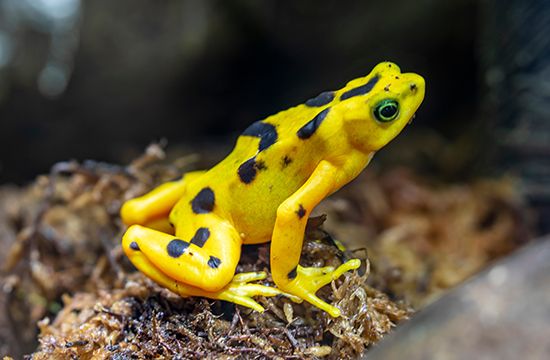
The Panamanian golden toad (Atelopus zeteki) is a small, distinctively colored toad characterized by its bright yellow skin, which is often marked with black spots or blotches.1
Key physical attributes include:
- Size: The species exhibits sexual dimorphism, with females being larger at approximately 53 mm (2 inches) compared to males, which measure about 45 mm (1.8 inches).1
- Toxicity: Their skin secretes a potent, water-soluble toxin known as zetekitoxin, which disrupts nerve cell function to deter predators.1
- Tadpole Morphology: The tadpoles possess a specialized ventral sucker, an adaptation that allows them to remain attached to rocks and other surfaces within fast-flowing forest streams.1
While they are often referred to as toads, they belong to the family Bufonidae, though some experts classify them within the separate family Atelopodidae, commonly known as stub-footed toads.1
What other amphibian species are closely related to the Panamanian golden toad?
The Panamanian golden toad (Atelopus zeteki) belongs to the family Bufonidae, a group that includes most toads. Within this family, the golden toad is part of the genus Atelopus.1
While classification systems have evolved, many authorities now place the genus Atelopus within the Bufonidae family. Historically, some researchers grouped Atelopus with the genus Brachycephalus into a separate family known as the stub-footed toads (Atelopodidae), though this classification is now generally relegated to the Bufonidae.12
Because the taxonomy of amphibians is subject to ongoing scientific study and shifting phylogenetic models, the exact relationships between these groups continue to be refined as researchers utilize DNA evidence and cladistics to clarify evolutionary history.23
What conservation efforts were made to save the Panamanian golden toad?
The Panamanian golden toad (Atelopus zeteki) is currently classified by the International Union for Conservation of Nature (IUCN) as a critically endangered species, with experts noting that it may be extinct in the wild.1
The primary driver of this decline is amphibian chytridiomycosis, a devastating disease caused by the fungus Batrachochytrium dendrobatidis (Bd). This pathogen is particularly lethal to members of the genus Atelopus, as it infects the epidermis, disrupting essential gas exchange and electrolyte balance, which ultimately leads to cardiac arrest.4
While the species is legally protected in Panama and serves as a national symbol, the 2018 census reported fewer than 50 adults remaining. Conservation efforts have focused on monitoring these dwindling populations and managing the impact of the pandemic fungus, which has caused widespread declines in amphibian biodiversity globally.14
We could dive deeper into the specific challenges of managing fungal diseases in wild amphibian populations or explore other species currently threatened by chytridiomycosis.
What is the Panamanian golden toad and where was it found?
The Panamanian golden toad (Atelopus zeteki) is a small, diurnal toad recognized for its bright yellow skin, which often features black spots or blotches. It is native to moderate elevations in the central region of Panama, where it has become a national symbol.1
This species is notable for its potent skin toxin, zetekitoxin, which serves as a defense mechanism against predators by affecting nerve cells. In their natural habitat, these toads are terrestrial, with males establishing territories along fast-flowing forest streams where they communicate through soft, trilled calls and visual signals like waving their forefeet.1
Currently, the International Union for Conservation of Nature (IUCN) classifies the Panamanian golden toad as a critically endangered species, and it is feared to be extinct in the wild, with fewer than 50 adults reported in the most recent census.1
Sources
- Panamanian golden toad — Encyclopædia Britannica
- frog and toad - Critical appraisal — Encyclopædia Britannica
- amphibian - Annotated classification — Encyclopædia Britannica
- amphibian chytridiomycosis — Encyclopædia Britannica
Published on · 3 min read