Surinam Toad
The Surinam toad (Pipa pipa) is an aquatic species found in the wild in the Guianas and parts of Brazil. As an entirely aquatic animal, it prefers habitats…
Where is the Surinam toad found in the wild, and what type of habitat does it prefer?
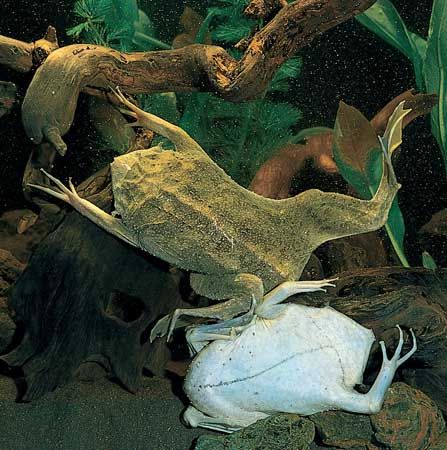
The Surinam toad (Pipa pipa) is an aquatic species found in the wild in the Guianas and parts of Brazil. As an entirely aquatic animal, it prefers habitats that support its lifestyle, spending its life in water where it mates and incubates its eggs on the female’s back.12
How does the Surinam toad’s reproduction process differ from other amphibians?
The reproduction of the Surinam toad (Pipa pipa) is distinct from many other amphibians due to its unique method of brood care and development. While most amphibians lay eggs that develop independently or are cared for by males, the Surinam toad exhibits a specialized form of maternal brooding.14
Key aspects of its reproductive process include:
- Maternal Incubation: During mating, the male fertilizes the eggs and presses them onto the female’s back. Over several hours, the female’s skin grows around each egg, enclosing them in individual, cyst-like depressions covered by a horny lid.13
- Direct Development: Unlike many amphibians that hatch as free-swimming tadpoles, the Surinam toad undergoes direct development. The young remain within these skin pockets, where they metamorphose and eventually emerge as miniature versions of the adult after approximately 80 days.15
- Aquatic Environment: While other species with direct development often lay eggs in terrestrial environments like leaf litter or moss, the Surinam toad completes this entire process while remaining strictly aquatic.5
What are the unique physical characteristics of the Surinam toad?
The Surinam toad (Pipa pipa) possesses several distinct physical characteristics adapted to its fully aquatic lifestyle:
- Body Shape: It has a flat, squarish body and a flat head, which are well-suited for its life in the water.1
- Size: Adults typically measure between 10 and 17 cm (4 to 7 inches) in length.1
- Head Features: The toad has small eyes and loose flaps of skin located on its snout and jaws.1
- Digits: The digits on its feet end in small, star-shaped appendages that assist the animal in finding food.1
- Family Traits: As a member of the family Pipidae, it exhibits extreme aquatic specialization, including extensive webbing between the toes to aid in swimming.2
What are the feeding habits and diet of the Surinam toad?
The Surinam toad (Pipa pipa) is an opportunistic predator that consumes a diverse diet consisting of various small vertebrates and invertebrates found within its aquatic habitat.1
To assist in locating its prey, the toad utilizes specialized physical adaptations. The digits on its feet terminate in small, star-shaped appendages that are highly sensitive and aid the animal in finding food. Unlike many other toads, which typically use sticky tongues to capture insects, the Surinam toad relies on these tactile appendages to navigate and detect potential meals in its environment.18
Sources
- Surinam toad — Encyclopædia Britannica
- pipa — Encyclopædia Britannica
- Surinam toad — Merriam-Webster
- frog and toad - Direct development from egg to froglet — Encyclopædia Britannica
- Reproductive behaviour - Amphibians — Encyclopædia Britannica
- frog and toad - Structural modifications — Encyclopædia Britannica
- frog and toad - Size range and diversity of structure — Encyclopædia Britannica
- toad — Encyclopædia Britannica
Published on · 2 min read