Regal Moth
Regal moths, which belong to the subfamily Ceratocampinae, are found exclusively in the New World. Specifically, the royal walnut moth (Citheronia regalis)…
Where can regal moths be found, and what is their typical habitat?
Regal moths, which belong to the subfamily Ceratocampinae, are found exclusively in the New World. Specifically, the royal walnut moth (Citheronia regalis), often referred to as the regal moth, is a large, showy species native to the Americas.12
Regarding their habitat, these moths are closely associated with forested environments. As adults, they serve as indicators of forest health and biodiversity1. Their larvae, such as the hickory horned devil, rely on specific tree foliage for sustenance, feeding primarily on the leaves of walnut, hickory, and persimmon trees. Depending on the specific species within the group, some pupate in the ground, while others spin cocoons.1
What are the distinctive physical characteristics of the regal moth?
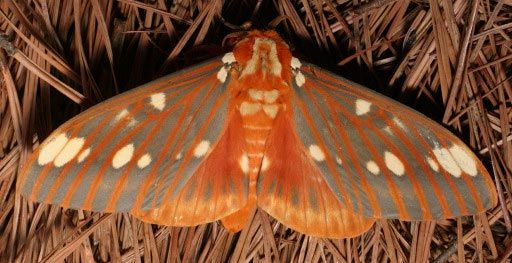
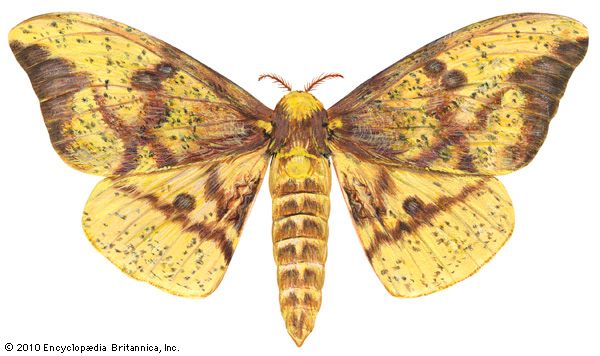
The regal moth (Citheronia regalis), also known as the royal walnut moth, is a large, showy insect characterized by its stout, hairy body and broad, vividly patterned wings.12
Its distinctive coloration includes:
- Forewings: Olive-gray in color, featuring yellow spots and prominent red veins.12
- Hindwings: Reddish-orange, also marked with yellow spots.12
Like other members of the saturniid family, adult regal moths possess reduced, vestigial mouthparts, meaning many do not feed during their adult stage. Males are distinguished by their feathery antennae, which are specialized to detect the pheromone scents released by females over long distances.1
In their larval stage, these moths are known as hickory horned devils. These large, green caterpillars are physically striking, featuring a body covered in black-tipped red spines and colorful knots, which serve as a defense mechanism.1
What do regal moth caterpillars eat, and how does this affect their appearance?
The caterpillars of the regal moth (Citheronia regalis), commonly known as hickory horned devils, feed primarily on the foliage of walnut, hickory, and persimmon trees.1
Their diet and growth are closely linked to their striking physical appearance. As they consume these leaves, they develop into large, green caterpillars characterized by a series of colorful knots and prominent, black-tipped red spines located behind their heads. While these caterpillars appear ferocious, they are harmless to humans; their intimidating look, often augmented by spines or irritant barbs, serves as a defense mechanism to deter potential predators.14
In the broader context of Lepidoptera, many caterpillars accumulate bitter or toxic chemicals from the plants they consume to protect themselves from predators, though the primary defense for the hickory horned devil remains its formidable, spiny appearance.4
What is the life cycle of the regal moth, from egg to adult?
The life cycle of the regal moth (Citheronia regalis) follows the process of complete metamorphosis, consisting of four distinct stages: egg, larva, pupa, and adult.13
- Egg: The cycle begins when a female lays eggs on the foliage of host plants, such as walnut, hickory, or persimmon trees.1
- Larva: Upon hatching, the larva emerges as a caterpillar. Known as the hickory horned devil, this stage is characterized by a green body with colorful knots and black-tipped red spines. The caterpillar feeds extensively on tree foliage to fuel its growth.1
- Pupa: Once fully grown, the caterpillar enters the pupa stage. During this phase, the insect undergoes a dramatic transformation within a protective environment. While some moths spin cocoons, the regal moth typically pupates in the ground.13
- Adult: Finally, the adult emerges. These moths have stout, hairy bodies and broad, vividly patterned wings. As adults, they possess vestigial mouthparts and often do not feed, focusing instead on reproduction.1
Sources
- regal moth — Encyclopædia Britannica
- regal moth — Merriam-Webster
- Lepidoptera - Thorax — Encyclopædia Britannica
- caterpillar — Encyclopædia Britannica
- Lepidoptera - Head — Encyclopædia Britannica
- pupa — Encyclopædia Britannica
Published on · 3 min read